Germination of Bacillus species which can lead to food poisoning
February 13, 2012

Germination of Bacillus species which can lead to food poisoning

Enlarge

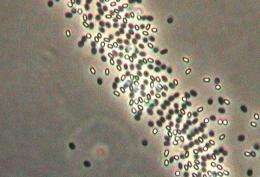
Some bacteria can form spores (survival capsules) that are particularly resistant to heat. Since sporogenous bacteria can also cause food poisoning and a reduction in food quality, they constitute a significant threat to the food industry.

If spores are to pose a risk, they have to "wake up" from a state of and return to their normal growth cycle through a process called germination. Irene Stranden Løvdal's doctoral research has studied the germination process in four different species of Bacillus. Her findings are of importance for the production and safety of foods with a long shelf-life.

Refrigerated foods with a shelf-life of several weeks are often heat-processed at temperatures between 65 – 95 C. This kills the majority of bacteria, but Bacillus spores can survive, germinate and develop into growing bacteria. Thermal treatment of this kind will in fact improve the growth potential of sporogenous bacteria because the heat kills competing bacteria flora and stimulates the surviving spores so that germination can commence more rapidly. The thermal treatment can increase the risk of spore germination in food and result in subsequent bacterial growth and a risk of quality deterioration and .

Løvdal has investigated how the germination characteristics of the spores of four different Bacillus species are affected by heat treatment. She has used knowledge about the spores' response to temperature to experiment with a method which can reduce the spore level without increasing the overall thermal treatment of the food product.

The method, called double heat treatment, involved warming up the food first in order to activate the spores, then lowering the temperature to allow germination and then increasing the heat once more in order to kill the germinated spores. The effect of this procedure varied from food to food but in some cases, the level of spores was reduced by more than 99.9%.

Løvdal has also studied some of the more fundamental, genetic elements linked to the germination of belonging to the species B. licheniformis. Closely related, sporogenous have a genomic area called gerA. This codes for a receptor which registers the presence of specific nutrients (germinants) that can trigger germination. Løvdal discovered that this genomic area in B. licheniformis is important for germination processes initiated by amino acid germinants.

The doctoral research was carried out at The Norwegian School of Veterinary Science (NVH) and at Nofima in Stavanger. Researchers and fellows at The Norwegian Defence Research Establishment were also key collaborators.

More information: Irene Stranden Løvdal defended her doctoral thesis on 3rd February 2012 at The Norwegian School of Veterinary Science. The thesis is entitled: "Germination of Bacillus species related to food spoilage and safety”.

Provided by Norwegian School of Veterinary Science search and more info website

Filter


Move the slider to adjust rank threshold, so that you can hide some of the comments.


Display comments: newest first

88HUX88
Feb 13, 2012

Rank: not rated yet
what's the time interval between heat and reheat?
kaasinees
Feb 13, 2012

Rank: 1 / 5 (1)
two words: pesceterian diets.
Rank not rated yet
Relevant PhysicsForums posts

More news stories

Manufacturing genes to attack flu virus

An international research team has manufactured a new protein that can combat deadly flu epidemics.

Biology / Biotechnology

created 11 hours ago | popularity not rated yet | comments 0 | with audio podcast

Scientist: Evolution debate will soon be history

(AP) -- Richard Leakey predicts skepticism over evolution will soon be history. Not that the avowed atheist has any doubts himself.

Biology / Evolution

created May 26, 2012 | popularity 3.4 / 5 (21) | comments 98

More plant species responding to global warming than previously thought

(Phys.org) -- Far more wild plant species may be responding to global warming than previous large-scale estimates have suggested.

Biology / Ecology

created May 22, 2012 | popularity 4.6 / 5 (14) | comments 18 | with audio podcast

For monogamous sparrows, it doesn't pay to stray (but they do it anyway)

It's quite common for a female song sparrow to stray from her breeding partner and mate with the male next door, but a new study shows that sleeping around can be costly.

Biology / Plants & Animals

created May 22, 2012 | popularity 5 / 5 (2) | comments 8 | with audio podcast

Thousands of shellfish found dead in Peru

Thousands of crustaceans were found dead off the coast of Lima following the mystery mass death of dolphins and pelicans, the Peruvian Navy said Friday.

Biology / Ecology

created May 26, 2012 | popularity 4.7 / 5 (7) | comments 7


'Unzipped' carbon nanotubes could help energize fuel cells, batteries

Multi-walled carbon nanotubes riddled with defects and impurities on the outside could replace some of the expensive platinum catalysts used in fuel cells and metal-air batteries, according to scientists at ...

Change in developmental timing was crucial in the evolutionary shift from dinosaurs to birds: study

At first glance, it's hard to see how a common house sparrow and a Tyrannosaurus Rex might have anything in common. After all, one is a bird that weighs less than an ounce, and the other is a dinosaur that ...

Computer model used to pinpoint prime materials for efficient carbon capture

When power plants begin capturing their carbon emissions to reduce greenhouse gases – and to most in the electric power industry, it's a question of when, not if – it will be an expensive undertaking.

T cells 'hunt' parasites like animal predators seek prey, study shows

By pairing an intimate knowledge of immune-system function with a deep understanding of statistical physics, a cross-disciplinary team at the University of Pennsylvania has arrived at a surprising finding: T cells use a movement ...

Yale study concludes public apathy over climate change unrelated to science literacy

Are members of the public divided about climate change because they don't understand the science behind it? If Americans knew more basic science and were more proficient in technical reasoning, would public consensus match ...

Land and sea species differ in climate change response: study

(Phys.org) -- Marine and terrestrial species will likely differ in their responses to climate warming, new research by Simon Fraser University and Australia’s University of Tasmania has found.