Structural and functional secrets of a zinc transporter protein with a role in human disease
Feb 24, 2012
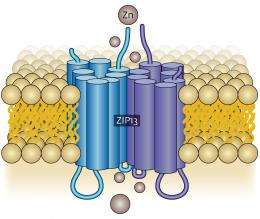
Figure 1: ZIP13 proteins, involved in SCD-EDS, pair up to form homo-dimers, and feature intracellular loops with unknown functions. Credit: Reproduced from Ref. 1 © 2011 Toshiyuki Fukada

Up to one-tenth of the proteins encoded in the human genome incorporate zinc, making this element indispensable to biological function. Indeed, most organisms employ a host of specialized transporter proteins to maintain appropriate zinc levels, and failures in these pathways can cause serious health issues. 

Recent research from Toshiyuki Fukada and colleagues at the RIKEN Research Center for Allergy and Immunology in Yokohama has characterized the structure and function of one of these proteins, ZIP13.1  From previous research on ZIP13, they knew that mice lacking this suffer diverse problems2. “Zinc-related events modulated bone, tooth and connective tissue development,” says Fukada, “and there was a link between ZIP13 and human disease.” For example, patients with a new type of inherited disease, currently called spondylocheiro dysplastic Ehlers-Danlos syndrome (SCD-EDS) that mirrors defects seen in these mice, exhibit a crippling mutation in this gene. 

ZIP13 belongs to a subset of proteins that facilitate zinc entry into the cell, known as the LIV-1 subfamily of ZIP zinc transporters (LZT)3. From their characterization work, Fukada and colleagues confirmed that increased ZIP13 expression leads to more efficient zinc influx. 

Intriguingly, ZIP13 resides within the membranes of the Golgi apparatus, an organelle responsible for protein processing, rather than at the outer membrane of the cell. This suggests that ZIP13 may manage intracellular zinc levels by directing the release of zinc from the Golgi.  

Fukada and colleagues also discovered that ZIP13 features a largely unstructured loop domain that extends outside the membrane. Although previous studies have linked this region with protein degradation in other LZT proteins, it appears to play no such role for ZIP13. The researchers were also surprised to find that ZIP13 molecules act in pairs, forming structures known as homo-dimers (Fig. 1). Fukada speculates that this may offer important clues into this protein’s function. 

“The mechanism of zinc transport used by ZIP13 and other LZT proteins remains unknown. This is an open question,” says Fukada. Further progress will require investigation of the atomic-level structure of ZIP13 and related proteins.

He hopes that their work on ZIP13 will benefit patients with conditions associated with abnormal zinc regulation. Defining ZIP13 function will also be a major step towards understanding the mechanisms that determine each zinc transporter’s biological specificity, and how they contribute to cellular functions. “One of my general interests in ‘zinc biology’ is to understand the logic behind how each transporter pathway specifically controls biological events,” says Fukada.

Explore further: Attacking MRSA with metals from antibacterial clays

More information: 1. Bin, B.H., et al. Biochemical characterization of human ZIP13 protein: a homo-dimerized zinc transporter involved in the Spondylocheiro dysplastic Ehlers-Danlos syndrome. Journal of Biological Chemistry 286, 40255–40265 (2011). 

2. Fukada, T., et al. The zinc transporter SLC39A13/ZIP13 is required for connective tissue development; its involvement in BMP/TGF-beta signaling pathways. PLoS ONE 3, e3642 (2008).

3. Fukada, T. & Kambe, T. Molecular and genetic features of zinc transporters in physiology and pathogenesis. Metallomics 3, 662–674 (2011). 

add to favorites email to friend print save as pdf

Related Stories

Lending a helping hand

Jul 15, 2011

Many proteins, the primary building blocks of life, depend on elements such as copper, zinc and other trace elements to function properly. “Some metal molecules are required as a structural component ...

Uptake protein acts as zinc's doorway to the cell

Nov 22, 2010

(PhysOrg.com) -- A study to be published as the "Paper of the Week" in the Journal of Biological Chemistry this December details how zinc, an element fundamental to cell growth, enters the cell via zinc-s ...

High-Res View of Zinc Transport Protein

Sep 13, 2009

(PhysOrg.com) -- How much difference can a tenth of a nanometer make? When it comes to figuring out how proteins work, an improvement in resolution of that miniscule amount can mean the difference between seeing where atoms ...

Recommended for you

Attacking MRSA with metals from antibacterial clays

May 17, 2013

In the race to protect society from infectious microbes, the bugs are outrunning us. The need for new therapeutic agents is acute, given the emergence of novel pathogens as well as old foes bearing heightened antibiotic resistance.

Keeping fruit, vegetables and cut flowers fresh longer

May 15, 2013

New technology offers the promise of reducing billions of dollars of losses that occur each year from the silent, invisible killer of fruits, vegetables and cut flowers—a gas whose effects are familiar to everyone who has ...

Why don't beetles freeze in the winter?

May 14, 2013

For 37 years, Queen's University Biochemistry professor Peter Davies has been unraveling the mystery of why some organisms including insects and fish don't freeze in the winter. His research into insect antifreeze protein ...

The molecular basis of strawberry aroma

May 13, 2013

You know that summer is here when juicy red strawberries start to appear on the shelves. In Germany, this seasonal fruit has never been more popular: on average 3.5 kilos per head were consumed in 2012—a ...

A new dimension for 3-D protein structures

May 13, 2013

(Phys.org) —3D structures of biological molecules like proteins directly affect the way they behave in our bodies. EPFL scientists have developed a new infrared-UV laser method to more accurately determine ...

User comments : 0

More news stories

Attacking MRSA with metals from antibacterial clays

In the race to protect society from infectious microbes, the bugs are outrunning us. The need for new therapeutic agents is acute, given the emergence of novel pathogens as well as old foes bearing heightened antibiotic resistance.

Beautiful 'flowers' self-assemble in a beaker

By simply manipulating chemical gradients in a beaker of fluid, materials scientists at Harvard have found that they can control the growth behavior of crystals to create precisely tailored structures—such ...

Making gold green: New non-toxic method for mining gold

Northwestern University scientists have struck gold in the laboratory. They have discovered an inexpensive and environmentally benign method that uses simple cornstarch—instead of cyanide—to isolate gold from raw materials ...

Heat-related deaths in Manhattan projected to rise

Residents of Manhattan will not just sweat harder from rising temperatures in the future, says a new study; many may die. Researchers say deaths linked to warming climate may rise some 20 percent by the 2020s, ...

Kinks and curves at the nanoscale

One of the basic principles of nanotechnology is that when you make things extremely small—one nanometer is about five atoms wide, 100,000 times smaller than the diameter of a human hair—they are going ...

Mice, gerbils perish in Russia space flight

A number of mice and eight gerbils sent into space in a Russian capsule destined to find out how well organisms can withstand extended flights perished during their journey, scientists said Sunday as the ...