When did the feather take flight?
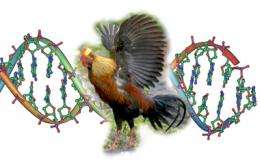
(PhysOrg.com) -- Some 125 million years ago--more recently than once thought possible -- the molecular structure of the modern feather began to take form, according to molecular dating research by scientists at the University of South Carolina.
The team also sees hints that powered flight might be the innovation that drove the feather's evolution from that point forward.
What goes into a feather?
Feathers are largely made of proteins, and particularly of beta-keratin, which is also found in the scales and claws of birds, as well as related species like crocodiles and anoles, the small green lizard common throughout the southeastern United States. Mammals express a similar but distinct protein, alpha-keratin, in hair and fingernails.
Beta-keratin is one of the main structural 'bricks' in scales, feathers, and claws. Over millions of years of evolution, several families of these building blocks have evolved. Roger Sawyer, a biologist in USC's College of Arts and Sciences, has been studying the details of the bricks made of beta-keratin since the early 1970s; his approach has been molecular, using biochemistry and immunology to access new data as innovations in laboratory tools became available over the years.
His research group has helped to define the families of beta-keratins that have evolved since the protein first appeared almost 300 million years ago. In a central portion of the protein, one amino acid sequence (31 residues long) is highly conserved throughout all the species that express beta-keratin, but differences on either end of this region reflect differences in species--as well as the type of appendage.
By looking at the kind of beta-keratin found in scales, claws, and feathers in modern animals, for example, Sawyer's lab has grouped certain sequences into families, defined in a straightforward manner as scale, claw, and feather beta-keratins.
Molecular dating offers fresh insight into evolutionary history
And, thanks to recent advances in genetic sequencing, the full genomes of several modern animals are now available, including the zebra finch, the chicken, and the turkey. The fossil record shows that the zebra finch and the chicken began diverging about 100 million years ago, and their gene sequences offer a comparison of how far their genomes have diverged since emerging from a common ancestor. By comparing the details of how the gene sequences for the beta-keratins are now arranged in the genomes of modern animals with how much time it has taken for those species differences to arise, Sawyer's group has developed new insight into how and when the beta-keratin families developed.
A dramatic expansion of feather beta-keratin sequences 125 million years ago
And as Sawyer and post-doc Matthew Greenwold reported in December in the Journal of Experimental Zoology, one big surprise was that the evolution of the family of feather beta-keratins doesn't appear to coincide with the evolutionary origin of feathers themselves. The fully feathered fossil of Anchiornis huxleyi, for example, is 155 million years old, yet Sawyer's results point to the family of feather beta-keratin just beginning to develop its distinguishing characteristics about 143 million years ago. Moreover, about 125 million years ago, there began a dramatic expansion of feather beta-keratin sequences throughout the genome.
They have also shown that the scale and claw families of beta-keratin emerged earlier than that, concluding that the first feathers comprised beta-keratins more similar to those now found in scales and claws--a more primitive feather, in a sense.
Their conclusions dovetail with a variety of other biophysical assessments that the early feathers could not support powered flight. Lack of strength in the central stem (the rachis) and possible inflexibility afforded by the early families of beta-keratin have been posited as reasons that the feather originally evolved for reasons other than flight--temperature regulation or mating displays, for example.
And in a paper published last year in BMC Evolutionary Biology, they reported a preponderance of feather beta-keratin sequences in modern birds--a wide range of similar but not identical sequences that began to multiply at that important junction 125 million years ago when the modern feather beta-keratin began to proliferate throughout the avian genome.
Was powered flight the key to change 125 million years ago?
So at that time "something likely happened with the feather's evolution," said Greenwold. "An innovation that allowed the expansion of that family of the beta-keratin, which is highly functional and important to the ecology of these animals. Something allowed that duplication, expansion, and fixation of these duplicate genes."
The conclusion is tentative, but compelling: powered flight may well have been the innovation that evolutionary pressure subsequently began to refine.
Being able to better define the details of evolution is a satisfying product of the recent advances in comparative genomics, and new information is flowing forth--Sawyer and Greenwold are gaining access to new genomic data sets at a rate on the order of one a week now.
They're particularly keen to examine the details of flightless birds, such as the ostrich and emu. For better understanding powered flight and beta-keratin, "those should give some real insight," said Sawyer.
Provided by University of South Carolina


