Charter service: Encasing the Magna Carta
February 8, 2012

Charter service: Encasing the Magna Carta

Enlarge

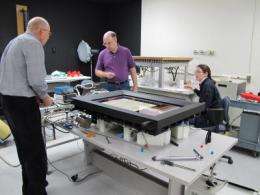
The Magna Carta rests in its argon-filled NIST encasement at the Archives Conservation lab. Credit: Hill/NARA

You often hear about the Framers of the Constitution, but not so much the framers of the Magna Carta. They work for the National Institute of Standards and Technology (NIST).

Not the authors, of course; they've been dead 700 years. But a NIST engineering team, at the behest of the National Archives, designed and built a state-of-the-art encasement and transport cart to protect the Archive's prized copy of the 1297 Magna Carta. Their work—and the freshly conserved Magna Carta—were on display Feb. 2, 2012, at a special "behind-the-scenes" showing at the National Archives Conservation Lab. The enclosure is designed to visually enhance the parchment document while maintaining the interior environment so it does not degrade the document, which is the underpinning to Western Civilization and U.S. law.

The encasement is basically a controlled environment, explained NIST Project Engineer Jay Brandenburg, who regularly does similar tasks to isolate sensitive lab equipment.

The first Magna Carta was signed in 1215 by King John of England. He was forced by an assembly of barons to put in writing, for the first time, the traditional rights and liberties of the country's free persons. After another confrontation with barons, Edward I not only reissued the Magna Carta in 1297, but for the first time, it was entered into the official Statute Rolls of England and became the foundation of English law.

This video is not supported by your browser at this time.

View NARA YouTube video of the encasement project

The owner of this copy of the Magna Carta, David M. Rubinstein, loaned the document to the National Archives and paid for its restoration and encasement.

While the Archives refurbished the parchment, NIST engineers and crafts people built a platform to hold the Magna Carta, the large encasement it sits in and a heavy-duty cart.

NIST worked from a three-dimensional laser scan of the document to support it on the platform and to create a nest to hold the original wax seal with Edward I's likeness, which is attached to the Magna Carta by a frail parchment ribbon.

The platform was created from a single 6-inch thick block of aluminum to minimize the number of joints or spots that could cause leaks in the encasement, explained Brandenburg. About 90 percent of the block was cut away with a computer-controlled milling machine based on the three-dimensional image to create the perfect fit.

The end result is an enclosure about 41 inches wide by 28 inches long and 6 inches deep. It weighs 225 pounds. The encasement cover is made of a special laminated glass with antireflective coatings to ensure maximum visibility of the document while protecting it. The encasement is sealed with close-fitting bolts that hold the frame against double O-rings that create the encasement seal. The case was filled with argon gas and will be monitored to avoid as much oxidation damage as possible.

The enclosure will likely never be seen in its entirety again. By mid-February it will be placed inside the new interactive display in the West Rotunda Gallery of the U.S. Building in Washington, D.C. There, alongside three other documents for which NIST built similar enclosures—the Declaration of Independence, the Constitution and the Bill of Rights—it will be on display for the 1 million visitors that pass through the Archives each year.

More information: To learn more about previous NIST work on document enclosures, visit "For Posterity: NIST Helps to Preserve the 'Charters of Freedom'" at http://www.100.nis … _project.htm

Provided by National Institute of Standards and Technology search and more info website

Filter


Move the slider to adjust rank threshold, so that you can hide some of the comments.


Display comments: newest first

COCO
Feb 09, 2012

Rank: 5 / 5 (1)
this seems more NIST's speed - after the debacle over their imaginary 911 work I hope that politics do not fudge science once again
kochevnik
Feb 09, 2012

Rank: not rated yet
I recommend the 2011 film Ironclad for those who haven't seen it.
Rank 4 /5 (2 votes)
Relevant PhysicsForums posts

More news stories

Browser wars flare in mobile space

The browser wars are heating up again, but this time the fight is for dominance of the mobile Internet.

Technology / Software

created 18 hours ago | popularity 4 / 5 (4) | comments 3

Probability of contamination from severe nuclear reactor accidents is higher than expected: study

Catastrophic nuclear accidents such as the core meltdowns in Chernobyl and Fukushima are more likely to happen than previously assumed. Based on the operating hours of all civil nuclear reactors and the number ...

Technology / Energy & Green Tech

created May 22, 2012 | popularity 3.6 / 5 (25) | comments 56 | with audio podcast

HyperSolar shows dirty water no barrier to power world

(Phys.org) -- The Santa Barbara, California, company, HyperSolar, is set to transparently share the ups and downs of its research experiences toward the company’s ultimate vision, successfully producing ...

Technology / Energy & Green Tech

created May 24, 2012 | popularity 4.8 / 5 (16) | comments 17 | with audio podcast report

SpotterRF debuts Radar Backpack Kit (w/ Video)

(Phys.org) -- SpotterRF has announced a special radar backpack kit designed to enhance situational awareness for soldiers on the ground. The company says its special radar is designed for warfighters as part ...

Technology / Hi Tech & Innovation

created May 26, 2012 | popularity 5 / 5 (5) | comments 13 | with audio podcast report

Tesla to launch electric sedan in US on June 22

Tesla Motors said Tuesday it would begin deliveries of "the world's first premium electric sedan" on June 22, slightly ahead of schedule.

Technology / Energy & Green Tech

created May 22, 2012 | popularity 4.5 / 5 (12) | comments 18


'Unzipped' carbon nanotubes could help energize fuel cells, batteries

Multi-walled carbon nanotubes riddled with defects and impurities on the outside could replace some of the expensive platinum catalysts used in fuel cells and metal-air batteries, according to scientists at ...

Change in developmental timing was crucial in the evolutionary shift from dinosaurs to birds: study

At first glance, it's hard to see how a common house sparrow and a Tyrannosaurus Rex might have anything in common. After all, one is a bird that weighs less than an ounce, and the other is a dinosaur that ...

Computer model used to pinpoint prime materials for efficient carbon capture

When power plants begin capturing their carbon emissions to reduce greenhouse gases – and to most in the electric power industry, it's a question of when, not if – it will be an expensive undertaking.

T cells 'hunt' parasites like animal predators seek prey, study shows

By pairing an intimate knowledge of immune-system function with a deep understanding of statistical physics, a cross-disciplinary team at the University of Pennsylvania has arrived at a surprising finding: T cells use a movement ...

Yale study concludes public apathy over climate change unrelated to science literacy

Are members of the public divided about climate change because they don't understand the science behind it? If Americans knew more basic science and were more proficient in technical reasoning, would public consensus match ...

Land and sea species differ in climate change response: study

(Phys.org) -- Marine and terrestrial species will likely differ in their responses to climate warming, new research by Simon Fraser University and Australia’s University of Tasmania has found.