British scientist warns AAAS of the threat posed by ocean acidification
February 20, 2012

British scientist warns AAAS of the threat posed by ocean acidification

One of the UK’s leading voices on ocean acidification has addressed a prestigious conference in Canada with a warning that marine biodiversity is at risk due to the corrosive effects of carbon dioxide.

Dr Jason Hall-Spencer, of Plymouth University, says that the combination of ocean acidification and rising water temperatures kills off corals, shellfish and other valuable marine life – posing a risk to industries such as fishing and tourism.

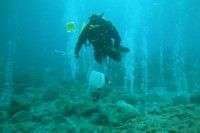
Dr Hall-Spencer addressed the Annual Meeting of the AAAS (The American Association for the Advancement of Science) in Vancouver and presented his findings from studying biodiversity at naturally occurring underwater CO2 vents.

He said: “Wherever we look along gradients of increasing CO2, the effects are strikingly similar; large falls in biodiversity occur both in the tropics and in colder waters.

“Important groups like sea urchins and coralline algae cannot survive as the CO2 makes the water corrosive. And warming makes many of the organisms even more vulnerable to the corrosive effects of carbon dioxide – so shellfish and tourism industries are right to be concerned about .”

The use of these carbon vents as ‘natural laboratories’ was initiated by Dr Hall-Spencer, after he became “frustrated” by the slow progress being made towards predicting what increasing CO2 levels might do to coastal ecosystems. He began work at Ischia Island in Italy, and has now expanded to sites around volcanoes in Sicily, Greece, Mexico and Papua New Guinea.

He has found that some organisms are able to adapt to the effects of long-term acidification as they calcify faster at high CO2 levels. Organisms with an outer layer of protective tissue, such as Balanophyllia europaea corals and Mytilus galloprovincialis mussels, can tolerate acidified seawater. But organisms that lack protective layers suffer corrosion to their exposed shells and skeletons.

Dr Hall-Spencer said: “Initial observations confirm that although increased CO2 benefits some organisms, including invasive species of algae and stinging jellyfish, it reduces biodiversity across-the-board from simple , such as bacteria, microalgae and foraminiferans, to flora-like seaweeds and seagrasses, and fauna, such as corals, sponges, and molluscs.

“We have also found evidence in Sicily of the rapid growth of slimy diatoms, which is useful to know as these slimy layers influence the structure of what grows on surfaces – the economic repercussions for the shipping and marine construction industries now need to be investigated.”

Dr Hall-Spencer, based in the School of Marine Sciences and Engineering, was the only UK academic to present at the conference.

Provided by University of Plymouth


Rank 5 /5 (1 vote)
Relevant PhysicsForums posts

More news stories

Yale study concludes public apathy over climate change unrelated to science literacy

Are members of the public divided about climate change because they don't understand the science behind it? If Americans knew more basic science and were more proficient in technical reasoning, would public consensus match ...

Space & Earth / Environment

created 11 hours ago | popularity 4.8 / 5 (6) | comments 27 | with audio podcast

Land and sea species differ in climate change response: study

(Phys.org) -- Marine and terrestrial species will likely differ in their responses to climate warming, new research by Simon Fraser University and Australia’s University of Tasmania has found.

Space & Earth / Environment

created 9 hours ago | popularity 4 / 5 (5) | comments 6 | with audio podcast

10 million years needed to recover from mass extinction

It took some 10 million years for Earth to recover from the greatest mass extinction of all time, latest research has revealed.

Space & Earth / Earth Sciences

created 11 hours ago | popularity 4.2 / 5 (5) | comments 2 | with audio podcast

Sophisticated simulations predict future warming

The chances of our planet being hit by a global warming of 3 degrees Celsius by 2050 is as likely as it being hit by an increase of 1.4 degrees, new research shows. Presented in the journal Nature Geoscience, the British study ...

Space & Earth / Earth Sciences

created May 22, 2012 | popularity 3.8 / 5 (11) | comments 51

Kyoto Protocol architect 'frustrated' by climate dialogue

UN climate talks are going nowhere, as politicians dither or bicker while the pace of warming dangerously speeds up, one of the architects of the Kyoto Protocol told AFP.

Space & Earth / Environment

created May 23, 2012 | popularity 3.4 / 5 (8) | comments 42


'Unzipped' carbon nanotubes could help energize fuel cells, batteries

Multi-walled carbon nanotubes riddled with defects and impurities on the outside could replace some of the expensive platinum catalysts used in fuel cells and metal-air batteries, according to scientists at ...

Change in developmental timing was crucial in the evolutionary shift from dinosaurs to birds: study

At first glance, it's hard to see how a common house sparrow and a Tyrannosaurus Rex might have anything in common. After all, one is a bird that weighs less than an ounce, and the other is a dinosaur that ...

Computer model used to pinpoint prime materials for efficient carbon capture

When power plants begin capturing their carbon emissions to reduce greenhouse gases – and to most in the electric power industry, it's a question of when, not if – it will be an expensive undertaking.

T cells 'hunt' parasites like animal predators seek prey, study shows

By pairing an intimate knowledge of immune-system function with a deep understanding of statistical physics, a cross-disciplinary team at the University of Pennsylvania has arrived at a surprising finding: T cells use a movement ...

Stunning image of smallest possible five-ringed structure

Scientists have created and imaged the smallest possible five-ringed structure – about 100,000 times thinner than a human hair – and you'll probably recognise its shape.

Browser wars flare in mobile space

The browser wars are heating up again, but this time the fight is for dominance of the mobile Internet.