Researchers uncover transparency limits on transparent conducting oxides
January 18, 2012

Researchers uncover transparency limits on transparent conducting oxides

Enlarge

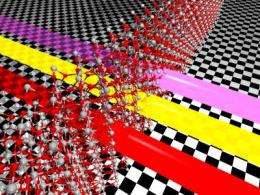
Three beams of light (red for infrared, yellow for visible light, and violet for ultraviolet) travel through a layer of SnO2. Absorption by the conduction electrons in the oxide reduces the intensity of the beams. Credit: Hartwin Peelaers, UC Santa Barbara

Researchers in the Computational Materials Group at the University of California, Santa Barbara (UCSB) have uncovered the fundamental limits on optical transparency in the class of materials known as transparent conducting oxides. Their discovery will support development of energy efficiency improvements for devices that depend on optoelectronic technology, such as light- emitting diodes and solar cells.

Transparent conducting oxides are used as transparent contacts in a wide range of optoelectronic devices, such as , light-emitting diodes (LEDs), and LCD touch screens. These materials are unique in that they can conduct electricity while being transparent to visible light. For optoelectronic devices to be able to emit or absorb light, it is important that the electrical contacts at the top of the device are optically transparent. Opaque metals and most lack the balance between these two characteristics to be functional for use in such technology.

In a paper published in Applied Physics Letters, the UCSB researchers used cutting-edge calculation methods to investigate tin dioxide (SnO2), a widely-used conducting oxide.

Conducting oxides strike an ideal balance between transparency and conductivity because their wide band gaps prevent absorption of visible light by excitation of electrons across the gap, according to the researchers. At the same time, dopant atoms provide additional electrons in the conduction band that enable . However, these can also absorb light by being excited to higher states.

"Direct absorption of visible light cannot occur in these materials because the next available electron level is too high in energy. But we found that more complex absorption mechanisms, which also involve , can be remarkably strong", says Hartwin Peelaers, a postdoctoral researcher and the lead author of the paper. The other authors are Emmanouil Kioupakis, now at the University of Michigan, and Chris Van de Walle, a professor in the UCSB Materials Department and head of the research group.

They found that tin dioxide only weakly absorbs visible light, thus letting most light pass through, so that it is still a useful transparent contact. In their study, the transparency of SnO2 declined when moving to other wavelength regions. Absorption was 5 times stronger for ultraviolet light and 20 times stronger for the infrared light used in telecommunications.

"Every bit of light that gets absorbed reduces the efficiency of a solar cell or LED", remarked Chris Van de Walle. "Understanding what causes the absorption is essential for engineering improved materials to be used in more efficient devices."

More information: APL 100, 011914 (2012)

Journal reference: Applied Physics Letters search and more info website

Provided by University of California - Santa Barbara search and more info website


Rank 5 /5 (3 votes)
Relevant PhysicsForums posts
  • Laser noise spectrum
    created6 hours ago
  • Transparency of molten substances?
    createdMay 25, 2012
  • saturated paramagnetic and ferromagnetic
    createdMay 24, 2012
  • How to calculate the bandstructure of Twisted Bilayer Graphene
    createdMay 23, 2012
  • vast computational richness from swapping one proton
    createdMay 22, 2012
  • Oscillator strength of mixed LH- and HH-excitons
    createdMay 22, 2012
  • More from Physics Forums - Atomic, Solid State, Comp. Physics

More news stories

Is a classical electrodynamics law incompatible with special relativity?

(Phys.org) -- The laws of classical electromagnetism that were developed in the 19th century are the same laws that scientists use today. They include Maxwell’s four equations along with the Lorentz la ...

Physics / General Physics

created May 24, 2012 | popularity 4.7 / 5 (18) | comments 43 | with audio podcast feature

Landmark calculation clears the way to answering how matter is formed

(Phys.org) -- An international collaboration of scientists, including Thomas Blum, associate professor of physics, is reporting in landmark detail the decay process of a subatomic particle called a kaon – ...

Physics / General Physics

created May 25, 2012 | popularity 4.3 / 5 (22) | comments 52 | with audio podcast

Lying in wait for WIMPs: Researchers seek to dramatically increase sensitivity of Large Underground Xenon detector

Although it's invisible, dark matter accounts for at least 80 percent of the matter in the universe. No one knows what it is, but most scientists would bet on weakly interacting massive particles, or WIMPs.

Physics / General Physics

created May 23, 2012 | popularity 4 / 5 (7) | comments 17 | with audio podcast

Hawaii lab turns laser-powered bubbles into microrobots

(Phys.org) -- A team of scientists from the University of Hawaii are working on microrobots created from bubbles of air in a saline solution. The bubbles take on their title of “robots” as a laser ...

Physics / General Physics

created May 23, 2012 | popularity 5 / 5 (4) | comments 2 | with audio podcast weblog

Sound increases the efficiency of boiling

Scientists at the Georgia Institute of Technology achieved a 17-percent increase in boiling efficiency by using an acoustic field to enhance heat transfer. The acoustic field does this by efficiently removing vapor bubbles ...

Physics / Soft Matter

created May 24, 2012 | popularity 5 / 5 (2) | comments 2


Stunning image of smallest possible five-ringed structure

Scientists have created and imaged the smallest possible five-ringed structure – about 100,000 times thinner than a human hair – and you'll probably recognise its shape.

'Unzipped' carbon nanotubes could help energize fuel cells, batteries

Multi-walled carbon nanotubes riddled with defects and impurities on the outside could replace some of the expensive platinum catalysts used in fuel cells and metal-air batteries, according to scientists at ...

Change in developmental timing was crucial in the evolutionary shift from dinosaurs to birds: study

At first glance, it's hard to see how a common house sparrow and a Tyrannosaurus Rex might have anything in common. After all, one is a bird that weighs less than an ounce, and the other is a dinosaur that ...

Computer model used to pinpoint prime materials for efficient carbon capture

When power plants begin capturing their carbon emissions to reduce greenhouse gases – and to most in the electric power industry, it's a question of when, not if – it will be an expensive undertaking.

T cells 'hunt' parasites like animal predators seek prey, study shows

By pairing an intimate knowledge of immune-system function with a deep understanding of statistical physics, a cross-disciplinary team at the University of Pennsylvania has arrived at a surprising finding: T cells use a movement ...

Land and sea species differ in climate change response: study

(Phys.org) -- Marine and terrestrial species will likely differ in their responses to climate warming, new research by Simon Fraser University and Australia’s University of Tasmania has found.