Ulcer-causing bacteria baffled by mucus: Viscoelasticity impact on collective behavior of swimming microorganisms
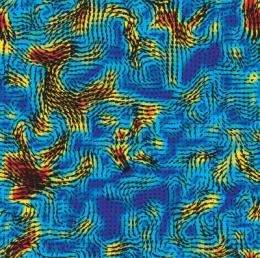
Researchers at Rensselaer Polytechnic Institute have discovered how certain polymers -- like those found in human mucus and saliva -- make it significantly more difficult for ulcer-causing bacteria to coordinate. The findings raise many new questions about the relationship between the individual and group behaviors of bacteria. The study also suggests that human mucus, saliva, and other biological fluid barriers may have evolved to disrupt the ability of harmful bacteria to coordinate. Credit: Rensselaer/Underhill
Even the tiniest microscopic organisms make waves when they swim. In fact, dealing with these waves is a fact of life for the ulcer-causing bacteria H. pylori.
The bacteria are known to change their behavior in order to compensate for the waves created by other bacteria swimming around in the same aquatic neighborhood. From the relatively simple actions of these individual bacteria emerges a complex, coordinated group behavior.
A new study by engineering researchers at Rensselaer Polytechnic Institute demonstrates how introducing certain polymerslike those found in human mucus and salivainto the environment makes it significantly more difficult for H. pylori and other microorganisms to coordinate. The findings raise many new questions about the relationship between the individual and group behaviors of bacteria. The study also suggests that human mucus, saliva, and other biological fluid barriers may have evolved to disrupt the ability of harmful bacteria to coordinate.
"In the human body, microorganisms are always moving around in mucus, saliva, and other systems that exhibit elasticity due to the presence of polymers. Our study is among the first to look at how this elasticity impacts the collective behavior of microorganisms like H. pylori," said lead researcher Patrick T. Underhill, assistant professor in the Howard P. Isermann Department of Chemical and Biological Engineering at Rensselaer. "What we found is that polymers do in fact have a substantial impact on the flows created by the swimming bacteria, which in turn makes it more difficult for the individual bacteria to coordinate with each other. This opens the door to new ways of looking at our immune system."
Results of the study are detailed in the paper "Effect of viscoelasticity on the collective behavior of swimming microorganisms," recently published by the journal Physical Review E.
Underhill's study, based on large-scale computer simulations, leveraged the power of the Rensselaer Computational Center for Nanotechnology Innovations (CCNI), one of the world's most powerful university-based supercomputers. These simulations involved creating a computer model of more than 110,000 individual H. pylori bacteria simultaneously occupying a small volume of polymer-infused liquid. The simulations captured all of the individual actions and interactions created as the bacteria swam through the liquid. The most difficult aspect of this kind of simulation, Underhill said, is to identify collective behaviors and extract relevant conclusions from the massive amount of data generated.
See a video of a simulation:
This video is not supported by your browser at this time.
In addition to computer simulations, Underhill employed theoretical models to understand how the addition of elasticity to liquid impacts the waves created by swimming H. pylori and, in turn, the collective behavior of a large group of the bacteria. Bacteria like H. pylori are known as pushers, as they propel themselves through water by twisting the long helical filaments that trail behind them.More information: See the paper online at: http://link.aps.org/doi/10.1103/PhysRevE.84.061901
Provided by
Rensselaer Polytechnic Institute
-
From lemons to lemonade: Reaction uses carbon dioxide to make carbon-based semiconductor,
32 comments
-
Thioridazine kills cancer stem cells in human while avoiding toxic side-effects of conventional cancer treatments,
3 comments
-
SpaceX private rocket blasts off for space station (Update),
42 comments
-
Climate scientists say they have solved riddle of rising sea,
31 comments
-
SpaceX capsule has 'new car' smell, astronauts say (Update),
4 comments
-
Why does a boiled egg rotates while a raw egg doesn't?
1 hour ago
-
Lightning strike in mindair
1 hour ago
-
Why does light move?
3 hours ago
-
How to calculate the repulsion force between a permanent and an electromagnet?
4 hours ago
-
Why does light allow us to see things?
4 hours ago
-
Room temperature superconductivity
4 hours ago
- More from Physics Forums - General Physics
More news stories
Is a classical electrodynamics law incompatible with special relativity?
(Phys.org) -- The laws of classical electromagnetism that were developed in the 19th century are the same laws that scientists use today. They include Maxwell’s four equations along with the Lorentz la ...
Landmark calculation clears the way to answering how matter is formed
(Phys.org) -- An international collaboration of scientists, including Thomas Blum, associate professor of physics, is reporting in landmark detail the decay process of a subatomic particle called a kaon ...
May 25, 2012 |
4.3 / 5 (22) |
52
|
Lying in wait for WIMPs: Researchers seek to dramatically increase sensitivity of Large Underground Xenon detector
Although it's invisible, dark matter accounts for at least 80 percent of the matter in the universe. No one knows what it is, but most scientists would bet on weakly interacting massive particles, or WIMPs.
May 23, 2012 |
4 / 5 (7) |
17
|
Hawaii lab turns laser-powered bubbles into microrobots
(Phys.org) -- A team of scientists from the University of Hawaii are working on microrobots created from bubbles of air in a saline solution. The bubbles take on their title of robots as a laser ...
Sound increases the efficiency of boiling
Scientists at the Georgia Institute of Technology achieved a 17-percent increase in boiling efficiency by using an acoustic field to enhance heat transfer. The acoustic field does this by efficiently removing vapor bubbles ...
May 24, 2012 |
5 / 5 (2) |
2
Stunning image of smallest possible five-ringed structure
Scientists have created and imaged the smallest possible five-ringed structure about 100,000 times thinner than a human hair and you'll probably recognise its shape.
'Unzipped' carbon nanotubes could help energize fuel cells, batteries
Multi-walled carbon nanotubes riddled with defects and impurities on the outside could replace some of the expensive platinum catalysts used in fuel cells and metal-air batteries, according to scientists at ...
Change in developmental timing was crucial in the evolutionary shift from dinosaurs to birds: study
At first glance, it's hard to see how a common house sparrow and a Tyrannosaurus Rex might have anything in common. After all, one is a bird that weighs less than an ounce, and the other is a dinosaur that ...
Computer model used to pinpoint prime materials for efficient carbon capture
When power plants begin capturing their carbon emissions to reduce greenhouse gases and to most in the electric power industry, it's a question of when, not if it will be an expensive undertaking.
T cells 'hunt' parasites like animal predators seek prey, study shows
By pairing an intimate knowledge of immune-system function with a deep understanding of statistical physics, a cross-disciplinary team at the University of Pennsylvania has arrived at a surprising finding: T cells use a movement ...
Land and sea species differ in climate change response: study
(Phys.org) -- Marine and terrestrial species will likely differ in their responses to climate warming, new research by Simon Fraser University and Australia’s University of Tasmania has found.
Jan 18, 2012
Rank: not rated yet