UC Riverside bug expert visits Rwanda to solve mystery surrounding specialty coffee sector
January 5, 2012

UC Riverside bug expert visits Rwanda to solve mystery surrounding specialty coffee sector

Enlarge

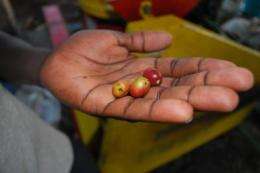
Photo shows antestia-bitten coffee cherry. Credit: Global Knowledge Initiative.

The expertise of entomologists at the University of California, Riverside has a worldwide impact, with researchers tracking down the natural enemy of the Asian citrus psyllid in Pakistan, identifying insecticidal fungi to control katydids in Papua New Guinea, suppressing the cottony cushion scale in the Galapagos Islands, and collecting red palm weevils in Southeast Asia – to name just a few research projects.

Now Thomas Miller, a professor of entomology and a Jefferson Science Fellow, will travel to Rwanda, Africa, to help solve a mystery surrounding the country's specialty coffee sector – a sector that accounts for 26 percent of the country's agricultural exports.

A defect called "potato taste" – thought to be caused in part by the antestia bug – is threatening to deter international buyers from purchasing Rwandan coffee.

"When stink bugs feed on plants, they can affect the taste of the fruit from the plants," Miller explained. "For example, the brown marmorated stink bug feeding on tomatoes changes their taste. Certain tea plants, when fed upon by leafhoppers, produce leaves with improved taste. Much of the underlying reasons for these are not known."

Determining the specific cause of potato taste is a major challenge Miller and Christian Cilas, a French scientist, face after they travel to Rwanda on Jan. 7. Currently, there is no definitive link between potato taste and antestia bug, only hypotheses.

Miller will stay in Rwanda for two weeks – one week will be comprised of meetings, including three national workshops for stakeholders across private sectors, research, academia, and government; the other week will be used in field visits. He expects to get a better understanding of potato taste and its causes, gather samples for analysis in the United States, and begin collaborations with Rwandan scientists.

"We will devise a multi-pronged strategy for ridding Rwanda's specialty coffee of potato taste defect," Miller said. "And we will also assist Rwanda in reaching out and making contacts with people grappling with similar problems globally."

Starting Jan. 9, Miller and Cilas will join a group of researchers from the National University of Rwanda to solve the mystery surrounding potato taste.

The collective effort to eliminate potato taste in Rwandan specialty coffee is being organized under the auspices of the Global Knowledge Initiative (GKI), an international non-profit. Through the Learning and Innovation for Network for Knowledge and Solutions (LINK) Program, GKI helps scientists, innovators, and entrepreneurs worldwide construct purpose-driven networks to tackle challenges like the one Miller and Cilas will confront in Rwanda. A full analysis of LINK Rwanda will enable the international team to maximize efforts and leverage shared resources.

"We believe science has entered The Collaboration Era," said Sara Farley, GKI's chief operating officer. "By lowering the transaction cost of partnerships and clarifying the context for them, we think the 21st century will be marked by unprecedented levels of knowledge partnerships like this one. We hope to engage UC Riverside in as many of them as possible."

Provided by University of California - Riverside search and more info website


Rank not rated yet
Relevant PhysicsForums posts

More news stories

Manufacturing genes to attack flu virus

An international research team has manufactured a new protein that can combat deadly flu epidemics.

Biology / Biotechnology

created 6 hours ago | popularity not rated yet | comments 0 | with audio podcast

Scientist: Evolution debate will soon be history

(AP) -- Richard Leakey predicts skepticism over evolution will soon be history. Not that the avowed atheist has any doubts himself.

Biology / Evolution

created May 26, 2012 | popularity 3.5 / 5 (20) | comments 89

More plant species responding to global warming than previously thought

(Phys.org) -- Far more wild plant species may be responding to global warming than previous large-scale estimates have suggested.

Biology / Ecology

created May 22, 2012 | popularity 4.6 / 5 (14) | comments 18 | with audio podcast

For monogamous sparrows, it doesn't pay to stray (but they do it anyway)

It's quite common for a female song sparrow to stray from her breeding partner and mate with the male next door, but a new study shows that sleeping around can be costly.

Biology / Plants & Animals

created May 22, 2012 | popularity 5 / 5 (2) | comments 8 | with audio podcast

Thousands of shellfish found dead in Peru

Thousands of crustaceans were found dead off the coast of Lima following the mystery mass death of dolphins and pelicans, the Peruvian Navy said Friday.

Biology / Ecology

created May 26, 2012 | popularity 4.7 / 5 (7) | comments 7


Stunning image of smallest possible five-ringed structure

Scientists have created and imaged the smallest possible five-ringed structure – about 100,000 times thinner than a human hair – and you'll probably recognise its shape.

'Unzipped' carbon nanotubes could help energize fuel cells, batteries

Multi-walled carbon nanotubes riddled with defects and impurities on the outside could replace some of the expensive platinum catalysts used in fuel cells and metal-air batteries, according to scientists at ...

Change in developmental timing was crucial in the evolutionary shift from dinosaurs to birds: study

At first glance, it's hard to see how a common house sparrow and a Tyrannosaurus Rex might have anything in common. After all, one is a bird that weighs less than an ounce, and the other is a dinosaur that ...

Computer model used to pinpoint prime materials for efficient carbon capture

When power plants begin capturing their carbon emissions to reduce greenhouse gases – and to most in the electric power industry, it's a question of when, not if – it will be an expensive undertaking.

T cells 'hunt' parasites like animal predators seek prey, study shows

By pairing an intimate knowledge of immune-system function with a deep understanding of statistical physics, a cross-disciplinary team at the University of Pennsylvania has arrived at a surprising finding: T cells use a movement ...

Land and sea species differ in climate change response: study

(Phys.org) -- Marine and terrestrial species will likely differ in their responses to climate warming, new research by Simon Fraser University and Australia’s University of Tasmania has found.