Turtles' mating habits protect against effects of climate change
January 24, 2012

Turtles' mating habits protect against effects of climate change

Enlarge

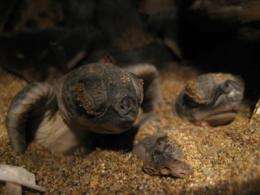
These are green turtle hatchlings. Credit: Photo by Kimberley Stokes, University of Exeter

The mating habits of marine turtle may help to protect them against the effects of climate change, according to new research led by the University of Exeter. Published today in the journal Proceedings of the Royal Society B, the study shows how the mating patterns of a population of endangered green turtles may be helping them deal with the fact that global warming is leading to a disproportionate number of females being born.

The gender of baby turtles is determined by the temperature of the eggs during incubation, with warmer temperatures leading to more females being born. Higher average mean that offspring from some populations are predominantly female. This is threatening the future of some populations and there are concerns that inbreeding within groups due to a lack of males will lead to health problems.

The study focused on a population of the green turtle, Chelonia mydas, nesting in Northern Cyprus, where, due to the high , 95 per cent of babies are female. The study involved a team from the University of Exeter (UK), University of Lefke (Turkey) and North Cyprus Society for Protection of Turtles. Through , they were able to ascertain the paternity of baby turtles and, contrary to what they had expected, they found a large number of mating males.

The researchers found that 28 males sired offspring with 20 nesting females: an average of 1.4 males for every female. This means that each female's offspring were sired by one or more fathers. The researchers were surprised to find no evidence that any males fathered offspring born in that season with more than one female.
Turtles' mating habits protect against effects of climate change
Enlarge

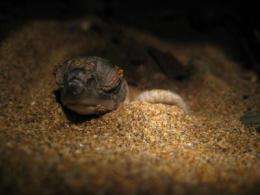
This is a green turtle hatchling. Credit: Photo by Kimberley Stokes, University of Exeter

The research team had thought that one single male might be breeding with multiple females. However, their results suggest that a large number of males are mating with different females at different times. This means that there is less chance of inbreeding.

The team also carried out satellite tracking to discover that males cover thousands of miles of ocean within one breeding season. This suggests they could have also been mating with females at other sites in Turkey or North Africa.

Lead researcher University of Exeter PhD student Lucy Wright said: "It is fantastic to know that there are so many males fathering offspring in this population of . There is great concern that a lack of males could lead to in small populations of marine turtles, potentially causing a population crash. However our research suggests that there are more males out there than expected considering the female-biased hatchling sex ratios and that their mating patterns will buffer the population against any potential feminising ."

Corresponding author Dr Annette Broderick added: "Climate change remains a great threat to marine turtles, but our ongoing research will help us focus on where the priority areas are for management that may help them cope with future change."

Journal reference: Proceedings of the Royal Society B search and more info website

Provided by University of Exeter search and more info website

4.3 /5 (3 votes)  

Filter


Move the slider to adjust rank threshold, so that you can hide some of the comments.


Display comments: newest first

gwrede
Jan 25, 2012

Rank: 5 / 5 (2)
Climate change remains a great threat to marine turtles
Now, that is a statement, considering that turtles have been around for two hundred million years.

During that time there have been ice ages, draughts, hot periods, and massive extinctions. The sea level, sea water composition, other species around them, and other things have seen massive changes. Actually, there is all the reason to believe that turtles will be around when humans are but a distant memory.
antialias_physorg
Jan 25, 2012

Rank: 3.5 / 5 (4)
The sea level, sea water composition, other species around them, and other things have seen massive changes.

All at relatively slow timescales. Given slow changes in the environment species can adapt to large shifts. But the current situation si different. We're changing the climate radically within decades/centuries - not milennia. To adapt you need to give these critters at least a few (dozen) generations to cope. Right now we're not giving them that time.

This has been true of a few other situations inthe past when massive extinctions have taken place. Any surving species probably held on by the skin of their teeth (and some blind luck). We shouldn't expect a species to survive such a scenario just because it has done so once already. Every dieback is different and poses different challenges - which may or may not be terminal for a species.
gwrede
Feb 12, 2012

Rank: not rated yet
@antialias, seems you haven't read about Yellowstone, Krakatoa, meteor impacts. All these cause sudden discontinuities in the environment. Turtles have survived them better than any other species, and more consistently.
ryggesogn2
Feb 12, 2012

Rank: 1 / 5 (1)
"The mating habits of marine turtle may help to protect them against the effects of climate change,"
Marine turtles have been around for millions of years so it should be obvious they have adapted to changing climates.
antialias_physorg
Feb 12, 2012

Rank: not rated yet
Turtles have survived them better than any other species, and more consistently.

Turtels have a different survival strategy than most (aside from being hardy critters).
Many otzer species have a real problem if their numbers are diminished (e.g. by some LOCALIZED cataclymic event) to the point where mates cannot be found by the few surviving specimens. The life expectancy of many animals is comparably low - so if the number of offspring doesn't at least eqaul the number of individuals in a very short timespan the species may die out.

Turtles are long lived. They can take a long time to find mates (and their tendency to mass-mate in the same spot year after year also increases the chance sof finding a partner - even if the number of individuals suddenly drops)

But we're not talking localized event here. We're talking global ecological shifts. That's a different challenge alltogether. I hope they make it. It's up to us not to make it too hard on them.
Rank 4.3 /5 (3 votes)
Relevant PhysicsForums posts

More news stories

Manufacturing genes to attack flu virus

An international research team has manufactured a new protein that can combat deadly flu epidemics.

Biology / Biotechnology

created 6 hours ago | popularity not rated yet | comments 0 | with audio podcast

Scientist: Evolution debate will soon be history

(AP) -- Richard Leakey predicts skepticism over evolution will soon be history. Not that the avowed atheist has any doubts himself.

Biology / Evolution

created May 26, 2012 | popularity 3.5 / 5 (20) | comments 89

More plant species responding to global warming than previously thought

(Phys.org) -- Far more wild plant species may be responding to global warming than previous large-scale estimates have suggested.

Biology / Ecology

created May 22, 2012 | popularity 4.6 / 5 (14) | comments 18 | with audio podcast

For monogamous sparrows, it doesn't pay to stray (but they do it anyway)

It's quite common for a female song sparrow to stray from her breeding partner and mate with the male next door, but a new study shows that sleeping around can be costly.

Biology / Plants & Animals

created May 22, 2012 | popularity 5 / 5 (2) | comments 8 | with audio podcast

Thousands of shellfish found dead in Peru

Thousands of crustaceans were found dead off the coast of Lima following the mystery mass death of dolphins and pelicans, the Peruvian Navy said Friday.

Biology / Ecology

created May 26, 2012 | popularity 4.7 / 5 (7) | comments 7


Stunning image of smallest possible five-ringed structure

Scientists have created and imaged the smallest possible five-ringed structure – about 100,000 times thinner than a human hair – and you'll probably recognise its shape.

'Unzipped' carbon nanotubes could help energize fuel cells, batteries

Multi-walled carbon nanotubes riddled with defects and impurities on the outside could replace some of the expensive platinum catalysts used in fuel cells and metal-air batteries, according to scientists at ...

Change in developmental timing was crucial in the evolutionary shift from dinosaurs to birds: study

At first glance, it's hard to see how a common house sparrow and a Tyrannosaurus Rex might have anything in common. After all, one is a bird that weighs less than an ounce, and the other is a dinosaur that ...

Computer model used to pinpoint prime materials for efficient carbon capture

When power plants begin capturing their carbon emissions to reduce greenhouse gases – and to most in the electric power industry, it's a question of when, not if – it will be an expensive undertaking.

T cells 'hunt' parasites like animal predators seek prey, study shows

By pairing an intimate knowledge of immune-system function with a deep understanding of statistical physics, a cross-disciplinary team at the University of Pennsylvania has arrived at a surprising finding: T cells use a movement ...

Land and sea species differ in climate change response: study

(Phys.org) -- Marine and terrestrial species will likely differ in their responses to climate warming, new research by Simon Fraser University and Australia’s University of Tasmania has found.