Team finds natural reasons behind nitrogen-rich forests
January 16, 2012 By Evelyn Boswell

Team finds natural reasons behind nitrogen-rich forests

Enlarge

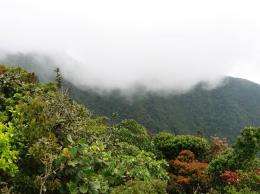
This nitrogen-rich mountain rainforest is located on Volcan Orosi in Costa Rica. (Photo by Jack Brookshire).

(PhysOrg.com) -- Many tropical forests are extremely rich in nitrogen even when there are no farms or industries nearby, says Montana State University researcher Jack Brookshire.

It's because of that occur naturally in the forests, Brookshire and four colleagues said in a paper they published Jan. 15 in the online version of the journal .

Disputing some long-held beliefs about high nitrogen levels in forests, Brookshire said pollution isn't always the reason behind it. It can also be caused by natural interactions between the forest and nutrient cycles. Brookshire and his team suggested that in mountainous , nitrogen availability may not limit plant growth or its response to higher carbon dioxide levels in the atmosphere.

Brookshire began his study in 2006 when he was a postdoctoral researcher at Princeton University. He continued it after moving to MSU in 2009. He is now an assistant professor in the Department of Land Resources and Environmental Sciences.

To conduct their study, Brookshire, two scientists from Princeton University and two researchers from the Stroud Water Research Center in Avondale, Pa., used data collected between 1990 and 2008 to examine the concentration of dissolved nitrogen compounds and the of nitrate in streams in six mountain forests in Costa Rica and 55 mountain forests across Central American and the Caribbean.

All of the forests were old-growth tropical forests with no signs of large-scale disturbance. They were classified as mountain evergreen, mountain rainforest or cloud forest. Evergreen forests in Costa Rica are at lower altitudes. Rainforests are at higher elevations. Cloud forests are at the highest elevation. They are bathed in clouds or moisture for much of the year.
Team finds natural reasons behind nitrogen-rich forests
Enlarge

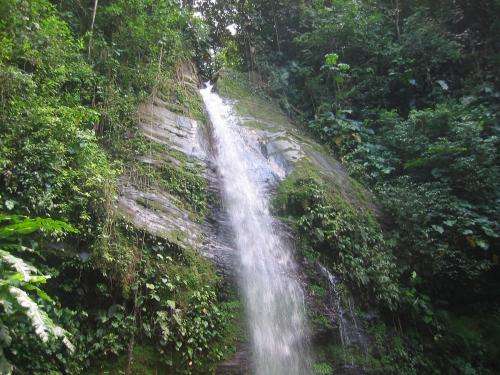
A stream drains a nitrogen-rich rainforest in the Northern Range of Trinidad. (Photo by Jack Brookshire).

The researchers also examined new samples that Brookshire collected in Costa Rica and Trinidad. Sampling was an exciting process that involved hiking through thick forests and swimming through narrow rock gorges, Brookshire said. He was able to avoid snake bites, but not the stinging insects or oppressive humidity.

"You don't dry out," Brookshire said.

The research team found high levels of nitrate in the streams of the tropical forests, indicating large losses of bioavailable nitrogen, Brookshire said. They also found evidence that the loss wasn't recent or a one-time thing. They discovered that the nitrate resulted from plant-soil interactions and not directly from atmospheric deposition.

Tropical forests are significant reservoirs for carbon, and their future relies on interactions with nutrient cycles, he said.

Scientists in the past have compared the effect of industry and agriculture on the temperate forests of the northern hemisphere, but relatively little research has been conducted on forests near the equator, Brookshire said. He decided to look at forests in Costa Rica and Trinidad because he already had colleagues there and they, like him, were intrigued by the fact that some tropical forests have dramatic nitrogen exports without apparent human causes.

"These systems have a natural capacity to build up levels of nitrates in soil that we only see in the most polluted temperate forests," Brookshire said.

The research published in Nature Geoscience will continue, Brookshire said.

"This is an on-going research project to figure out how forests work in the larger earth climate system and how they might respond to global change," Brookshire said. "The deep mysteries about how these ecosystems work, we are just beginning to understand. Things are much more complex than previously thought."

Co-authors on the Nature Geoscience paper were Lars Hedin and Daniel Sigman at Princeton University, and Denis Newbold and John Jackson from the Stroud Water Research Center. Their research was supported by grants from the A.W. Mellon Foundation, the National Science Foundation, the National Oceanic and Atmospheric Administration and research endowments at Stroud.

Provided by Montana State University search and more info website

4.8 /5 (6 votes)  

Filter


Move the slider to adjust rank threshold, so that you can hide some of the comments.


Display comments: newest first

Sean_W
Jan 16, 2012

Rank: not rated yet
Only a climate scientist would have trouble explaining where fixed nitrogen might come from without appealing to human pollution. Send these experts to a high school biology class.
Rank 4.8 /5 (6 votes)
Relevant PhysicsForums posts

More news stories

Land and sea species differ in climate change response: study

(Phys.org) -- Marine and terrestrial species will likely differ in their responses to climate warming, new research by Simon Fraser University and Australia’s University of Tasmania has found.

Space & Earth / Environment

created 4 hours ago | popularity 3.7 / 5 (3) | comments 5 | with audio podcast

Yale study concludes public apathy over climate change unrelated to science literacy

Are members of the public divided about climate change because they don't understand the science behind it? If Americans knew more basic science and were more proficient in technical reasoning, would public consensus match ...

Space & Earth / Environment

created 6 hours ago | popularity 4.8 / 5 (4) | comments 11 | with audio podcast

10 million years needed to recover from mass extinction

It took some 10 million years for Earth to recover from the greatest mass extinction of all time, latest research has revealed.

Space & Earth / Earth Sciences

created 6 hours ago | popularity 5 / 5 (3) | comments 1 | with audio podcast

Sophisticated simulations predict future warming

The chances of our planet being hit by a global warming of 3 degrees Celsius by 2050 is as likely as it being hit by an increase of 1.4 degrees, new research shows. Presented in the journal Nature Geoscience, the British study ...

Space & Earth / Earth Sciences

created May 22, 2012 | popularity 4.4 / 5 (9) | comments 51

Aliens don't want to eat us, says former SETI director

Alien life probably isn’t interested in having us for dinner, enslaving us or laying eggs in our bellies, according to a recent statement by former SETI director Jill Tarter.

Space & Earth / Space Exploration

created May 25, 2012 | popularity 4.4 / 5 (14) | comments 41


Stunning image of smallest possible five-ringed structure

Scientists have created and imaged the smallest possible five-ringed structure – about 100,000 times thinner than a human hair – and you'll probably recognise its shape.

'Unzipped' carbon nanotubes could help energize fuel cells, batteries

Multi-walled carbon nanotubes riddled with defects and impurities on the outside could replace some of the expensive platinum catalysts used in fuel cells and metal-air batteries, according to scientists at ...

Change in developmental timing was crucial in the evolutionary shift from dinosaurs to birds: study

At first glance, it's hard to see how a common house sparrow and a Tyrannosaurus Rex might have anything in common. After all, one is a bird that weighs less than an ounce, and the other is a dinosaur that ...

Computer model used to pinpoint prime materials for efficient carbon capture

When power plants begin capturing their carbon emissions to reduce greenhouse gases – and to most in the electric power industry, it's a question of when, not if – it will be an expensive undertaking.

T cells 'hunt' parasites like animal predators seek prey, study shows

By pairing an intimate knowledge of immune-system function with a deep understanding of statistical physics, a cross-disciplinary team at the University of Pennsylvania has arrived at a surprising finding: T cells use a movement ...

Scientists develop ultra-sensitive test that detects diseases in their earliest stages

Scientists have developed an ultra-sensitive test that should enable them to detect signs of a disease in its earliest stages, in research published today in the journal Nature Materials.