Slaves or not, Babylonians were like us, says book
January 6, 2012 By Linda B. Glaser
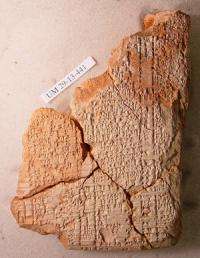
This is one of the cuneiform tablets that Jonathan Tenney, assistant professor of ancient Near Eastern studies, addresses in the new book, "Life at the Bottom of Babylonian Society: Servile Laborers at Nippur in the 14th and 13th Centuries, B.C." With the permission of the University of Pennsylvania Museum of Archaeology and Anthropology
(PhysOrg.com) -- They got married, had children, made beer. Although they lived 3,500 years ago in Nippur, Babylonia, in many ways they seem like us. Whether they were also slaves is a hotly contested question which Jonathan Tenney, assistant professor of ancient Near Eastern studies, addresses in the newly released "Life at the Bottom of Babylonian Society: Servile Laborers at Nippur in the 14th and 13th Centuries, B.C." (Brill).
The book is based on Tenney's dissertation at the University of Chicago, for which he received the 2010 Dissertation of the Year Award by the American Academic Research Institute in Iraq.
Some previous scholars identified the 8,000-strong group of government workers as temple employees. "But the problem is the records included food for little babies, which didn't make much sense," says Tenney, who joined the Cornell faculty this past fall. "And sometimes the workers ran away, and when they were captured they were put in prison."
Tenney translated more than 500 cuneiform tablets in his hunt for the truth about these weavers, musicians, "water sprinklers" and others in service to the governors of Nippur. By using quantitative measurements to create demographic data, he was able to look at population dynamics, family structure and the legal status of this population. He then compared the Babylonian group's demography with other better-studied groups, such as those in Roman Egypt, medieval Tuscany and on American slave plantations.
"Whether they're slaves is not what's valuable to me about this work," Tenney says. "The point is we don't have an historical demography of Babylonia at all. We don't even know how many people were living there at any given time." His book is the most detailed study yet done of any population group in Babylonia.
The picture Tenney draws of family life in this servile population is surprising in its mundanity. By far the majority of households were nuclear, husband-wife-children or a single parent with children, usually a widow, instead of slaves living together or in groups. Tenney was able to track some families for as long as 32 years.
"As you start to work with slavery you realize how many misconceptions we have," he says. "Being a slave doesn't necessarily mean you can't have a family life and raise children and develop your own individual culture and identity. I think that slavery and freedom exist on a continuum of varying degrees." He left it to his readers to decide where the Babylonians about whom he wrote fit on that continuum.
The tablets Tenney translated were excavated by scholars from the University of Pennsylvania in the 1890s in what is now Iraq; they are some of the earliest Babylonian texts ever found. Tenney will publish the raw data from his research in the forthcoming "Middle Babylonian Administrative and Legal Documents Concerning the Public Servile Population of Nippur."
Provided by
Cornell University
-
From lemons to lemonade: Reaction uses carbon dioxide to make carbon-based semiconductor,
32 comments
-
Thioridazine kills cancer stem cells in human while avoiding toxic side-effects of conventional cancer treatments,
3 comments
-
SpaceX private rocket blasts off for space station (Update),
42 comments
-
Climate scientists say they have solved riddle of rising sea,
31 comments
-
SpaceX capsule has 'new car' smell, astronauts say (Update),
4 comments
-
Interesting WWII Public INformation Leaflet
May 19, 2012
-
Treaty of the Pyrenees
May 08, 2012
- More from Physics Forums - History & Humanities
More news stories
Change in developmental timing was crucial in the evolutionary shift from dinosaurs to birds: study
At first glance, it's hard to see how a common house sparrow and a Tyrannosaurus Rex might have anything in common. After all, one is a bird that weighs less than an ounce, and the other is a dinosaur that ...
Other Sciences / Archaeology & Fossils
8 hours ago |
5 / 5 (6) |
0
|
Social welfare cuts ultimately come with heavy price, researchers say
(Phys.org) -- Slashing government funding for Medicaid, food stamps and other programs that serve the poor while politically popular with some lawmakers and many conservatives may do more harm ...
Other Sciences / Social Sciences
May 24, 2012 |
4.1 / 5 (22) |
155
Ancient Bethlehem seal unearthed in Jerusalem
Israeli archaeologists have discovered a 2,700-year-old seal that bears the inscription "Bethlehem," the Israel Antiquities Authority announced Wednesday, in what experts believe to be the oldest artifact ...
Other Sciences / Archaeology & Fossils
May 23, 2012 |
3.3 / 5 (15) |
24
Dollars and sense: Why are some people morally against tax?
As the U.S. presidential election campaigns heat up, the economic debate is dominated by bailouts, austerity and, inevitably, taxation. Now a new study published in Symbolic Interaction asks why tax is such an important issue ...
Other Sciences / Social Sciences
May 23, 2012 |
2.3 / 5 (3) |
19
Oldest Jewish archaeological evidence on the Iberian Peninsula
German archaeologists of the Friedrich Schiller University Jena found one of the oldest archaeological evidence so far of Jewish Culture on the Iberian Peninsula at an excavation site in the south of Portugal, ...
Other Sciences / Archaeology & Fossils
May 25, 2012 |
4.2 / 5 (6) |
12
Stunning image of smallest possible five-ringed structure
Scientists have created and imaged the smallest possible five-ringed structure about 100,000 times thinner than a human hair and you'll probably recognise its shape.
'Unzipped' carbon nanotubes could help energize fuel cells, batteries
Multi-walled carbon nanotubes riddled with defects and impurities on the outside could replace some of the expensive platinum catalysts used in fuel cells and metal-air batteries, according to scientists at ...
Computer model used to pinpoint prime materials for efficient carbon capture
When power plants begin capturing their carbon emissions to reduce greenhouse gases and to most in the electric power industry, it's a question of when, not if it will be an expensive undertaking.
T cells 'hunt' parasites like animal predators seek prey, study shows
By pairing an intimate knowledge of immune-system function with a deep understanding of statistical physics, a cross-disciplinary team at the University of Pennsylvania has arrived at a surprising finding: T cells use a movement ...
Land and sea species differ in climate change response: study
(Phys.org) -- Marine and terrestrial species will likely differ in their responses to climate warming, new research by Simon Fraser University and Australia’s University of Tasmania has found.
Yale study concludes public apathy over climate change unrelated to science literacy
Are members of the public divided about climate change because they don't understand the science behind it? If Americans knew more basic science and were more proficient in technical reasoning, would public consensus match ...
Jan 06, 2012
Rank: 2.5 / 5 (16)
I'm not saying it was right of course. We have such a black and white view of slavery nowadays but it was a different time back then and it is fascinating to discover the differences and the parallels to our culture today. Remember - a great man once said, "If we do not remember our past, we are condemned to repeat it."
Jan 06, 2012
Rank: 1.5 / 5 (22)
Jan 06, 2012
Rank: 4.7 / 5 (17)
NOT working and being supplied with the means to live at the existential minimum is not slavery.
Slavery is when people are treated as property and are forced to work.
Jan 06, 2012
Rank: 4.1 / 5 (11)
Which follows that slave owners argued because they own a the property (a slave), they are more likely to treat them better than someone who rents them as wage earners, essentially viewing them replaceable parts of a machine.
He was not defending slavery, merely stating how easily crude arguments can be twisted into being rational for one's own ends.
Jan 06, 2012
Rank: 3.7 / 5 (9)
Jan 06, 2012
Rank: 4 / 5 (4)
This would appear to be the opposite of slavery...
Jan 06, 2012
Rank: 1.6 / 5 (14)
They become dependent upon the state and must do what the state demands to live.
Jan 06, 2012
Rank: 1 / 5 (1)
Oh, now I understand what you meant.
Jan 06, 2012
Rank: 4.2 / 5 (5)
A taxpayer could be considered a slave of the state for a fraction of her time, based on her tax rate.
In North Korea, most of the population could be considered slaves of the state.
Jan 06, 2012
Rank: 1.3 / 5 (14)
1) the slavery that was prevalent in some parts of the southern states from the 1600s through the end of the Civil War and Reconstruction. This slavery was the outright ownership of one man over another. Not all white Southerners owned slaves, but there were some American Indian tribes who owned black slaves.
2) the slavery that the individual imposes on him/herself by refusal to take advantage of the education provided to young people by American taxpayers, so that the self-imposed slavery prevents the person from acquiring a better paying job to support himself and his family.
His/her slavery can also take the form of being enslaved to illegal drugs, alcohol, abnormal sex drive that may lead to rape and abuse. criminal behavior and many other abnormalities.
Jan 06, 2012
Rank: 1.3 / 5 (14)
4) the slavery of the poor who have been led to believe that they are ENTITLED to the taxpayers' money while not making an effort to find employment. They are enslaved because their "entitlements" are calculated to KEEP THEM DOWN, with no hope for advancement in life. They are enslaved to the idea that those who EARNED their money have no right to that money. And they are enslaved to the idea that without their welfare checks, they will starve to death.
They are also enslaved by the expectation of those Liberals/Socialists in power that the poor will consistently VOTE them into political office again and again. The threat of losing welfare checks keeps them loyal.
Jan 06, 2012
Rank: 4.7 / 5 (14)
No. They have the right to look for a job, leave the country, or xercise any and all rights that all other citizens have. Ther is no force here.
You are equating charity to slavery. Not even in the most twisted way does this make any sense.
Jan 07, 2012
Rank: 2 / 5 (15)
Charity is FREELY given not coerced by the state. Most people who receive charity understand they are not entitled and there is usually someone for them to thank.
Jan 07, 2012
Rank: 3 / 5 (6)
If you fail to pay the penalty, you may be prosecuted and if convicted ordered to pay a fine.
Jan 07, 2012
Rank: not rated yet
Jan 08, 2012
Rank: not rated yet
Likely, but not conclusive.