Researchers identify skull of South America's oldest predator
January 18, 2012 by Bob Yirka report

Researchers identify skull of South America's oldest predator

Enlarge

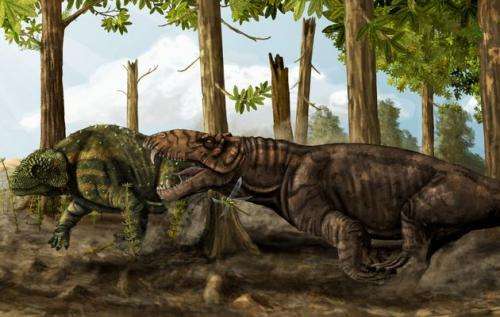
Pampaphoneus biccai, illustration. Image credit: Voltaire Neto / University of Witwatersrand

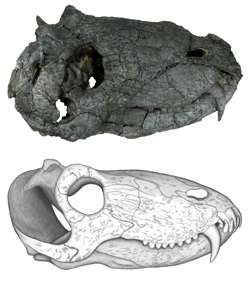
(PhysOrg.com) -- Back in 2008, budding paleontologists, Juan Cisneros and Cesar Schultz, still college students, found a skull in a part of Brazil known as the pampas region of Rio Grande do Sul. They’d decided to dig there after studying images from Google Earth.

Because is covered in so much vegetation, it’s difficult to find sites. Google Earth allows such researchers to see patches of open areas, so upon finding one, that’s where the team went. Afterwards, they took pictures of their find and sent them back to their professor at the University of Witwatersrand, in South Africa, which is a sort of hotbed for fossil study due to the large numbers of specimens found in an area nearby known as the Karoo. After much study, the two finders of the fossil and a team from Witwatersrand, will have their findings published in the , and report that they believe the once belonged to a creature called Pampaphoneus biccai and is related to an ancient reptile found in South Africa called Australosyodon.
Researchers identify skull of South America's oldest predator

The skull. Image credit: University of Witwatersrand

The name they’ve given it comes from pampas, the name of the open plains where the skull was found and the word for killer. Biccai comes from Bicca, the last name of the man who owned the land.

Because they have only a skull to work with, the team has had to use the remains of other similar ancient remains found in South Africa, Russia and China to deduce what the reptile might have looked like. They believe it falls into the class Dinocephalian therapsid (reptiles with some mammal characteristics) and was about the size of a leopard, cold blooded, and had powerful jaws that enabled it to rip flesh from prey it very likely caught. Also, they believe it lived somewhere around 265 million years ago, putting it before the dinosaurs, which meant it also lived in a time when the continents were joined which explains how it could be so similar to other therapsids found in Africa and Asia.

The team also believe Pampaphoneus biccai lived in herds because of footprint finds of relatives in South Africa. Scientists hope that the new find will help in plotting the migration of the ancient therapsids, which may help buffer arguments about the geography of the ancient continent known as Pangeae.

More information: Carnivorous dinocephalian from the Middle Permian of Brazil and tetrapod dispersal in Pangaea, PNAS, Published online before print January 17, 2012, doi: 10.1073/pnas.1115975109

Abstract
The medial Permian (∼270–260 Ma: Guadalupian) was a time of important tetrapod faunal changes, in particular reflecting a turnover from pelycosaurian- to therapsid-grade synapsids. Until now, most knowledge on tetrapod distribution during the medial Permian has come from fossils found in the South African Karoo and the Russian Platform, whereas other areas of Pangaea are still poorly known. We present evidence for the presence of a terrestrial carnivorous vertebrate from the Middle Permian of South America based on a complete skull. Pampaphoneus biccai gen. et sp. nov. was a dinocephalian “mammal-like reptile” member of the Anteosauridae, an early therapsid predator clade known only from the Middle Permian of Russia, Kazakhstan, China, and South Africa. The genus is characterized, among other features, by postorbital bosses, short, bulbous postcanines, and strongly recurved canines. Phylogenetic analysis indicates that the Brazilian dinocephalian occupies a middle position within the Anteosauridae, reinforcing the model of a global distribution for therapsids as early as the Guadalupian. The close phylogenetic relationship of the Brazilian species to dinocephalians from South Africa and the Russian Platform suggests a closer faunistic relationship between South America and eastern Europe than previously thought, lending support to a Pangaea B-type continental reconstruction.

Press release

Journal reference: Proceedings of the National Academy of Sciences search and more info website

© 2011 PhysOrg.com

4.8 /5 (5 votes)  

Filter


Move the slider to adjust rank threshold, so that you can hide some of the comments.


Display comments: newest first

Golden_Snow_Real
Jan 18, 2012

Rank: 3 / 5 (1)
nice
barakn
Jan 18, 2012

Rank: 5 / 5 (1)
A "herd" of predators? Perhaps "pride" or "pack" would be better words here.
tadchem
Jan 18, 2012

Rank: 4 / 5 (1)
"Pangeae"? I believe you mean "Pangea," since there was only one at the time.
Loodt
Feb 07, 2012

Rank: not rated yet
tadchem, maybe you were in a bit of a rush, as the article used the spelling pangaea.
Rank 4.8 /5 (5 votes)
Relevant PhysicsForums posts

More news stories

Change in developmental timing was crucial in the evolutionary shift from dinosaurs to birds: study

At first glance, it's hard to see how a common house sparrow and a Tyrannosaurus Rex might have anything in common. After all, one is a bird that weighs less than an ounce, and the other is a dinosaur that ...

Other Sciences / Archaeology & Fossils

created 8 hours ago | popularity 5 / 5 (6) | comments 0 | with audio podcast

Social welfare cuts ultimately come with heavy price, researchers say

(Phys.org) -- Slashing government funding for Medicaid, food stamps and other programs that serve the poor – while politically popular with some lawmakers and many conservatives – may do more harm ...

Other Sciences / Social Sciences

created May 24, 2012 | popularity 4.1 / 5 (22) | comments 155

Ancient Bethlehem seal unearthed in Jerusalem

Israeli archaeologists have discovered a 2,700-year-old seal that bears the inscription "Bethlehem," the Israel Antiquities Authority announced Wednesday, in what experts believe to be the oldest artifact ...

Other Sciences / Archaeology & Fossils

created May 23, 2012 | popularity 3.3 / 5 (15) | comments 24

Dollars and sense: Why are some people morally against tax?

As the U.S. presidential election campaigns heat up, the economic debate is dominated by bailouts, austerity and, inevitably, taxation. Now a new study published in Symbolic Interaction asks why tax is such an important issue ...

Other Sciences / Social Sciences

created May 23, 2012 | popularity 2.3 / 5 (3) | comments 19

Oldest Jewish archaeological evidence on the Iberian Peninsula

German archaeologists of the Friedrich Schiller University Jena found one of the oldest archaeological evidence so far of Jewish Culture on the Iberian Peninsula at an excavation site in the south of Portugal, ...

Other Sciences / Archaeology & Fossils

created May 25, 2012 | popularity 4.2 / 5 (6) | comments 12


Stunning image of smallest possible five-ringed structure

Scientists have created and imaged the smallest possible five-ringed structure – about 100,000 times thinner than a human hair – and you'll probably recognise its shape.

'Unzipped' carbon nanotubes could help energize fuel cells, batteries

Multi-walled carbon nanotubes riddled with defects and impurities on the outside could replace some of the expensive platinum catalysts used in fuel cells and metal-air batteries, according to scientists at ...

Computer model used to pinpoint prime materials for efficient carbon capture

When power plants begin capturing their carbon emissions to reduce greenhouse gases – and to most in the electric power industry, it's a question of when, not if – it will be an expensive undertaking.

T cells 'hunt' parasites like animal predators seek prey, study shows

By pairing an intimate knowledge of immune-system function with a deep understanding of statistical physics, a cross-disciplinary team at the University of Pennsylvania has arrived at a surprising finding: T cells use a movement ...

Land and sea species differ in climate change response: study

(Phys.org) -- Marine and terrestrial species will likely differ in their responses to climate warming, new research by Simon Fraser University and Australia’s University of Tasmania has found.

Yale study concludes public apathy over climate change unrelated to science literacy

Are members of the public divided about climate change because they don't understand the science behind it? If Americans knew more basic science and were more proficient in technical reasoning, would public consensus match ...