Scientists still searching for the Beagle 2 crash site on Mars
January 16, 2012 By Nancy Atkinson, Universe Today

Scientists Still Searching for the Beagle 2 Crash Site on Mars

Enlarge

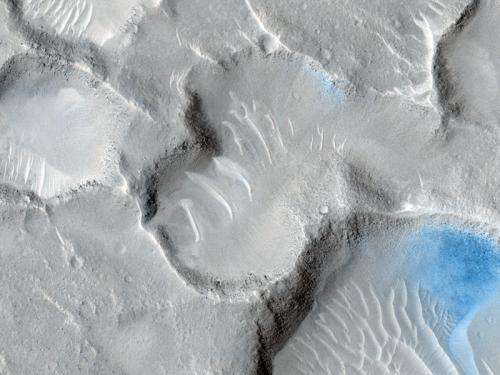
An image from the HiRISE camera of the Isidis basin region where the Beagle 2 lander was supposed to touch down. Credit: NASA/JPL/University of Arizona

Since its disappearance in December 2003, scientists and citizen scientists alike have continued the search for Europe’s Beagle 2 lander which likely crashed on Mars. Its disappearance is a mystery and if the spacecraft could be located, it might be possible to discover what went wrong.

The Mars Reconnaissance Orbiter’s powerful HiRISE camera has been regularly taking high-resolution images of the Isidis basin region where the Beagle 2 was supposed to touch down.

“Nothing resembling the Beagle lander has been seen in any of the HiRISE images, although we aren’t sure that they’ve been thoroughly searched,” said HiRISE Principal Investigator Alfred McEwen, writing on the HiRISE website.

So, join in the search and take a look!

Above is the 12th such image taken by HiRISE.

McEwen said the easiest thing to spot would be the bright parachute — if it actually deployed. Remember how HiRISE was able to find the parachutes at the MER landing sites, and even capture the Phoenix lander descending on its parachute? The Beagle 2’s parachute would be a good clue to search for.

Dust should not be a problem as far as hiding the lander or parachutes, McEwen said. “Dust deposition over the past eight years probably would not disguise the bright feature over equatorial regions of Mars,” he said noting that the parachutes are still easy to spot at the MER and Pathfinder landing sites. “At high latitudes the brightness patterns are reset each winter by the seasonal deposits of carbon-dioxide and dust, as seen at the Phoenix landing site.”

All contact with Beagle 2 was lost after its separation from the Express spacecraft, just six days before atmospheric entry. McEwen said the lack of telemetry on its way to the surface means there is little information about where the spacecraft may have landed on the surface, but searching in the region where it was expected to land is a good place to start.

More information: You can download high-resolution version of this image here.
For an idea of what the Beagle 2 hardware might look like, see this web page.

Source: Universe Today

Filter


Move the slider to adjust rank threshold, so that you can hide some of the comments.


Display comments: newest first

scidog
Jan 17, 2012

Rank: not rated yet
when photos like this are posted i wish that a well known object would be superimposed on them to give us an idea of what we are looking at.
Rank 5 /5 (3 votes)
Relevant PhysicsForums posts
  • Distance of planets from stars and revolution
    created8 hours ago
  • revamping general concept and cosmological principle
    createdMay 25, 2012
  • Transiting Exoplanet Light Curve
    createdMay 25, 2012
  • Math behind Theoretical Physics
    createdMay 24, 2012
  • Do we know whats at the center of galaxies yet?
    createdMay 23, 2012
  • Structure of the Milky Way?
    createdMay 20, 2012
  • More from Physics Forums - General Astronomy

More news stories

Land and sea species differ in climate change response: study

(Phys.org) -- Marine and terrestrial species will likely differ in their responses to climate warming, new research by Simon Fraser University and Australia’s University of Tasmania has found.

Space & Earth / Environment

created 6 hours ago | popularity 3.8 / 5 (4) | comments 5 | with audio podcast

Yale study concludes public apathy over climate change unrelated to science literacy

Are members of the public divided about climate change because they don't understand the science behind it? If Americans knew more basic science and were more proficient in technical reasoning, would public consensus match ...

Space & Earth / Environment

created 8 hours ago | popularity 4.8 / 5 (5) | comments 20 | with audio podcast

10 million years needed to recover from mass extinction

It took some 10 million years for Earth to recover from the greatest mass extinction of all time, latest research has revealed.

Space & Earth / Earth Sciences

created 8 hours ago | popularity 4 / 5 (4) | comments 1 | with audio podcast

Sophisticated simulations predict future warming

The chances of our planet being hit by a global warming of 3 degrees Celsius by 2050 is as likely as it being hit by an increase of 1.4 degrees, new research shows. Presented in the journal Nature Geoscience, the British study ...

Space & Earth / Earth Sciences

created May 22, 2012 | popularity 3.8 / 5 (11) | comments 51

Aliens don't want to eat us, says former SETI director

Alien life probably isn’t interested in having us for dinner, enslaving us or laying eggs in our bellies, according to a recent statement by former SETI director Jill Tarter.

Space & Earth / Space Exploration

created May 25, 2012 | popularity 4.4 / 5 (15) | comments 41


Stunning image of smallest possible five-ringed structure

Scientists have created and imaged the smallest possible five-ringed structure – about 100,000 times thinner than a human hair – and you'll probably recognise its shape.

'Unzipped' carbon nanotubes could help energize fuel cells, batteries

Multi-walled carbon nanotubes riddled with defects and impurities on the outside could replace some of the expensive platinum catalysts used in fuel cells and metal-air batteries, according to scientists at ...

Change in developmental timing was crucial in the evolutionary shift from dinosaurs to birds: study

At first glance, it's hard to see how a common house sparrow and a Tyrannosaurus Rex might have anything in common. After all, one is a bird that weighs less than an ounce, and the other is a dinosaur that ...

Computer model used to pinpoint prime materials for efficient carbon capture

When power plants begin capturing their carbon emissions to reduce greenhouse gases – and to most in the electric power industry, it's a question of when, not if – it will be an expensive undertaking.

T cells 'hunt' parasites like animal predators seek prey, study shows

By pairing an intimate knowledge of immune-system function with a deep understanding of statistical physics, a cross-disciplinary team at the University of Pennsylvania has arrived at a surprising finding: T cells use a movement ...

Scientists develop ultra-sensitive test that detects diseases in their earliest stages

Scientists have developed an ultra-sensitive test that should enable them to detect signs of a disease in its earliest stages, in research published today in the journal Nature Materials.