Soon for sale? Ethnic veggies like maxixe and shiso
January 12, 2012 By Aaron Munzer

Soon for sale? Ethnic veggies like maxixe and shiso

Enlarge

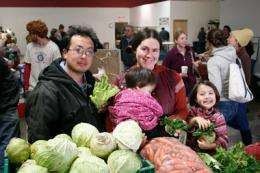
Chaw Chang and Lucy Garrison, owners of Stick and Stone Farm in Ulysses, N.Y., at the Ithaca Farmer's Market Winter Market with their children Ezra and Greta, and some of their Asian vegetable offerings, tat soi and napa cabbage. (Aaron Munzer)

Komatsuna. Shiso. Winged beans. Maxixe. They're not your garden-variety vegetables.

But while they may be relatively unknown outside of their home countries, a project by Cornell Cooperative Extension is trying to give these their time in the sun.

Extension associate Robert Hadad, who works with the Cornell Vegetable Program, is planning various trials of these and other crops in conjunction with growers in Monroe, Wayne and Ontario counties, in addition to extension-owned fields.

Successful outcomes could bring such unusual ethnic vegetables to farmers markets and dinner tables across the state and region. They would also offer a new option for locavores and a comforting, familiar one to , especially the fast-growing Asian and Latino communities.

"It's also for the Eastern European heritage community; Russians, Serbians, a lot of these people have been here for a number of years, but they're used to certain foods from their homeland that aren't usually available," Hadad said. "It's bringing local food closer to home for them."

Hadad is seeking to determine which vegetables can be grown in the Northeast's climate, how best to introduce the varieties to growers and how to get consumers to buy them.

To these ends, Hadad recently held a workshop in conjunction with associate professor Frank Mangan of the University of Massachusetts for local growers in Canandaigua that introduced them to the crops and allowed him to gauge interest in the idea.

Mangan has completed a number of field trials of Latino varieties that have seen success in Massachusetts farmers markets and Whole Food stores, including such crops as Brazilian squash and water spinach. Hadad said he will build on Mangan's research in choosing crops to experiment with in New York.

"He gave our growers a lot of inspiration about what's capable of being grown here," Hadad said.

Next up for Hadad is reaching out to the to let them know that a little taste from home thousands of miles away is being grown by the farmer down the road.

"If we can get a few people to come out, I'm sure word of mouth will be our biggest ally," he said.

Mangan said for New York farmers, the millions of Mexicans, Puerto Ricans, Guatemalans and Salvadorans present a profitable demographic. "These are relatively new immigrant groups, and there are tremendous opportunities to grow crops that they use. They don't eat sweet corn; they want grain corn or field corn," he said.

Ulysses-based farmers Lucy Garrison and Chaw Chang, who run Stick and Stone Farm, which sells certified organic vegetables through a community supported agriculture (CSA) program and at the Ithaca Farmers Market, have experimented with a number of ethnic vegetable varieties, mostly Asian greens.

Garrison said there are challenges marketing the unusual vegetables to consumers, but once they try them, either as part of a CSA share or as a sample of fresh kohlrabi at the market, they come back for more.

"At first we had a hard time selling tatsoi [spinach mustard] or napa cabbage to anyone else but ethnic Chinese people in the summer, but at winter market, people were more brave about trying something when there weren't as many choices. Now we're selling a lot more of those things in the fall," Garrison said.

Garrison and Chang have been so successful selling Asian crops that they are planning an Asian vegetable CSA share, intended to serve the large Asian student population at Cornell, in addition to faculty members.

Provided by Cornell University search and more info website

Filter


Move the slider to adjust rank threshold, so that you can hide some of the comments.


Display comments: newest first

Isaacsname
Jan 12, 2012

Rank: not rated yet
A fair bit of " Asian " greens can be direct-sown into a prepared bed for " cut-and-come-again " crops.

Here's a good tip:

When your garlic plants set flower ( The tops form a curlie cue ) you can snap the tops off and eat them, I forget the various names for the dish ( sum yao ? ) absolutely delish, like garlicky asparagus. Also forces your garlic bulbs to get bigger, win-win.
Rank 4 /5 (1 vote)
Relevant PhysicsForums posts

More news stories

Manufacturing genes to attack flu virus

An international research team has manufactured a new protein that can combat deadly flu epidemics.

Biology / Biotechnology

created 8 hours ago | popularity not rated yet | comments 0 | with audio podcast

Scientist: Evolution debate will soon be history

(AP) -- Richard Leakey predicts skepticism over evolution will soon be history. Not that the avowed atheist has any doubts himself.

Biology / Evolution

created May 26, 2012 | popularity 3.4 / 5 (21) | comments 97

More plant species responding to global warming than previously thought

(Phys.org) -- Far more wild plant species may be responding to global warming than previous large-scale estimates have suggested.

Biology / Ecology

created May 22, 2012 | popularity 4.6 / 5 (14) | comments 18 | with audio podcast

For monogamous sparrows, it doesn't pay to stray (but they do it anyway)

It's quite common for a female song sparrow to stray from her breeding partner and mate with the male next door, but a new study shows that sleeping around can be costly.

Biology / Plants & Animals

created May 22, 2012 | popularity 5 / 5 (2) | comments 8 | with audio podcast

Thousands of shellfish found dead in Peru

Thousands of crustaceans were found dead off the coast of Lima following the mystery mass death of dolphins and pelicans, the Peruvian Navy said Friday.

Biology / Ecology

created May 26, 2012 | popularity 4.7 / 5 (7) | comments 7


Stunning image of smallest possible five-ringed structure

Scientists have created and imaged the smallest possible five-ringed structure – about 100,000 times thinner than a human hair – and you'll probably recognise its shape.

'Unzipped' carbon nanotubes could help energize fuel cells, batteries

Multi-walled carbon nanotubes riddled with defects and impurities on the outside could replace some of the expensive platinum catalysts used in fuel cells and metal-air batteries, according to scientists at ...

Change in developmental timing was crucial in the evolutionary shift from dinosaurs to birds: study

At first glance, it's hard to see how a common house sparrow and a Tyrannosaurus Rex might have anything in common. After all, one is a bird that weighs less than an ounce, and the other is a dinosaur that ...

Computer model used to pinpoint prime materials for efficient carbon capture

When power plants begin capturing their carbon emissions to reduce greenhouse gases – and to most in the electric power industry, it's a question of when, not if – it will be an expensive undertaking.

T cells 'hunt' parasites like animal predators seek prey, study shows

By pairing an intimate knowledge of immune-system function with a deep understanding of statistical physics, a cross-disciplinary team at the University of Pennsylvania has arrived at a surprising finding: T cells use a movement ...

Land and sea species differ in climate change response: study

(Phys.org) -- Marine and terrestrial species will likely differ in their responses to climate warming, new research by Simon Fraser University and Australia’s University of Tasmania has found.