Ruthless boas know when to ditch their squeeze
January 18, 2012

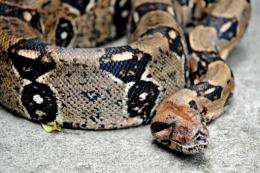
Boa constrictors can sense the heartbeat of their quarry as they suffocate it

Enlarge

Boa constrictors can sense the heartbeat of their quarry as they suffocate it, thus giving themselves the signal to know when the prey is dead, scientists say.

Boa constrictors can sense the heartbeat of their quarry as they suffocate it, thus giving themselves the signal to know when the prey is dead, scientists say.

In a study published on Wednesday in the journal Biology Letters, snake experts at Dickinson College in Carlisle, Pennsylvania pondered how the boa can tell when its target is lifeless and can then be swallowed.

Timing the constriction is vital for these snakes.

Squeezing is a huge drain on their energy reserves, for their rises sevenfold during the operation. And while they are coiled around the prey, they themselves are vulnerable to other predators.

The team used a clever idea -- "warm cadaveric " -- to monitor the boas.

These were that had been humanely killed, frozen and then re-warmed to 38 degrees Celsius (100.4 degrees Fahrenheit) using an electric blanket.

The rodents' bodies were then fitted with two tiny gauges: a sensor to monitor external pressure and a replica heart, comprising a water-filled bulb that was connected by a tube to an external pump, which imitated a heartbeat.

Primed for action, the hi-tech rats were placed within striking range of seven captive-born snakes which had never been exposed to live prey and nine wild-caught counterparts.

The herpetologists carried out three experiments, each time controlling the rat's fake heartbeat, to see how long the boa kept up its squeeze.

When they shut off the heartbeat for 10 minutes, the snakes continued their constriction for another seven minutes or so and then released the rat, presuming it to be dead.

But snakes confronted with a rat with a continuously beating heartbeat doubled the pressure and kept up the squeeze for around 22 minutes.

This is a phenomenal achievement, and the longest ever observed for any snake, says the paper.

Rats without a heartbeat were constricted for about 12 minutes on average. But the snake notably did not adjust its coils or apply periodic bursts of pressure, as it did with rats with a beating heart.

Overall, wild snakes were cannier about how long and how much to squeeze.

"Our findings suggest that the ability to respond to a is innate, whereas the magnitude of the response is guided by experience," says the study.

"We suggest that the capacity to improve performance through learning enables to become efficient predators of variable and unpredictable prey animals."

(c) 2012 AFP


Rank 5 /5 (1 vote)
Relevant PhysicsForums posts

More news stories

Manufacturing genes to attack flu virus

An international research team has manufactured a new protein that can combat deadly flu epidemics.

Biology / Biotechnology

created 8 hours ago | popularity not rated yet | comments 0 | with audio podcast

Scientist: Evolution debate will soon be history

(AP) -- Richard Leakey predicts skepticism over evolution will soon be history. Not that the avowed atheist has any doubts himself.

Biology / Evolution

created May 26, 2012 | popularity 3.4 / 5 (21) | comments 97

More plant species responding to global warming than previously thought

(Phys.org) -- Far more wild plant species may be responding to global warming than previous large-scale estimates have suggested.

Biology / Ecology

created May 22, 2012 | popularity 4.6 / 5 (14) | comments 18 | with audio podcast

For monogamous sparrows, it doesn't pay to stray (but they do it anyway)

It's quite common for a female song sparrow to stray from her breeding partner and mate with the male next door, but a new study shows that sleeping around can be costly.

Biology / Plants & Animals

created May 22, 2012 | popularity 5 / 5 (2) | comments 8 | with audio podcast

Thousands of shellfish found dead in Peru

Thousands of crustaceans were found dead off the coast of Lima following the mystery mass death of dolphins and pelicans, the Peruvian Navy said Friday.

Biology / Ecology

created May 26, 2012 | popularity 4.7 / 5 (7) | comments 7


Stunning image of smallest possible five-ringed structure

Scientists have created and imaged the smallest possible five-ringed structure – about 100,000 times thinner than a human hair – and you'll probably recognise its shape.

'Unzipped' carbon nanotubes could help energize fuel cells, batteries

Multi-walled carbon nanotubes riddled with defects and impurities on the outside could replace some of the expensive platinum catalysts used in fuel cells and metal-air batteries, according to scientists at ...

Change in developmental timing was crucial in the evolutionary shift from dinosaurs to birds: study

At first glance, it's hard to see how a common house sparrow and a Tyrannosaurus Rex might have anything in common. After all, one is a bird that weighs less than an ounce, and the other is a dinosaur that ...

Computer model used to pinpoint prime materials for efficient carbon capture

When power plants begin capturing their carbon emissions to reduce greenhouse gases – and to most in the electric power industry, it's a question of when, not if – it will be an expensive undertaking.

T cells 'hunt' parasites like animal predators seek prey, study shows

By pairing an intimate knowledge of immune-system function with a deep understanding of statistical physics, a cross-disciplinary team at the University of Pennsylvania has arrived at a surprising finding: T cells use a movement ...

Land and sea species differ in climate change response: study

(Phys.org) -- Marine and terrestrial species will likely differ in their responses to climate warming, new research by Simon Fraser University and Australia’s University of Tasmania has found.