Juvenile predation preventing Steller sea lion recovery
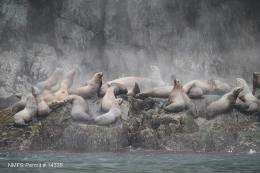
A new study suggests that the impact of predation on juvenile Steller sea lions in the Gulf of Alaska has been significantly underestimated, creating a "productivity pit" from which their population will have difficulty recovering without a reduction of predators.
Scientists using "life history transmitters" to study Steller sea lions found evidence of age-structured predation by orcas (killer whales) and other large predators in Alaska's Prince William Sound and adjacent areas, which may change with the population density of the sea lions.
Results of the study are being published this week in the journal PLoS ONE.
"It is generally accepted that most pinniped populations suffer from high attrition in the juvenile years, but this study suggests that predation accounts for most, if not all of this attrition in the case of Steller sea lions," said Markus Horning, an Oregon State University marine mammal expert and lead author on the study.
"The focus of predators on juveniles has the end result of heavily capping female recruitment – or the number of females that survive until they are old enough to have pups," Horning added.
Previous studies have pointed to a reduction of birth rates as a possible explanation for the decline of Steller sea lions in Alaska. But the newly published study by Horning, who works at OSU's Hatfield Marine Science Center in Newport, Ore., and Jo-Ann Mellish of the Alaska Sea Life Center and the University of Alaska Fairbanks, counters that and suggests that predators increasingly are targeting younger Steller sea lions as populations of the marine mammal decrease – reducing the numbers of potential breeding females.
The end result may be the same: Not enough Steller sea lions are being born each year to rejuvenate the population, which has declined by 80 percent over the past four decades.
However, the mechanisms for such a deficit in newborn pups may be different, Horning says. Previous studies suggest that reduced birth rates are a result of episodic changes in the ocean that affect feeding, growth and reproduction. Other factors known to affect sea lions – including mortality from fishing gear, ship strikes, and legal and illegal hunting – typically affect survival, but rarely result in a lower birth rate.
Predation, on the other hand, may be preventing too many juveniles from reaching breeding age, the study concludes. Orcas are the most common predators of Steller sea lions, though salmon sharks and Pacific sleeper sharks also are known predators, and great whites are suspected.
To measure mortality and predation among western Steller sea lions, the researchers deployed specialized transmitters in 36 juvenile sea lions from 2005 to 2011 in the Kenai Fjords and Prince William Sound region of the Gulf of Alaska. The abdominally implanted archival tags are designed to record data on temperature, light and other properties during the sea lions' lives, and after the animals die, transmit data to satellites.
These unique buoyant tags are liberated from decomposing or dismembered carcasses after death, or are passed through the digestive tract of predators, and float to the surface or rest ashore, according to Horning, an investigator with OSU's Marine Mammal Institute.
"The transmitters are amazing recorders of the life history of the animals, and can tell us in most cases how they died," Horning said. "Gradual cooling and delayed extrusion are signs of a non-traumatic death, say disease or starvation, or of entanglement, drowning or shooting. When the sensors record precipitous drops in ambient temperature along with immediate sensing of light and the onset of data transmission, it is indicative of acute death by massive trauma – usually associated with dismemberment by predators."
Horning said other traumatic deaths, including ship strikes and shooting should leave a different "signature" on the recorders and are unlikely to result in the immediate extrusion of the tags.
During the study period, 12 of the animals died and at least 11 of those deaths were by predation, the researchers noted. Once they established a rate of predation-related deaths, the researchers applied that to a new population model of Steller sea lions and discovered that such a high rate of predation among juveniles could make it impossible for the population to recover without a lessening of predation.
Previous research has shown that an adult killer whale, from a purely caloric standpoint, would need to consume 2-3 Steller sea lions pups per day to exist, or one adult female sea lion every two to three days. The new population model developed by Horning suggests that as Steller populations decrease, predators may be targeting more juveniles.
"Young sea lions spend more time close to shore and the haul-outs where they are suckled by their mothers," said Horning, an associate professor of fisheries and wildlife at OSU. "They can be found more predictably by predators than can older animals and adult males."
"As the density of more 'profitable' adults declines, more juveniles may be targeted and never grow to adulthood, which makes rebuilding their populations problematic," Horning added. "Unless predation is lessened, it appears they are in a productivity pit."
The model suggests that at the highest abundance (such as before the decline began four decades ago), pups comprise 7 percent of all predation events, juveniles 46 percent, and adults 47 percent. But when overall populations decline to a level of 20 percent (which is the current level for the western stock), pups comprise 23 percent of the mortality, juveniles 72 percent, and adults just 5 percent.
"This changeover strongly suggests an age-structure density dependence in predation rates," the authors wrote.
Provided by Oregon State University


