Insects top latest inventory of newly discovered species
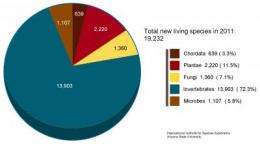
More than half of the 19,232 species newly known to science in 2009, the most recent calendar year of compilation, were insects – 9,738 or 50.6 percent – according to the 2011 State of Observed Species (SOS) report released Jan. 18 by the International Institute for Species Exploration at Arizona State University.
The second largest group in the 2009 numbers was vascular plants, totaling 2,184 or 11.3 percent. Of the 19,232 in the total count, seven were birds, 41 were mammals and 1,487 were arachnids – spiders and mites.
And, according to this latest report, there was a 5.6 percent increase in new living species discovered in 2009, compared to 2008.
The annual SOS report card on the status of human knowledge of Earth's species summarizes what is known about global flora and fauna. The 19,232 species described as "new" or newly discovered during calendar year 2009 represent about twice as many species as were known in the lifetime of Carolus Linnaeus, the Swedish botanist who initiated the modern system of plant and animal names and classifications more than 250 years ago, said the report's author, Quentin Wheeler, an ASU entomologist and founding director of the species institute.
"The cumulative knowledge of species since 1758 when Linnaeus was alive is nearly 2 million, but much remains to be done," Wheeler said. "A reasonable guess is that 10 million additional plant and animal species await discovery by scientists and amateur species explorers."
Additionally, recent macrogenomic surveys of DNA from terrestrial and marine environments have revealed "enormous and previously unsuspected levels of genetic diversity that corresponds in some not-yet-understood way to species diversity," explained Wheeler.
"It has been speculated, for example, that marine microbial species alone could number 20 million," he said.
With those staggering numbers as a backdrop, statistics, or "species bites," from the latest report note that:
- Almost 24 percent of the new vascular plant species discovered in 2009 were in the monocot order Asparagales, which includes orchids, hyacinths, irises, daffodils, amaryllis, allium, aloe and, of course, asparagus.
- Year to year, the largest order of newly discovered insects is the beetles, and, 2009 was no exception. Overall, 3,485 new beetle species (Coleoptera) were officially described including rove beetles (568), ground beetles (421), long-horned beetles (369), leaf beetles (356) and scarabs (288).
- Only 41 new living mammal species were officially described in 2009 and of those, 83 percent were either bats (44 percent) or rodents (39 percent).
- Almost 90 percent (133) of the new living amphibian species described in 2009 were frogs.
- There was almost five times more fossil bird species (34) newly described in 2009 than living birds (seven).
- Typical of most years, the largest number of new fish species was in the order Perciformes and 29 percent of those were in the families Gobiidaw (22) and Cichlidae (11). Gobies include some of the tiniest fish on Earth, and the cichlids include some of the most popular aquarium fish, including the angelfish and damselfish.
- Of the 626 newly described living crustacean species, 224 (31.8 percent) were in the order Decapoda, which includes crayfish, crabs, lobsters, prawns and shrimp.
- The Colubridae is the largest family of snakes and in 2009, almost 65 percent of the newly described living snakes were colubrids. In addition to 31 new snakes, new reptile species (living) included 38 lizards, 29 geckos, 12 iguanas, five chameleons and two turtles.
- More than 13 percent of the new fungus species (living) described in 2009 were gilled mushrooms in the order Agaricales (178). Of the mushrooms, more than one-fifth (21.3 percent) were in the family Marasmiaceae, which includes shiitake mushrooms.
"As the number of species increases, so too does our understanding of the biosphere," said Wheeler, a professor in the School of Sustainability and a Senior Sustainability Scientist in the Global Institute of Sustainability at ASU. "It is through knowledge of the unique attributes of species that we illuminate the origin and evolutionary history of life on our planet. As we find out where species live and how they interact, we increase our ability to understand the function of ecosystems and make effective, fact-based decisions regarding conservation."
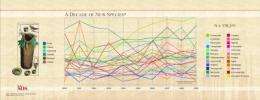
This is the fourth year for the annual State of Observed Species report compiled by the International Institute for Species Exploration. In addition to the 2011 report, the institute is also releasing a Retro SOS – a decade of species discovery in review – 2000-2009. The Retro SOS notes that from 2000 through 2009, there were 176,311 newly discovered species.
"It is particularly instructive to understand the tempo and patterns of discovery in recent years," said Wheeler, adding, "Given this data, it is interesting to ponder underlying causes of trends."
The "obvious lesson" from compiling this data, according to Wheeler, is that all nomenclatural acts, including descriptions of new species, must be mandatorily registered going forward. "In the animal world it takes about two years to mine the international literature for evidence of newly named species. The current lack of registration requirements simply compounds the problem of an already massive backlog," he said.
The report notes there are increasing calls for more aggressive and visionary approaches to mapping the species of the biosphere. "The adaptation of cyberinfrastructure to eliminate bottlenecks in the practice of taxonomy has created an opportunity to vastly accelerate species exploration," said Wheeler, who uses the SOS report and the annual naming of the top 10 new species each May, as ways to draw attention to this mission.
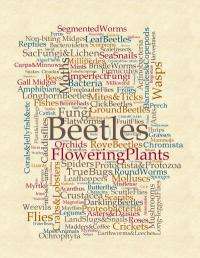
The SOS report and the Retro SOS are filled with statistics and charts, including a colorful word cloud. Sara Pennak, assistant director for partnerships and public outreach at the institute, prepared the data synthesis and analysis for the reports, which are available online at http://species.asu.edu.
Partners in this effort include: Algae Base. MycoBank, International Journal of Systematic and Evolutionary Microbiology, World Register of Marine Species (WoRMS), Thomson Reuters Zoological Record, International Plant Names Index, UniProt and Taxatoy.
Provided by Arizona State University


