Gadget Watch: Control a PC with body motions
January 13, 2012 By PETER SVENSSON , AP Technology Writer

Gadget Watch: Control a PC with body motions (AP)

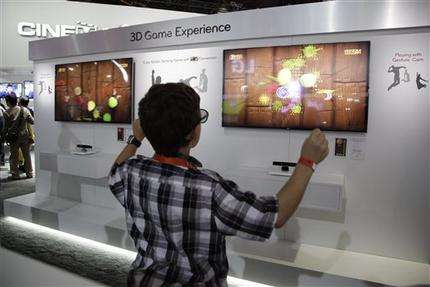
In this Jann. 11, 2012 file photo, a boy plays with a motion sensing 3D version of the video game Fruit Ninja at the LG exhibit at the 2012 International CES tradeshow, in Las Vegas. (AP Photo/Julie Jacobson)

(AP) -- Don't trash your keyboard and mouse just yet. But three companies at the International Consumer Electronics Show demonstrated depth-sensing cameras that let you to control your computer by moving your hands or body.

Microsoft's Kinect add-on for the console has already popularized these cameras for gaming. Now, the technology is being set loose for use on other devices. However, like many gadgets shown at the annual Las Vegas-based extravaganza of phones, PCs and TVs, the cameras aren't quite ready for the mass market.

The companies showed off their cameras to give and a chance to work with the technology and incorporate it in their products. For the rest of us, it's a taste of what the future might hold.

WHY IT'S HOT: The cameras represent another challenge to the keyboard-and-mouse regime, which is already being eroded by touch screens. If you're in front of a depth-sensing camera, you don't have to touch the screen to control it with your fingers or hands. (This works with non-depth-sensing cameras as well, but they're not as good at figuring out what you're doing.) At the PrimeSense booth, visitors could browse and play the contents of a digital video library with - basically, anything you'd do with a mouse today. The Israeli company's camera goes into the Kinect and is now sold separately as the Asus Xtion.

BEHIND THE LENS: The cameras can tell how far away things are in their . PrimeSense does this by sending out an invisible pattern of light, and registering how it's deformed when it hits objects. SoftKinetics' camera works almost like radar, but with light: it sends out and measures how fast it comes back. Where it takes longer, it figures out that that part of the image is further away.

THE DOWNSIDE: If you buy one of these now, there isn't much you can do with it, unless you're a software developer. The Asus Xtion comes with a few simple Kinect-like games for your PC. For all of these cameras, the depth-sensing range is limited to about 12 feet, and at the far end of the range, accuracy is reduced. That means finger gestures may not be picked up from across the living room.

AVAILABILITY: Microsoft said it will start selling a "Kinect for Windows" camera starting Feb. 1st, for $249. Asus started selling the Xtion in December for $149. SoftKinetics, a Belgian company, started selling its camera around the same time for $499.

©2012 The Associated Press. All rights reserved. This material may not be published, broadcast, rewritten or redistributed.


Rank not rated yet
Relevant PhysicsForums posts

More news stories

Browser wars flare in mobile space

The browser wars are heating up again, but this time the fight is for dominance of the mobile Internet.

Technology / Software

created 14 hours ago | popularity 5 / 5 (2) | comments 3

Probability of contamination from severe nuclear reactor accidents is higher than expected: study

Catastrophic nuclear accidents such as the core meltdowns in Chernobyl and Fukushima are more likely to happen than previously assumed. Based on the operating hours of all civil nuclear reactors and the number ...

Technology / Energy & Green Tech

created May 22, 2012 | popularity 3.6 / 5 (25) | comments 56 | with audio podcast

HyperSolar shows dirty water no barrier to power world

(Phys.org) -- The Santa Barbara, California, company, HyperSolar, is set to transparently share the ups and downs of its research experiences toward the company’s ultimate vision, successfully producing ...

Technology / Energy & Green Tech

created May 24, 2012 | popularity 4.8 / 5 (16) | comments 17 | with audio podcast report

SpotterRF debuts Radar Backpack Kit (w/ Video)

(Phys.org) -- SpotterRF has announced a special radar backpack kit designed to enhance situational awareness for soldiers on the ground. The company says its special radar is designed for warfighters as part ...

Technology / Hi Tech & Innovation

created May 26, 2012 | popularity 5 / 5 (5) | comments 13 | with audio podcast report

Tesla to launch electric sedan in US on June 22

Tesla Motors said Tuesday it would begin deliveries of "the world's first premium electric sedan" on June 22, slightly ahead of schedule.

Technology / Energy & Green Tech

created May 22, 2012 | popularity 4.5 / 5 (12) | comments 18


Stunning image of smallest possible five-ringed structure

Scientists have created and imaged the smallest possible five-ringed structure – about 100,000 times thinner than a human hair – and you'll probably recognise its shape.

'Unzipped' carbon nanotubes could help energize fuel cells, batteries

Multi-walled carbon nanotubes riddled with defects and impurities on the outside could replace some of the expensive platinum catalysts used in fuel cells and metal-air batteries, according to scientists at ...

Change in developmental timing was crucial in the evolutionary shift from dinosaurs to birds: study

At first glance, it's hard to see how a common house sparrow and a Tyrannosaurus Rex might have anything in common. After all, one is a bird that weighs less than an ounce, and the other is a dinosaur that ...

Computer model used to pinpoint prime materials for efficient carbon capture

When power plants begin capturing their carbon emissions to reduce greenhouse gases – and to most in the electric power industry, it's a question of when, not if – it will be an expensive undertaking.

T cells 'hunt' parasites like animal predators seek prey, study shows

By pairing an intimate knowledge of immune-system function with a deep understanding of statistical physics, a cross-disciplinary team at the University of Pennsylvania has arrived at a surprising finding: T cells use a movement ...

Land and sea species differ in climate change response: study

(Phys.org) -- Marine and terrestrial species will likely differ in their responses to climate warming, new research by Simon Fraser University and Australia’s University of Tasmania has found.