New frog species is world's smallest vertebrate
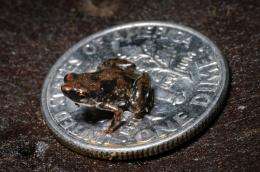
This is a photograph of a paratype of P. amanuensis (LSUMZ 95004) on a US dime (diameter 17.91 mm). Credit: Rittmeyer EN, et al. doi:10.1371/journal.pone.0029797
LSU's Chris Austin recently discovered two new species of frogs in New Guinea, one of which is now the world's tiniest known vertebrate, averaging only 7.7 millimeters in size less than one-third of an inch. It ousts Paedocypris progenetica, an Indonesian fish averaging more than 8 millimeters, from the record. Austin, leading a team of scientists from the United States including LSU graduate student Eric Rittmeyer, made the discovery during a three-month long expedition to the island of New Guinea, the world's largest and tallest tropical island.
"It was particularly difficult to locate Paedophryne amauensis due to its diminutive size and the males' high pitched insect-like mating call," said Austin. "But it's a great find. New Guinea is a hotspot of biodiversity, and everything new we discover there adds another layer to our overall understanding of how biodiversity is generated and maintained."
Austin, curator of herpetology at LSU's Museum of Natural Science and associate professor of biological sciences, is no stranger to discovering new species, having described numerous species previously unknown to science, including frogs, lizards and parasites.
These most recent species descriptions, which will be published in PLoS ONE on Jan. 11, highlight an interesting trend among the discovery of extremely small vertebrates. The research was supported by the National Science Foundation.
"The size limit of vertebrates, or creatures with backbones, is of considerable interest to biologists because little is understood about the functional constraints that come with extreme body size, whether large or small," said Austin.
With more than 60,000 vertebrates currently known to man, the largest being the blue whale with an average size of more than 25 meters (75 feet) and the smallest previously being a small Indonesian fish averaging around 8 millimeters, there was originally some thought that extreme size in vertebrates might be associated with aquatic species, as perhaps the buoyancy offers support and facilitates the development of extremism. However, both new species of frogs Austin described are terrestrial, suggesting that living in water is not necessary for small body size.
"The ecosystems these extremely small frogs occupy are very similar, primarily inhabiting leaf litter on the floor of tropical rainforest environments," said Austin. "We now believe that these creatures aren't just biological oddities, but instead represent a previously undocumented ecological guild they occupy a habitat niche that no other vertebrate does."
More information: Rittmeyer EN, Allison A, Gru¨ ndler MC, Thompson DK, Austin CC (2012) Ecological Guild Evolution and the Discovery of the World's Smallest Vertebrate. PLoS ONE 7(1): e29797. doi:10.1371/journal.pone.0029797
Journal reference:
PLoS ONE
Provided by
Louisiana State University
-
From lemons to lemonade: Reaction uses carbon dioxide to make carbon-based semiconductor,
32 comments
-
Thioridazine kills cancer stem cells in human while avoiding toxic side-effects of conventional cancer treatments,
3 comments
-
SpaceX private rocket blasts off for space station (Update),
42 comments
-
Climate scientists say they have solved riddle of rising sea,
31 comments
-
SpaceX capsule has 'new car' smell, astronauts say (Update),
4 comments
-
What would stain as translucent on light-coloured fabric?
May 26, 2012
-
How do I identify different bacteria on culture plates?
May 26, 2012
-
Why Do Dogs do Strange things...
May 25, 2012
-
What does exophillic and endophillic mean in terms of mosquito and their control?
May 24, 2012
-
Semen stains glows under black lights (uv light)?
May 23, 2012
-
Question on Human Chromosome 2
May 23, 2012
- More from Physics Forums - Biology
More news stories
Manufacturing genes to attack flu virus
An international research team has manufactured a new protein that can combat deadly flu epidemics.
7 hours ago |
not rated yet |
0
|
Scientist: Evolution debate will soon be history
(AP) -- Richard Leakey predicts skepticism over evolution will soon be history. Not that the avowed atheist has any doubts himself.
May 26, 2012 |
3.5 / 5 (20) |
93
More plant species responding to global warming than previously thought
(Phys.org) -- Far more wild plant species may be responding to global warming than previous large-scale estimates have suggested.
May 22, 2012 |
4.6 / 5 (14) |
18
|
For monogamous sparrows, it doesn't pay to stray (but they do it anyway)
It's quite common for a female song sparrow to stray from her breeding partner and mate with the male next door, but a new study shows that sleeping around can be costly.
May 22, 2012 |
5 / 5 (2) |
8
|
Thousands of shellfish found dead in Peru
Thousands of crustaceans were found dead off the coast of Lima following the mystery mass death of dolphins and pelicans, the Peruvian Navy said Friday.
May 26, 2012 |
4.7 / 5 (7) |
7
Stunning image of smallest possible five-ringed structure
Scientists have created and imaged the smallest possible five-ringed structure about 100,000 times thinner than a human hair and you'll probably recognise its shape.
'Unzipped' carbon nanotubes could help energize fuel cells, batteries
Multi-walled carbon nanotubes riddled with defects and impurities on the outside could replace some of the expensive platinum catalysts used in fuel cells and metal-air batteries, according to scientists at ...
Change in developmental timing was crucial in the evolutionary shift from dinosaurs to birds: study
At first glance, it's hard to see how a common house sparrow and a Tyrannosaurus Rex might have anything in common. After all, one is a bird that weighs less than an ounce, and the other is a dinosaur that ...
Computer model used to pinpoint prime materials for efficient carbon capture
When power plants begin capturing their carbon emissions to reduce greenhouse gases and to most in the electric power industry, it's a question of when, not if it will be an expensive undertaking.
T cells 'hunt' parasites like animal predators seek prey, study shows
By pairing an intimate knowledge of immune-system function with a deep understanding of statistical physics, a cross-disciplinary team at the University of Pennsylvania has arrived at a surprising finding: T cells use a movement ...
Land and sea species differ in climate change response: study
(Phys.org) -- Marine and terrestrial species will likely differ in their responses to climate warming, new research by Simon Fraser University and Australia’s University of Tasmania has found.
Jan 11, 2012
Rank: 4.7 / 5 (3)
Still I guess it died for a good cause, a neat photograph that made the researcher feel good.
Jan 12, 2012
Rank: 5 / 5 (2)
Given that upon collecting a new spcies there's usually a host of lethal stuff being done to them (dissections, prepartions for exhibitions and whatnot) I think that is a pretty small concern.
Jan 12, 2012
Rank: not rated yet
Jan 12, 2012
Rank: not rated yet