Electronic tattoo monitors brain, heart and muscles (w/ video)
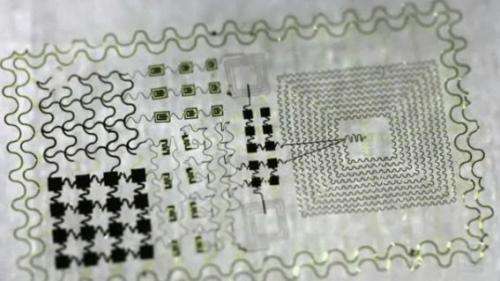
Imagine if there were electronics able to prevent epileptic seizures before they happen. Or electronics that could be placed on the surface of a beating heart to monitor its functions. The problem is that such devices are a tough fit. Body tissue is soft and pliable while conventional circuits can be hard and brittle--at least until now.
"We're trying to bridge that gap, from silicon, wafer-based electronics to biological, 'tissue-like' electronics, to really blur the distinction between electronics and the body," says materials scientist John Rogers at the University of Illinois Urbana-Champaign.
With support from the National Science Foundation (NSF), he's developing elastic electronics. The innovation builds upon years of collaboration between Rogers and Northwestern University engineer Yonggang Huang, who had earlier partnered with Rogers to develop flexible electronics for hemispherical camera sensors and other devices that conform to complex shapes.
This is circuitry with a real twist that's able to monitor and deliver electrical impulses into living tissue. Elastic electronics are made of tiny, wavy silicon structures containing circuits that are thinner than a human hair, and bend and stretch with the body. "As the skin moves and deforms, the circuit can follow those deformations in a completely noninvasive way," says Rogers. He hopes elastic electronics will open a door to a whole range of what he calls "bio-integrated" medical devices.
One example is what Rogers calls, an "electronic sock"--in this case, elastic electronics are wrapped around a model of a rabbit heart like a stocking. "It's designed to accommodate the motion of the heart but at the same time keep active electronics into contact with the tissue," explains Rogers.
Using animal models, Rogers has developed a version of the sock that can inject current into the heart tissue to detect and stop certain forms of arrhythmia.
Rogers also demonstrates prototypes of a catheter that can be inserted through the arteries and into the chambers of the heart to map electrical activity and provide similar types of therapies.
He believes that one day this technology will lead to devices like an implantable circuit that diagnoses and perhaps even treats seizures by injecting current into the brain.
The device might detect differences in brainwave activity that occur just before a seizure sets in, and could automatically counteract any electrical abnormalities. Prototypes of the circuits are being tested that can detect muscle movement, heart activity and brain waves just by being placed on the surface of the skin like temporary tattoos. The prototypes can detect the body's electrical activity nearly as well as conventional, rigid electrode devices in use currently.
Rogers says their size could offer benefits in many important cases, such as monitoring the health and wellness of premature babies. "They are such tiny humans that this epidermal form of electronics could really be valuable in the monitoring of these babies in a manner that is completely noninvasive and mechanically 'invisible'," he points out.
Provided by National Science Foundation


