Belarus imposes tough new Internet curbs
January 6, 2012 by Valery Kalinovsky

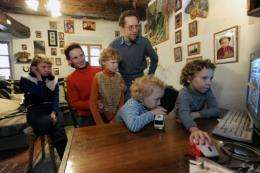
Belarus architect Maxim Kapran and his family look at a computer monitor at home in Rakau, west of Minsk, last month

Enlarge

Ex-Soviet Belarus unveiled tough new Internet restrictions on Friday that limit public access to opposition websites and impose fines on providers for failing to monitor their clients.

Ex-Soviet Belarus unveiled tough new Internet restrictions on Friday that limit public access to opposition websites and impose fines on providers for failing to monitor their clients.

The new rules also require all local Internet vendors to register with the authorities and imposes sanctions on those selling their goods in Belarus through foreign websites.

The restrictions came amid an expanding on the opposition by President Alexander Lukashenko and sparked confusion on the streets of the capital Minsk about what the new rules actually mean.

Lukashenko's administration said the law in no way limits people's access to foreign websites and is only meant to ensure "transparent" retail operations and help protect people from dangerous and .

"This does not limit citizens' use of Internet resources in any way. Their access to foreign websites is not being restricted," said a statement from Lukashenko's official information and analysis centre.

Officials said the restrictions would still allow foreign retailers such as Amazon to operate in Belarus without registering on the .by domain.

But opposition websites said the list of banned organisations deemed "" includes leading human rights centres Vyasna (Spring) and Charter 97 -- both based abroad but freely accessible in Belarus.

The law bars state organisations and universities from opening such websites and forces cybercafes and restaurants with Internet access to store information about those who do access them for up to a year.

This rule also extends to home network providers and requires them to "record and store... of Internet services users and information about the Internet services that have been provided".

"According to independent experts, the authorities' main goal is to control the main opposition websites," the Belarussky Partizan news website said.

The authoritarian Lukashenko has been ostracised by Western nations since rising to power in 1994 and attempting to recreate a Soviet-style command system under which all forms of dissent are condemned.

The wave of restrictions was extended last year following his controversial re-election and now includes a ban on people's right to stage any form of protest on the streets without permission from the authorities.

Belarus already ranks 154th out of 178 countries on a media freedoms list compiled in 2010 by their Reporters Without Borders watchdog and the new curbs left many asking how far they actually extend.

"We still have no official instructions about which sites we are supposed to be filtered and who makes the decisions about these things," a worker with the Beltelecom state Internet operator said on condition of anonymity.

Private cybercafe owners said the rules were likely to hurt their business because users will be especially careful about keeping their personal data private.

"If we really do have to start switching off sites, we are going to lose a lot of our clients," said a cafe owner who agreed to be identified as Alexander.

Both Vyasna and Charter 97 have been hounded by the authorities for years because of their calls for anti-Lukashenko rallies and detailed reports about those jailed by his regime.

Vyasna's founder Ales Beliatsky was jailed for four-and-a-half years on tax evasion charges in November.

Charter 97 said that hackers last week had accessed its editor's computer and used stolen passwords to create false stories and delete the organisation's archives.

(c) 2012 AFP


Rank not rated yet
Relevant PhysicsForums posts

More news stories

Browser wars flare in mobile space

The browser wars are heating up again, but this time the fight is for dominance of the mobile Internet.

Technology / Software

created 15 hours ago | popularity 5 / 5 (2) | comments 3

Probability of contamination from severe nuclear reactor accidents is higher than expected: study

Catastrophic nuclear accidents such as the core meltdowns in Chernobyl and Fukushima are more likely to happen than previously assumed. Based on the operating hours of all civil nuclear reactors and the number ...

Technology / Energy & Green Tech

created May 22, 2012 | popularity 3.6 / 5 (25) | comments 56 | with audio podcast

HyperSolar shows dirty water no barrier to power world

(Phys.org) -- The Santa Barbara, California, company, HyperSolar, is set to transparently share the ups and downs of its research experiences toward the company’s ultimate vision, successfully producing ...

Technology / Energy & Green Tech

created May 24, 2012 | popularity 4.8 / 5 (16) | comments 17 | with audio podcast report

SpotterRF debuts Radar Backpack Kit (w/ Video)

(Phys.org) -- SpotterRF has announced a special radar backpack kit designed to enhance situational awareness for soldiers on the ground. The company says its special radar is designed for warfighters as part ...

Technology / Hi Tech & Innovation

created May 26, 2012 | popularity 5 / 5 (5) | comments 13 | with audio podcast report

Tesla to launch electric sedan in US on June 22

Tesla Motors said Tuesday it would begin deliveries of "the world's first premium electric sedan" on June 22, slightly ahead of schedule.

Technology / Energy & Green Tech

created May 22, 2012 | popularity 4.5 / 5 (12) | comments 18


Stunning image of smallest possible five-ringed structure

Scientists have created and imaged the smallest possible five-ringed structure – about 100,000 times thinner than a human hair – and you'll probably recognise its shape.

'Unzipped' carbon nanotubes could help energize fuel cells, batteries

Multi-walled carbon nanotubes riddled with defects and impurities on the outside could replace some of the expensive platinum catalysts used in fuel cells and metal-air batteries, according to scientists at ...

Change in developmental timing was crucial in the evolutionary shift from dinosaurs to birds: study

At first glance, it's hard to see how a common house sparrow and a Tyrannosaurus Rex might have anything in common. After all, one is a bird that weighs less than an ounce, and the other is a dinosaur that ...

Computer model used to pinpoint prime materials for efficient carbon capture

When power plants begin capturing their carbon emissions to reduce greenhouse gases – and to most in the electric power industry, it's a question of when, not if – it will be an expensive undertaking.

T cells 'hunt' parasites like animal predators seek prey, study shows

By pairing an intimate knowledge of immune-system function with a deep understanding of statistical physics, a cross-disciplinary team at the University of Pennsylvania has arrived at a surprising finding: T cells use a movement ...

Land and sea species differ in climate change response: study

(Phys.org) -- Marine and terrestrial species will likely differ in their responses to climate warming, new research by Simon Fraser University and Australia’s University of Tasmania has found.