BASF, Philips develop OLED lighting for use as transparent car roof
January 19, 2012

BASF, Philips develop OLED lighting for use as transparent car roof

Enlarge

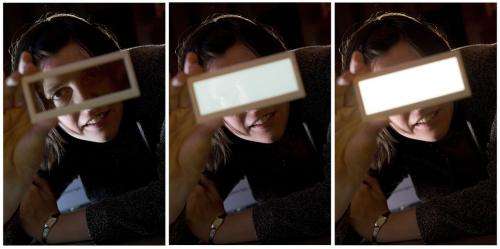
Transparent OLEDs are still in the research phase. Philips is leading research in this area and is the first to demonstrate transparent OLEDs in an application environment such as the car roof lighting concept with BASF.

(PhysOrg.com) -- BASF and Philips have achieved a practical breakthrough in the development of OLED (Organic Light Emitting Diode) technology that allows it to be integrated in car roofs. The OLEDs are transparent when switched off, allowing for a clear view outside the vehicle, yet providing light only within the vehicle when switched on. This OLED lighting concept for car roofs is the result of a longstanding cooperation between BASF and Philips in the research and development of OLED modules.

In addition to offering completely new design possibilities, the transparent OLED lighting concept also allows new approaches to automotive engineering. The transparent OLED sandwich structure can be combined with equally transparent .

“This combination allows the driver to enjoy a unique open-space feeling while it generates electricity during the day and pleasantly suffuses the interior with the warm light of the transparent, highly efficient OLEDs at night,” said Dr. Felix Görth, head of Organic Light-Emitting Diodes and Organic Photovoltaics at BASF Future Business GmbH.

BASF, Philips develop OLED lighting for use as transparent car roof
Enlarge

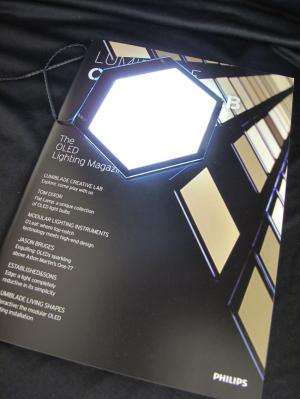
Philips' transparant OLED module for car roof lighting concept developed with BASF emits light into the vehicle when switched on.

BASF, Philips develop OLED lighting for use as transparent car roof
Enlarge

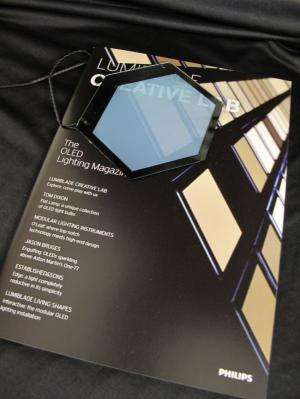
Philips' OLED module for car roof lighting concept developed with BASF is transparant when switched off.

Dr. Dietrich Bertram, General Manager of OLED Lighting at , added: “This project provides impressive evidence of new possibilities with OLEDs, and illustrates the potential of Philips’ Lumiblade OLED technology to help create innovative lighting applications that enhance people’s lives.”

BASF and Philips have cooperated closely since 2006 within the OLED 2015 initiative of Germany’s Federal Ministry of Education and Research (BMBF). develops organo-chemical materials such as dyes that are used in the development and manufacturing of OLEDs by Philips. Working together, the two partners put the innovative transparent OLED lighting technology into practice on a car roof.

OLED technology offers the advantage of high energy efficiency, in addition to creative flexibility and new options for designers. OLED light sources are just 1.8 millimeters thin and can be transparent. The entire surface of an illuminates with diffused light, making it a very soft light source that produces less harsh shadows compared to point light sources.

Source: Philips Electronics

Filter


Move the slider to adjust rank threshold, so that you can hide some of the comments.


Display comments: newest first

TrinityComplex
Jan 19, 2012

Rank: 5 / 5 (1)
Why stop at car roofs? These could be used in buildings in place of flourescents on the top floors (or other places, I suppose). Make them skylights, or put them at the end of solar tubes to allow for more natural light during the day, then have them come on when it gets darker. Studies show that humans are more awake/productive when exposed to sunlight vs. flourescent.
Jorsher
Jan 19, 2012

Rank: 5 / 5 (1)
Why stop at car roofs? These could be used in buildings in place of flourescents on the top floors (or other places, I suppose). Make them skylights, or put them at the end of solar tubes to allow for more natural light during the day, then have them come on when it gets darker. Studies show that humans are more awake/productive when exposed to sunlight vs. flourescent.


Exactly what I was thinking. Screw a traditional roof and lighting... I want an office with a view of the real sky, and light in the evening from captured solar energy.
plasticpower
Jan 20, 2012

Rank: not rated yet
Put them into the windshield too! It's about time we had read HUD displays showing us speed, navigation, etc on the windshield so we don't have to take our eyes off the road!
Phil_Heston
Jan 20, 2012

Rank: 1 / 5 (1)
Really not sure why this would be a good idea for cars? I mean, variable opacity glass screens have been available for years. OLED is specifically about light emitting. So it looks like it becomes opaque simply by emitting light that obscures (but doesn't stop) other light passing through. Now, in a car, why the heck would you want a lit-up roof? Sure, a clear roof letting the sky view in during the day. But at night time? Even soft lighting is pretty dangerous when they seem to suggest it would be a good idea.

The HUD suggestion in another comment is nice, but you don't need HUD on the whole screen so it's overkill where other solutions already exist. Maybe when there are complementary augmented reality applications, so the windscreen becomes an active enhanced display of your environment, then I could see some use (but AR is heavily perspective-dependent, i.e. it would work only for driver but not passenger or vice versa).

Nice technology, wrong application.
rawa1
Jan 20, 2012

Rank: 1 / 5 (3)
How some transparent thing can radiate? It violates all physical laws, we know...
gwrede
Jan 23, 2012

Rank: 5 / 5 (1)
This would be excellent for normal house windows and skylights. And you could make lampshades "that don't need the bulb" in the middle for tabletop and free-standing light fixtures. These could have the color of incandescent light while those in the windows would be daylight colored.

I see this market as much bigger than some glass car roof.
powerup1
Feb 13, 2012

Rank: not rated yet
How some transparent thing can radiate? It violates all physical laws, we know...


That is a very inane statement, but then again, look at the source. :-D
Rank 5 /5 (6 votes)
Relevant PhysicsForums posts

More news stories

Browser wars flare in mobile space

The browser wars are heating up again, but this time the fight is for dominance of the mobile Internet.

Technology / Software

created 15 hours ago | popularity 5 / 5 (2) | comments 3

Probability of contamination from severe nuclear reactor accidents is higher than expected: study

Catastrophic nuclear accidents such as the core meltdowns in Chernobyl and Fukushima are more likely to happen than previously assumed. Based on the operating hours of all civil nuclear reactors and the number ...

Technology / Energy & Green Tech

created May 22, 2012 | popularity 3.6 / 5 (25) | comments 56 | with audio podcast

HyperSolar shows dirty water no barrier to power world

(Phys.org) -- The Santa Barbara, California, company, HyperSolar, is set to transparently share the ups and downs of its research experiences toward the company’s ultimate vision, successfully producing ...

Technology / Energy & Green Tech

created May 24, 2012 | popularity 4.8 / 5 (16) | comments 17 | with audio podcast report

SpotterRF debuts Radar Backpack Kit (w/ Video)

(Phys.org) -- SpotterRF has announced a special radar backpack kit designed to enhance situational awareness for soldiers on the ground. The company says its special radar is designed for warfighters as part ...

Technology / Hi Tech & Innovation

created May 26, 2012 | popularity 5 / 5 (5) | comments 13 | with audio podcast report

Tesla to launch electric sedan in US on June 22

Tesla Motors said Tuesday it would begin deliveries of "the world's first premium electric sedan" on June 22, slightly ahead of schedule.

Technology / Energy & Green Tech

created May 22, 2012 | popularity 4.5 / 5 (12) | comments 18


Stunning image of smallest possible five-ringed structure

Scientists have created and imaged the smallest possible five-ringed structure – about 100,000 times thinner than a human hair – and you'll probably recognise its shape.

'Unzipped' carbon nanotubes could help energize fuel cells, batteries

Multi-walled carbon nanotubes riddled with defects and impurities on the outside could replace some of the expensive platinum catalysts used in fuel cells and metal-air batteries, according to scientists at ...

Change in developmental timing was crucial in the evolutionary shift from dinosaurs to birds: study

At first glance, it's hard to see how a common house sparrow and a Tyrannosaurus Rex might have anything in common. After all, one is a bird that weighs less than an ounce, and the other is a dinosaur that ...

Computer model used to pinpoint prime materials for efficient carbon capture

When power plants begin capturing their carbon emissions to reduce greenhouse gases – and to most in the electric power industry, it's a question of when, not if – it will be an expensive undertaking.

T cells 'hunt' parasites like animal predators seek prey, study shows

By pairing an intimate knowledge of immune-system function with a deep understanding of statistical physics, a cross-disciplinary team at the University of Pennsylvania has arrived at a surprising finding: T cells use a movement ...

Land and sea species differ in climate change response: study

(Phys.org) -- Marine and terrestrial species will likely differ in their responses to climate warming, new research by Simon Fraser University and Australia’s University of Tasmania has found.