AVIATR: An Airplane Mission for Titan
January 3, 2012 by Lillian Ortiz, Universe Today

AVIATR: An Airplane Mission for Titan

Enlarge

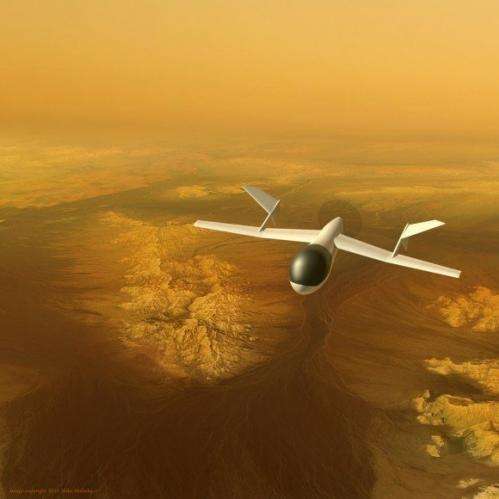
An artist's conception of AVIATR, an airplane mission to the second largest moon in our solar system: Titan. Credit: Mike Malaska 2011

It has been said that the atmosphere on Titan is so dense that a person could strap a pair of wings on their back and soar through its skies.

It’s a pretty fascinating thought. And Titan – Saturn’s largest moon – is a pretty fascinating place. After all, it’s the only other body in our solar system (besides Earth, of course) that has that type of and evidence of liquid on its surface.

“As far as its scientific interest, Titan is the most interesting target in the Solar System,” Dr. Jason W. Barnes of the University of Idaho told Universe Today.

That’s why Barnes and a team of 30 scientists and engineers created an unmanned mission concept to explore Titan called AVIATR (Aerial Vehicle for In-situ and Airborne Titan Reconnaissance). The plan, which primarily consists of a 120 kg plane soaring through the natural satellite’s atmosphere, was published online late last month.

The goal of the plane concept – which according to Barnes can serve as a standalone mission or as part of a larger Titan-focused exploration program – is to study the moon’s geography (its mountains, dunes, lakes and seas), as well as its atmosphere (the wind, haze, clouds and rain. Did you know that Titan is the only other place is our solar system where it rains?)

AVIATR is composed of three vehicles: one for space travel, one for entry and descent into Titan, and a plane to fly through the atmosphere. AVIATR, estimated to cost $715 million, would not prevent other missions from occurring on Titan, Barnes said. Instead, it would supplement the science being done by other projects.

“The science that AVIATR could do complements the science that can be accomplished from both orbiting and landed platforms,” the article stated.

Unfortunately, it seems like the plane concept won’t be happening anytime soon.

That’s because Titan didn’t make the National Research Council’s “Decadal Survey” – a prioritization of future planetary missions.

AVIATR: An Airplane Mission for Titan
Enlarge

Mission poster for AVIATR. Credit: Mike Malaska

“Titan was deferred to another decade,” Barnes said.

But, he hopes to continue to build support for AVIATR so that it can get onto the next decadal survey in 2020. “We certainly had a lot of interest from people. We are breaking the paradigm that a balloon was the right way to go to Titan,” Barnes said.

So, why send an unmanned plane to study Titan’s atmosphere?

“Titan is the best place to fly an airplane in the whole . We can go when and where we want,” Barnes said, adding that when compared to Earth, there’s four times more air and seven times less gravity on Titan. “A balloon is stuck in the wind.”

According to the article:

“A balloon entrained in primarily zonal winds near the equator would have no mechanism by which to travel to the polar regions to observe lakes and shoreline processes. Even if it were possible to get there, it is not clear that it would be desirable to send a balloon to the poles where Titan’s most violent meteorological activity takes place. AVIATR is both able to fly to the poles and is sufficiently robust to survive there.”

There’s also this issue: A shortage of plutonium-238.

“The radioactive decay of plutonium-238 provides the heat that powers RTGs, which can power spacecraft where there is insufficient sunlight for solar panels to operate. NASA is presently investing in a new type of RTG, called the ASRG,” the article stated. “A traditional hot-air balloon will not work on Titan with an ASRG owing to its lower heat production. In contrast, the AVIATR mission is specifically enabled by the use of ASRGs. The power density (in Watts per kilogram) and longevity of the ASRG allow an electrically-powered aircraft to fly on Titan.”

A plane could also find potential landing spots for future exploration. And, “since we are flying, we fly west the whole time so we can stay on the day side of Titan,” Barnes said.

That daylight would also help AVIATR collect photographic data during its travels and, according to Barnes, when it’s time to downlink that information, the plane would conserve energy by gliding through the air.

“And in doing so, we can also sample of bunch of altitude ranges,” Barnes said. “We are sampling the whole time.”

The plan seems interesting enough, but it’ll be quite a while before any data from the prospective mission would be coming back to Earth. If the plan is accepted (the earliest being 2020), the project would still have to be built, then once completed it would take 7 1/2 years to reach . Once there, the mission would take about a nominal Earth year to study.

“I now realize that it’s a career-long project,” Barnes said to Universe Today. “The plan at this point is to keep this in the forefront of people’s minds and take whatever new ideas that people suggest and try to improve its prospect for selection.

To view the complete proposal, published in Experimental Astronomy, go here.

Source: Universe Today

4.8 /5 (15 votes)  

Filter


Move the slider to adjust rank threshold, so that you can hide some of the comments.


Display comments: newest first

GSwift7
Jan 03, 2012

Rank: 3.3 / 5 (4)
It has been said that the atmosphere on Titan is so dense that a person could strap a pair of wings on their back and soar through its skies


If you build a habitat on Mars and fill it with Earth normal atmosphere, human powered flight would be easy on Mars too. There seem to be volcanic tubes on Mars that would be plenty big enough to fly around in, if you wanted to seal one off and fill it with air.

With the above plan, I would be worried about iceing on the aircraft, especially when it first enters the atmosphere. The aircraft would be extremely cold when it is first released from the entry stage. Trying to use the entry heat to warm it up would be too risky.

Here's some cool trivia: When a meteorite lands on earth it is cold, very cold. The part that heats up and burns off during entry is only a very thin layer and it boils away before it can heat the inside of the meteor. The part that hits the ground is so cold it will cause a freeze burn like dry ice.
WhiteJim
Jan 03, 2012

Rank: 3.3 / 5 (3)
This concept will work well on Venus too...
GSwift7
Jan 03, 2012

Rank: 4.2 / 5 (6)
This concept will work well on Venus too...


Yes, except for the heat problem. I don't think you could make an aircraft that could function very long in 800 F temperature. That's hot enough to melt the oven in your kitchen. The thick atmosphere on Venus also causes huge amounts of dust to be carried in the wind. I don't think you would want to fly in it. It's a little hard to imagine, but the dense atmosphere actually gives a lot of force to even a slight breeze. A ten mile/hour wind there would blow a car or house over easily. The air is so dusty that you can't see very far, making an aircraft nearly blind too.
nkalanaga
Jan 03, 2012

Rank: 4 / 5 (5)
Icing shouldn't be a problem in Titan. Water ice is a mineral at Titan's temperatures, and the atmosphere is above the freezing point of methane.
GSwift7
Jan 03, 2012

Rank: 4 / 5 (2)
Yeah, that's right. I wasn't thinking about it correctly. It's hard to imagine a place so different.
WhiteJim
Jan 03, 2012

Rank: 4.7 / 5 (3)
You're thinking of the Venus surface which is so hot. High above the clouds there will be a more temperate zone suitable for the plane to stay afloat... perhaps a ballon will be better in any event and stay up longer and without much fuel ... I don't know why no one sent a ballon to Venus already...
TheGhostofOtto1923
Jan 03, 2012

Rank: 5 / 5 (2)
If you build a habitat on Mars and fill it with Earth normal atmosphere, human powered flight would be easy on Mars too. There seem to be volcanic tubes on Mars that would be plenty big enough to fly around in, if you wanted to seal one off and fill it with air.
I remember reading a heinlein story as a kid about a huge lunar volcanic gas bubble which was used as an air reservoir. People would fly around in there with strap-on wings. And by golly here it is:
http://www.techno...Bnum=712

-I would think that instead of a plane or balloon for titan, a dirigible would be a good compromise? It would be able to hover very close to the ground, maybe grab samples.
TheGhostofOtto1923
Jan 03, 2012

Rank: 4 / 5 (3)
What was that tv documentary show about an intelligent robotic balloon sent to explore an earthlike planet? In the end it encountered some individuals which knocked it down (and cooked it up maybe)? I keep thinking sagan or NOVA or something like that.
TheGhostofOtto1923
Jan 03, 2012

Rank: 4 / 5 (3)
nkalanaga
Jan 03, 2012

Rank: 4.7 / 5 (3)
For Venus a dirigible would be perfect, and a balloon would work. If one used water for ballast the balloon could stay up for a long time. Put the water in a heat resistant flexible bag. It high altitudes, it would be water, take up little space, and provide ballast, keeping the balloon from going too high. When the balloon gets lower, the water heats, turns to steam, inflates the bag, and provides extra lift. The balloon goes back up. No need to discard ballast, so it can stay at the proper altitude range much longer. As long as the instruments can survive short periods above boiling everything should work well.

If you want it to stay higher you could use ammonia instead of water.
Sinister1811
Jan 04, 2012

Rank: 3.7 / 5 (3)
I think something like a light plane (for Venus) would be easier. Because then there's the problem of strong winds, Sulfuric acid clouds and lightning strikes.

For this mission to Titan, it would be awesome if the plane also came with a probe that they could drop into one of the seas, to explore for any potential life forms.
Ensa
Jan 04, 2012

Rank: 3 / 5 (1)
re: Venus derigible ideas - it has been explored a few times. The prospects look good - it looks do-able if only some crazy person would fund it...

http://www.univer...-cities/

GSwift7
Jan 04, 2012

Rank: 4.7 / 5 (3)
A high altitude drone for Venus wouldn't do you any good at all. You would be able to see exactly the same smog that you can see from orbit. To be of much benefit, it would need to get below the majority of the smog, where the air is really hot. There is a good reason that we have not explored Venus very much. Venus is extremely difficult to access, for a long list of reasons. The only lander to ever go there melted shortly after landing. The only purpose of sending a probe would be to examine the surface, so that means going down into the furnace. Balloons and drones sound great, but not really. A far better plan might be to drop a standard lander by parachute/landing rockets, then have it quickly grab samples and lanch a sample return carrier before it melts.
Possibilus
Jan 04, 2012

Rank: 5 / 5 (3)
I agree that for Titan, some type of hybrid dirigible or blimp design makes more sense in terms of energy efficiency, lift capacity, and a balance between maintaining elevation and steerability, not to mention survivability in cases of soft landings versus unpredictable landings that an airplane might require, even if unintended.
GSwift7
Jan 05, 2012

Rank: 5 / 5 (1)
Too bad there's no source of oxygen on Titan. All that methane would be awefully convenient for fuel. I'm sure it's easier to just run on a nuclear decay thermal generator, rather than bring oxygen and collect methane. If people ever wanted to go there, that might be a different story. Not sure why anyone would aside from science though. Huh, imagine this: A team of researchers goes there, they depend on the methane for fuel. Then their oxygen reclaim system malfunctions and they freeze to death while camped on the shore of a lake of burnable fuel. That might make for a good short story. I'll have to play with that one a little.
GSwift7
Jan 05, 2012

Rank: 5 / 5 (1)
I have been thinking about what Titan might be like, and reading up on it. Apparently the organics condense into earosol solids in the upper atmosphere, then fall down towards the surface when they get too big. That's what the orange smog is from, in theory. So there's loads of microscopic orange dust in the air, then it rains liquid methane. The place could be an orange/brown, muddy, icy, slushy mess. These aircraft probes we are talking about would need to fly through that dirty rain. That could cause all kinds of problems. If you have seen pictures of dust storms in the Middle East, imagine that with enough moisture so that it sticks to stuff. That's all just a guess, of course, since nobody really knows yet, but that's probably not too far off the mark.
Rank 4.8 /5 (15 votes)
Relevant PhysicsForums posts
  • Distance of planets from stars and revolution
    created8 hours ago
  • revamping general concept and cosmological principle
    createdMay 25, 2012
  • Transiting Exoplanet Light Curve
    createdMay 25, 2012
  • Math behind Theoretical Physics
    createdMay 24, 2012
  • Do we know whats at the center of galaxies yet?
    createdMay 23, 2012
  • Structure of the Milky Way?
    createdMay 20, 2012
  • More from Physics Forums - General Astronomy

More news stories

Land and sea species differ in climate change response: study

(Phys.org) -- Marine and terrestrial species will likely differ in their responses to climate warming, new research by Simon Fraser University and Australia’s University of Tasmania has found.

Space & Earth / Environment

created 6 hours ago | popularity 3.8 / 5 (4) | comments 5 | with audio podcast

Yale study concludes public apathy over climate change unrelated to science literacy

Are members of the public divided about climate change because they don't understand the science behind it? If Americans knew more basic science and were more proficient in technical reasoning, would public consensus match ...

Space & Earth / Environment

created 8 hours ago | popularity 4.8 / 5 (5) | comments 20 | with audio podcast

10 million years needed to recover from mass extinction

It took some 10 million years for Earth to recover from the greatest mass extinction of all time, latest research has revealed.

Space & Earth / Earth Sciences

created 8 hours ago | popularity 4 / 5 (4) | comments 1 | with audio podcast

Sophisticated simulations predict future warming

The chances of our planet being hit by a global warming of 3 degrees Celsius by 2050 is as likely as it being hit by an increase of 1.4 degrees, new research shows. Presented in the journal Nature Geoscience, the British study ...

Space & Earth / Earth Sciences

created May 22, 2012 | popularity 4.1 / 5 (10) | comments 51

Aliens don't want to eat us, says former SETI director

Alien life probably isn’t interested in having us for dinner, enslaving us or laying eggs in our bellies, according to a recent statement by former SETI director Jill Tarter.

Space & Earth / Space Exploration

created May 25, 2012 | popularity 4.4 / 5 (15) | comments 41


Stunning image of smallest possible five-ringed structure

Scientists have created and imaged the smallest possible five-ringed structure – about 100,000 times thinner than a human hair – and you'll probably recognise its shape.

'Unzipped' carbon nanotubes could help energize fuel cells, batteries

Multi-walled carbon nanotubes riddled with defects and impurities on the outside could replace some of the expensive platinum catalysts used in fuel cells and metal-air batteries, according to scientists at ...

Change in developmental timing was crucial in the evolutionary shift from dinosaurs to birds: study

At first glance, it's hard to see how a common house sparrow and a Tyrannosaurus Rex might have anything in common. After all, one is a bird that weighs less than an ounce, and the other is a dinosaur that ...

Computer model used to pinpoint prime materials for efficient carbon capture

When power plants begin capturing their carbon emissions to reduce greenhouse gases – and to most in the electric power industry, it's a question of when, not if – it will be an expensive undertaking.

T cells 'hunt' parasites like animal predators seek prey, study shows

By pairing an intimate knowledge of immune-system function with a deep understanding of statistical physics, a cross-disciplinary team at the University of Pennsylvania has arrived at a surprising finding: T cells use a movement ...

Scientists develop ultra-sensitive test that detects diseases in their earliest stages

Scientists have developed an ultra-sensitive test that should enable them to detect signs of a disease in its earliest stages, in research published today in the journal Nature Materials.