Astronomers release unprecedented data set on celestial objects that brighten and dim
January 12, 2012

Astronomers release unprecedented data set on celestial objects that brighten and dim

Enlarge

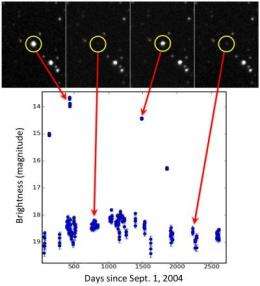
This is an image of a dwarf nova, which is a star system where material flows from a red giant star to a dense, compact star called a white dwarf. The flowing material triggers explosions that cause the system to flare up as seen from Earth. The graph shows the change in brightness of this system over a period of seven years. The images at the top show the nova at its brightest and dimmest, as indicated in the plot. Such systems are important for understanding stellar evolution, and the CRTS team has discovered nearly a thousand of them‑‑more than any other survey. Credit: The CRTS Survey Team, Caltech

Astronomers from the California Institute of Technology (Caltech) and the University of Arizona have released the largest data set ever collected that documents the brightening and dimming of stars and other celestial objects—two hundred million in total.

The night sky is filled with objects like asteroids that dash across the sky and others—like exploding stars and variable stars—that flash, dim, and brighten. Studying such phenomena can help astronomers better understand the evolution of stars, massive black holes in the centers of galaxies, and the structure of the Milky Way. These types of objects were also essential for the recent discovery of dark energy—the mysterious energy that dominates the expansion of the universe—which earned last year's Nobel Prize.

Using the Catalina Real-Time Transient Survey (CRTS), a project led by Caltech, the astronomers systematically scanned the heavens for these dynamic objects, producing an unprecedented data set that will allow scientists worldwide to pursue new research.

"Exploring variable objects and transient phenomena like stellar explosions is one of the most vibrant and growing research areas in astrophysics," says S. George Djorgovski, professor of astronomy at Caltech and principal investigator on the CRTS. "In many cases, this yields unique information needed to understand these objects."

The new data set is based on observations taken with the 0.7-meter telescope on Mt. Bigelow in Arizona. The observations were part of the Catalina Sky Survey (CSS), a search for Near-Earth Objects (NEOs)—asteroids that may pose a threat to Earth—conducted by astronomers at the University of Arizona. By repeatedly taking pictures of large swaths of the sky and comparing these images to previous ones, the CRTS is able to monitor the brightness of about half a billion objects, allowing it to search for those that dramatically brighten or dim. In this way, the CRTS team identified tens of thousands of variables, maximizing the science that can be gleaned from the original data.

The new data set contains the so-called brightness histories of a total of two hundred million stars and other objects, incorporating over 20 billion independent measurements. "This set of objects is an order of magnitude larger than the largest previously available data sets of their kind," says Andrew Drake, a staff scientist at Caltech and lead author on a poster to be presented at the meeting of the American Astronomical Society in Austin on January 12. "It will enable many interesting studies by the entire astronomical community."

One of the unique features of the survey, Drake says, is that it emphasizes an open-data philosophy. "We discover transient events and publish them electronically in real time, so that anyone can follow them and make additional discoveries," he explains.

"It is a good example of scientific-data sharing and reuse," Djorgovski says. "We hope to set an example of how data-intensive science should be done in the 21st century."

The data set includes over a thousand exploding stars called supernovae, including many unusual and novel types, as well as hundreds of so-called cataclysmic variables, which are pairs of stars in which one spills matter onto another, called a white dwarf; tens of thousands of other variable stars; and dwarf novae, which are binary that dramatically change in brightness.

"We take hundreds of images every night from each of our telescopes as we search for hazardous asteroids," adds Edward Beshore, principal investigator of the University of Arizona's asteroid-hunting CSS. "As far back as 2005, we were asking if this data could be useful to the community of astronomers. We are delighted that we could forge this partnership. In my estimation, it has been a great success and is a superb example of finding ways to get greater value from taxpayers' investments in basic science."

The team says they soon plan to release additional data taken with a 1.5-meter telescope on Mt. Lemmon in Arizona and a 0.5-meter telescope in Siding Spring in Australia.

Provided by California Institute of Technology search and more info website

4.8 /5 (6 votes)  

Rank 4.8 /5 (6 votes)
Relevant PhysicsForums posts
  • Distance of planets from stars and revolution
    created8 hours ago
  • revamping general concept and cosmological principle
    createdMay 25, 2012
  • Transiting Exoplanet Light Curve
    createdMay 25, 2012
  • Math behind Theoretical Physics
    createdMay 24, 2012
  • Do we know whats at the center of galaxies yet?
    createdMay 23, 2012
  • Structure of the Milky Way?
    createdMay 20, 2012
  • More from Physics Forums - General Astronomy

More news stories

Land and sea species differ in climate change response: study

(Phys.org) -- Marine and terrestrial species will likely differ in their responses to climate warming, new research by Simon Fraser University and Australia’s University of Tasmania has found.

Space & Earth / Environment

created 6 hours ago | popularity 3.8 / 5 (4) | comments 5 | with audio podcast

Yale study concludes public apathy over climate change unrelated to science literacy

Are members of the public divided about climate change because they don't understand the science behind it? If Americans knew more basic science and were more proficient in technical reasoning, would public consensus match ...

Space & Earth / Environment

created 8 hours ago | popularity 4.8 / 5 (5) | comments 20 | with audio podcast

10 million years needed to recover from mass extinction

It took some 10 million years for Earth to recover from the greatest mass extinction of all time, latest research has revealed.

Space & Earth / Earth Sciences

created 8 hours ago | popularity 4 / 5 (4) | comments 1 | with audio podcast

Sophisticated simulations predict future warming

The chances of our planet being hit by a global warming of 3 degrees Celsius by 2050 is as likely as it being hit by an increase of 1.4 degrees, new research shows. Presented in the journal Nature Geoscience, the British study ...

Space & Earth / Earth Sciences

created May 22, 2012 | popularity 4.1 / 5 (10) | comments 51

Aliens don't want to eat us, says former SETI director

Alien life probably isn’t interested in having us for dinner, enslaving us or laying eggs in our bellies, according to a recent statement by former SETI director Jill Tarter.

Space & Earth / Space Exploration

created May 25, 2012 | popularity 4.4 / 5 (15) | comments 41


Stunning image of smallest possible five-ringed structure

Scientists have created and imaged the smallest possible five-ringed structure – about 100,000 times thinner than a human hair – and you'll probably recognise its shape.

'Unzipped' carbon nanotubes could help energize fuel cells, batteries

Multi-walled carbon nanotubes riddled with defects and impurities on the outside could replace some of the expensive platinum catalysts used in fuel cells and metal-air batteries, according to scientists at ...

Change in developmental timing was crucial in the evolutionary shift from dinosaurs to birds: study

At first glance, it's hard to see how a common house sparrow and a Tyrannosaurus Rex might have anything in common. After all, one is a bird that weighs less than an ounce, and the other is a dinosaur that ...

Computer model used to pinpoint prime materials for efficient carbon capture

When power plants begin capturing their carbon emissions to reduce greenhouse gases – and to most in the electric power industry, it's a question of when, not if – it will be an expensive undertaking.

T cells 'hunt' parasites like animal predators seek prey, study shows

By pairing an intimate knowledge of immune-system function with a deep understanding of statistical physics, a cross-disciplinary team at the University of Pennsylvania has arrived at a surprising finding: T cells use a movement ...

Scientists develop ultra-sensitive test that detects diseases in their earliest stages

Scientists have developed an ultra-sensitive test that should enable them to detect signs of a disease in its earliest stages, in research published today in the journal Nature Materials.