Article by Rochester team is the most viewed in Biotech Journal
January 20, 2012

Article by Rochester team is the most viewed in Biotech Journal

Enlarge

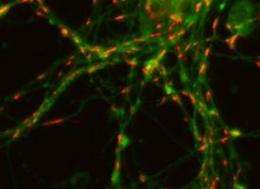
Mitochondria powering neurons are visible in red.

A review article by scientists at the University of Rochester Medical Center for the journal BioTechniques was the journal’s most-viewed article in 2011.

The first author of the paper, which was first published in February of last year, is Seth Perry, Ph.D., research assistant professor of Biomedical Engineering. Other authors include faculty members Handy Gelbard, M.D., Ph.D.; Edward Brown, Ph.D.; former graduate student John Norman, Ph.D.; and technical associate Justin Barbieri.

The article is designed as a guide for scientists making measurements about the mitochondria, the structures that churn out the energy that cells need to survive. Measurements of their membranes play an important role in virtually every scientific field, including cancer, neuroscience, and cardiovascular research. It’s through measures like these – difficult to understand for people who are not scientists, but routine in laboratories worldwide – that new medical discoveries and treatments are created.

The team’s article focuses on the technical aspects of using fluorescent probes to measure a phenomenon known as the “mitochondrial membrane potential,” which controls the cell’s ability to produce energy and is an important measure of how well a cell is functioning.

The paper has its roots in the Gelbard laboratory, where Perry worked on the molecular signaling involved in HIV-associated neurocognitive disorder, which ultimately affects the majority of patients with HIV.

Perry was making measurements on mitochondria that seemed to run counter to the findings of other groups. This caused Perry and colleagues to repeat their experiments several times, using different methods, combing through the technical details extensively to make sure there had been no errors. There weren’t, and many other scientists have since published similar findings.

“We learned firsthand just how important it is to run additional controls and experiments to most accurately interpret the results from these dyes,” said Perry. “Your measurements are only as good as the tools you use to make them, or more specifically, how you use those tools.”

“While there’s been a great deal of work done on mitochondrial physiology, including many excellent reviews, I found that the real nitty-gritty how-to information was hard to come by. There was a lot more I needed to know regarding the usage considerations and characteristics and pitfalls of the many probes available. Many scientists like us were left to sort out the information ourselves, every time we did an experiment. Our article is designed as a how-to manual, aimed at first-time or non-expert users.” 

In addition to his work on HIV and its effects on the nervous and immune systems, Perry is also working with Brown to explore the role of collagen in cancer metastases.

Provided by University of Rochester Medical Center search and more info website


Rank 5 /5 (1 vote)
Relevant PhysicsForums posts

More news stories

Manufacturing genes to attack flu virus

An international research team has manufactured a new protein that can combat deadly flu epidemics.

Biology / Biotechnology

created 8 hours ago | popularity not rated yet | comments 0 | with audio podcast

Scientist: Evolution debate will soon be history

(AP) -- Richard Leakey predicts skepticism over evolution will soon be history. Not that the avowed atheist has any doubts himself.

Biology / Evolution

created May 26, 2012 | popularity 3.5 / 5 (20) | comments 96

More plant species responding to global warming than previously thought

(Phys.org) -- Far more wild plant species may be responding to global warming than previous large-scale estimates have suggested.

Biology / Ecology

created May 22, 2012 | popularity 4.6 / 5 (14) | comments 18 | with audio podcast

For monogamous sparrows, it doesn't pay to stray (but they do it anyway)

It's quite common for a female song sparrow to stray from her breeding partner and mate with the male next door, but a new study shows that sleeping around can be costly.

Biology / Plants & Animals

created May 22, 2012 | popularity 5 / 5 (2) | comments 8 | with audio podcast

Thousands of shellfish found dead in Peru

Thousands of crustaceans were found dead off the coast of Lima following the mystery mass death of dolphins and pelicans, the Peruvian Navy said Friday.

Biology / Ecology

created May 26, 2012 | popularity 4.7 / 5 (7) | comments 7


Stunning image of smallest possible five-ringed structure

Scientists have created and imaged the smallest possible five-ringed structure – about 100,000 times thinner than a human hair – and you'll probably recognise its shape.

'Unzipped' carbon nanotubes could help energize fuel cells, batteries

Multi-walled carbon nanotubes riddled with defects and impurities on the outside could replace some of the expensive platinum catalysts used in fuel cells and metal-air batteries, according to scientists at ...

Change in developmental timing was crucial in the evolutionary shift from dinosaurs to birds: study

At first glance, it's hard to see how a common house sparrow and a Tyrannosaurus Rex might have anything in common. After all, one is a bird that weighs less than an ounce, and the other is a dinosaur that ...

Computer model used to pinpoint prime materials for efficient carbon capture

When power plants begin capturing their carbon emissions to reduce greenhouse gases – and to most in the electric power industry, it's a question of when, not if – it will be an expensive undertaking.

T cells 'hunt' parasites like animal predators seek prey, study shows

By pairing an intimate knowledge of immune-system function with a deep understanding of statistical physics, a cross-disciplinary team at the University of Pennsylvania has arrived at a surprising finding: T cells use a movement ...

Land and sea species differ in climate change response: study

(Phys.org) -- Marine and terrestrial species will likely differ in their responses to climate warming, new research by Simon Fraser University and Australia’s University of Tasmania has found.