Wine grapevines and native plants make a fine blend, study shows
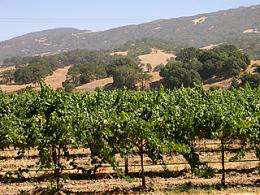
Vineyards that include a mixture of grape vines and native vegetation provide more environmental benefits than do just vines. Credit: Louise Jackson/UC Davis photo
(PhysOrg.com) -- Grapevines and native plants are a fine blend for the environment, suggests a team of researchers led by a plant ecologist at the University of California, Davis.
According to their research, reported in the online journal Carbon Balance and Management, vineyard landscapes that include both vines and native vegetation provide more environmental benefits than vineyards planted solidly in grapevines.
Potential ecological benefits include habitat for wildlife, pollinators and other beneficial insects; water quality enhancement; and mitigation of damaging greenhouse gases.
All too often, natural ecosystems are rapidly lost in regions where intensive agriculture becomes economically successful, said John Williams, a post-doctoral researcher in the Department of Environmental Science and Policy, and lead author of the study. The results of this study clearly indicate that agricultural systems that include a mosaic of both natural vegetation and planted crops can yield significant environmental benefits.
What is needed now are land-use policies that will include incentives that will make it economically viable for landowners to develop and manage such complex agricultural landscape mosaics, he said.
Agriculture has dramatically transformed both land-based and aquatic ecosystems around the world and much of that land will continue to be in agricultural production for years to come, said Louise Jackson, a professor and Cooperative Extension specialist in the UC Davis Department of Land, Air and Water Resources. It is imperative, therefore, that we promote a multifunctional approach to agricultural land use.
UC Davis has for decades led California in research devoted to all aspects of grape growing and winemaking and to solving real-world environmental problems, including climate change and habitat conservation.
The new study examined the amount of carbon storage on five ranches that produce organic grapes for the Bonterra label of Fetzer Vineyards, located in Northern Californias Mendocino County. Altogether, the ranches cover 2,962 acres, with roughly one third each devoted to vineyards, forested wildlands or grasslands. The ranches have been organically certified since the late 1980s.
Carbon storage is the process through which carbon dioxide is removed from the atmosphere and stored in wood and soil, lessening its impact on global climate change.
The researchers found that the level of carbon storage varied throughout the wildland areas, depending on the type of native vegetation, and, as expected, was much lower in the vineyard areas. In addition, the areas of conserved wildlands also retained habitat for native plant and animal species.
Provided by
UC Davis
-
From lemons to lemonade: Reaction uses carbon dioxide to make carbon-based semiconductor,
32 comments
-
Thioridazine kills cancer stem cells in human while avoiding toxic side-effects of conventional cancer treatments,
3 comments
-
SpaceX private rocket blasts off for space station (Update),
42 comments
-
Climate scientists say they have solved riddle of rising sea,
31 comments
-
SpaceX capsule has 'new car' smell, astronauts say (Update),
4 comments
-
Hypothetical desert earth
23 hours ago
-
More human population = greater mass?
May 25, 2012
-
Conversion from aircraft bearing to normal degrees
May 23, 2012
-
Interpretation/Analysis of the Lab results(HEPA filter)
May 22, 2012
-
Has anyone here attended the The Urbino Summer School in Paleoclimatology?
May 22, 2012
-
Earthquakes: Mag 6 N. Italy and Mag 5.6 W. Bulgaria
May 21, 2012
- More from Physics Forums - Earth
More news stories
Land and sea species differ in climate change response: study
(Phys.org) -- Marine and terrestrial species will likely differ in their responses to climate warming, new research by Simon Fraser University and Australia’s University of Tasmania has found.
6 hours ago |
3.8 / 5 (4) |
5
|
Yale study concludes public apathy over climate change unrelated to science literacy
Are members of the public divided about climate change because they don't understand the science behind it? If Americans knew more basic science and were more proficient in technical reasoning, would public consensus match ...
8 hours ago |
4.8 / 5 (5) |
20
|
10 million years needed to recover from mass extinction
It took some 10 million years for Earth to recover from the greatest mass extinction of all time, latest research has revealed.
Space & Earth / Earth Sciences
8 hours ago |
4 / 5 (4) |
1
|
Sophisticated simulations predict future warming
The chances of our planet being hit by a global warming of 3 degrees Celsius by 2050 is as likely as it being hit by an increase of 1.4 degrees, new research shows. Presented in the journal Nature Geoscience, the British study ...
Space & Earth / Earth Sciences
May 22, 2012 |
3.8 / 5 (11) |
51
Aliens don't want to eat us, says former SETI director
Alien life probably isnt interested in having us for dinner, enslaving us or laying eggs in our bellies, according to a recent statement by former SETI director Jill Tarter.
Space & Earth / Space Exploration
May 25, 2012 |
4.4 / 5 (15) |
41
Stunning image of smallest possible five-ringed structure
Scientists have created and imaged the smallest possible five-ringed structure about 100,000 times thinner than a human hair and you'll probably recognise its shape.
'Unzipped' carbon nanotubes could help energize fuel cells, batteries
Multi-walled carbon nanotubes riddled with defects and impurities on the outside could replace some of the expensive platinum catalysts used in fuel cells and metal-air batteries, according to scientists at ...
Change in developmental timing was crucial in the evolutionary shift from dinosaurs to birds: study
At first glance, it's hard to see how a common house sparrow and a Tyrannosaurus Rex might have anything in common. After all, one is a bird that weighs less than an ounce, and the other is a dinosaur that ...
Computer model used to pinpoint prime materials for efficient carbon capture
When power plants begin capturing their carbon emissions to reduce greenhouse gases and to most in the electric power industry, it's a question of when, not if it will be an expensive undertaking.
T cells 'hunt' parasites like animal predators seek prey, study shows
By pairing an intimate knowledge of immune-system function with a deep understanding of statistical physics, a cross-disciplinary team at the University of Pennsylvania has arrived at a surprising finding: T cells use a movement ...
Scientists develop ultra-sensitive test that detects diseases in their earliest stages
Scientists have developed an ultra-sensitive test that should enable them to detect signs of a disease in its earliest stages, in research published today in the journal Nature Materials.