Protecting UA telescopes during the winter cold
December 23, 2011 By Celeste Barajas
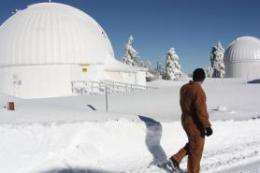
A Mountain Operation technician observes the Catalina Sky Survey telescope and the 32-inch Schulman telescope on Mt. Lemmon. Mountain Operations is the UA team responsible for the maintenance of telescope observatories. During the winter months, the team works to clear away snowfall on and around observatories. Credit: Jay Dee Barryman
(PhysOrg.com) -- Just as property owners are working to protect pipes from bursting during the winter cold, a UA team is working to protect telescope observatories.
While many are preparing for the winter holidays, shopping for last minute gifts and finalizing travel plans, University of Arizona's Mountain Operations is preparing for a long season of protecting telescope observatories from winter weather.
Mountain Operations, a team at UA's Steward Observatory, is in charge of keeping up a wide array of telescope facilities at several main sites among them, Kitt Peak, Mount Lemmon, Mount Graham and Mount Bigelow at the Catalina Station.
The telescope observatories are open almost every day of the year for researchers and for the public alike, even during the winter holidays.
"In the world of science it's just another day," said Bob Peterson, manager of Mountain Operations. But just another day in science is anything but ordinary.
Every morning, Peterson and his team receive an electronic Trouble Report detailing problems encountered at any of the sites related to computers, instruments, the weather or the telescope.
"If there is a problem and we can see it early we have a team take care of the problem that day," Peterson said. "So, by sunset, the astronomers are viewing the sky with a working telescope and instrument."
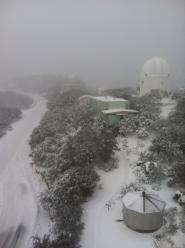
Southern view of Kitt Peak from the Steward Observatory Bok telescope. Credit: Jay Dee Barryman
Working behind the scenes, Mountain Operations do and oversee a little bit of everything, from operating the telescopes to maintaining utility systems.And each year, the team must prepare for winter.
That involves plowing snow off roadways during winter, operating snow removal equipment like front-end loaders and road graders.
"It's an adventure," Peterson said about working with Mountain Operations.
Sites like Mt. Lemmon can get more than 200 inches of snow, which requires clearing miles of roadways near and around telescope observatories. The team must also ensure thermostats are set, maintaining minimum building heat so pipes do not freeze, Peterson.
Mountain Operations also manages dormitories for research astronomers and maintain access to telescope facilities during and after snow storms. The team must also remove snow that gets on the telescope domes themselves
"We have to make sure that there is no snow or ice that could fall in and hurt the optics," said Joe Hoscheidt, instrumentation specialist for Mountain Operations. "We climb to the top of the domes to push the snow off. We wear a safety harness but it's a little unnerving if the wind is blowing it can be icy and it's eight stories high off the ground."
"We want to make sure the telescopes are ready for astronomers to use every night, whatever it takes," Peterson said.
At high altitudes, temperatures can reach as low as zero degrees at many of the observing sites. This allows for long winter seasons, lasting up to seven months from October to April. The team must be ready to face the challenges that come with every cold season.
"Two winters ago," Hoscheidt recalled "we had a really bad snowstorm that came in and we were trying to keep the sites open, plowing snow all day. The weather got worse and a huge tree had blown down across the road. We ended up staying at the sites all night."
"As far as the holidays go, we work based on the needs of the astronomers," Hoscheidt said. "We keep the facilities open so they could do their research, and with them doing their research, we all have a great job. It works well."
Provided by
University of Arizona
-
From lemons to lemonade: Reaction uses carbon dioxide to make carbon-based semiconductor,
32 comments
-
Thioridazine kills cancer stem cells in human while avoiding toxic side-effects of conventional cancer treatments,
3 comments
-
SpaceX private rocket blasts off for space station (Update),
42 comments
-
Climate scientists say they have solved riddle of rising sea,
31 comments
-
SpaceX capsule has 'new car' smell, astronauts say (Update),
4 comments
-
Hypothetical desert earth
23 hours ago
-
More human population = greater mass?
May 25, 2012
-
Conversion from aircraft bearing to normal degrees
May 23, 2012
-
Interpretation/Analysis of the Lab results(HEPA filter)
May 22, 2012
-
Has anyone here attended the The Urbino Summer School in Paleoclimatology?
May 22, 2012
-
Earthquakes: Mag 6 N. Italy and Mag 5.6 W. Bulgaria
May 21, 2012
- More from Physics Forums - Earth
More news stories
Land and sea species differ in climate change response: study
(Phys.org) -- Marine and terrestrial species will likely differ in their responses to climate warming, new research by Simon Fraser University and Australia’s University of Tasmania has found.
6 hours ago |
3.8 / 5 (4) |
5
|
Yale study concludes public apathy over climate change unrelated to science literacy
Are members of the public divided about climate change because they don't understand the science behind it? If Americans knew more basic science and were more proficient in technical reasoning, would public consensus match ...
8 hours ago |
4.8 / 5 (5) |
20
|
10 million years needed to recover from mass extinction
It took some 10 million years for Earth to recover from the greatest mass extinction of all time, latest research has revealed.
Space & Earth / Earth Sciences
8 hours ago |
4 / 5 (4) |
1
|
Sophisticated simulations predict future warming
The chances of our planet being hit by a global warming of 3 degrees Celsius by 2050 is as likely as it being hit by an increase of 1.4 degrees, new research shows. Presented in the journal Nature Geoscience, the British study ...
Space & Earth / Earth Sciences
May 22, 2012 |
4.1 / 5 (10) |
51
Aliens don't want to eat us, says former SETI director
Alien life probably isnt interested in having us for dinner, enslaving us or laying eggs in our bellies, according to a recent statement by former SETI director Jill Tarter.
Space & Earth / Space Exploration
May 25, 2012 |
4.4 / 5 (15) |
41
Stunning image of smallest possible five-ringed structure
Scientists have created and imaged the smallest possible five-ringed structure about 100,000 times thinner than a human hair and you'll probably recognise its shape.
'Unzipped' carbon nanotubes could help energize fuel cells, batteries
Multi-walled carbon nanotubes riddled with defects and impurities on the outside could replace some of the expensive platinum catalysts used in fuel cells and metal-air batteries, according to scientists at ...
Change in developmental timing was crucial in the evolutionary shift from dinosaurs to birds: study
At first glance, it's hard to see how a common house sparrow and a Tyrannosaurus Rex might have anything in common. After all, one is a bird that weighs less than an ounce, and the other is a dinosaur that ...
Computer model used to pinpoint prime materials for efficient carbon capture
When power plants begin capturing their carbon emissions to reduce greenhouse gases and to most in the electric power industry, it's a question of when, not if it will be an expensive undertaking.
T cells 'hunt' parasites like animal predators seek prey, study shows
By pairing an intimate knowledge of immune-system function with a deep understanding of statistical physics, a cross-disciplinary team at the University of Pennsylvania has arrived at a surprising finding: T cells use a movement ...
Scientists develop ultra-sensitive test that detects diseases in their earliest stages
Scientists have developed an ultra-sensitive test that should enable them to detect signs of a disease in its earliest stages, in research published today in the journal Nature Materials.