Shearing triggers odd behavior in microscopic particles
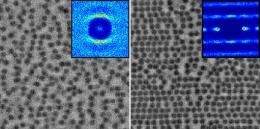
(PhysOrg.com) -- Microscopic spheres form strings in surprising alignments when suspended in a viscous fluid and sheared between two plates — a finding that will affect the way scientists think about the properties of such wide-ranging substances as shampoo and futuristic computer chips.
A team of scientists at Cornell University and the University of Chicago have imaged this behavior and have explained the forces causing it for the first time. Its findings appear in the Dec. 19-23 early edition of the Proceedings of the National Academy of Sciences.
“The experimental breakthrough revealed that these string structures were perpendicular to the shear instead of parallel to it, contrary to what many in the field were expecting,” said Aaron Dinner, associate professor in chemistry at UChicago and a study co-author.
The experiment was led by Itai Cohen, associate professor of physics at Cornell, who custom-built a device that would enable him simultaneously to exert shearing forces on suspended colloids (the spheres) and image the resulting motion at 100 frames per second with a confocal microscope. Imaging speed was critical to the experiment because the string-like structures appear only at certain shear rates.
“This issue of strings has been pretty controversial. I’m not sure that we’ve solved all the controversies associated with them, but at least we’ve made a step forward,” Cohen said.
Shearing forces affect the dynamic behavior of paint, shampoo and other viscous household products, but an understanding of these and related phenomena at the microscopic level has largely eluded a detailed scientific understanding until the last decade, Dinner noted.
Futuristically speaking, these forces potentially could be harnessed to produce microscopic patterns on computer chips or biosensors via special paints that flow easily when layered in one direction, but becomes hard when layered in another direction.
Cohen’s objective was more scientifically immediate: to devise an experiment that would overcome the technical difficulties associated with measuring the mechanical properties of the colloidal strings while also imaging their formation. “The holy grail is to be able to understand how the structure leads to the mechanical properties and then to be able to control the mechanical properties by influencing the structure,” Cohen explained.
Cohen, PhD’01, received his doctorate in physics at UChicago, as did lead author Xiang Cheng, PhD’09, a postdoctoral associate at Cornell who assembled the team; and co-author Xinliang Xu, PhD’07, a postdoctoral scholar at UChicago. The study co-authors also included Stuart Rice, the Frank P. Hixon Distinguished Service Professor Emeritus in Chemistry at UChicago and a 1999 recipient of the National Medal of Science.
As members of UChicago’s Materials Research Science and Engineering Center, Rice and Dinner are part of a larger effort to determine how materials behave under the influence of various dynamic forces. Some of their physics colleagues analyze forces operating on macroscopic scales, while chemists such as Rice and Dinner attempt to assess how those findings might apply to microscopic phenomena.
Rice and his UChicago co-authors used computer simulations to develop a precise explanation for the string-like colloidal structures that formed in the Cornell experiment. “The previous simulations all left out the consequences of the flow created in the supporting fluid as the particles move, the so-called hydrodynamic forces,” Rice said.
“A very large fraction of the work in the field neglects hydrodynamic forces because it’s hard. You try and get away with what you can,” Rice noted with amusement. “But in this case it turns out that the inclusion of those forces is the crucial element.”
The simulations allowed the UChicago team to control various experimental parameters to assess their relative importance. “You can play God,” Rice said. “The important finding is the overwhelming role of the lubrication forces and the anti-intuitive result that they create.”
The lubrication force comes into play when two colloids come together to behave much like macroscopic ball bearings soaking in a reservoir of goopy fluid.
“Pulling them apart would be working against the fluid and so it would be very hard,” Dinner said. “So actually, when you get a collision in these colloidal systems, those lubrication forces hold them together much longer, and that actually allows for some of the unique dynamics that give rise to the structure. That was specifically what the simulations showed.”
Xu, the UChicago postdoctoral scholar, adapted a mathematical formula developed by John Brady at the California Institute of Technology to simplify the simulations, which ran for days and weeks at a time. “Every time you rearrange the particles, the interactions are different,” Rice said. “If you were to calculate that directly, it would be extremely tedious.”
But Xu’s adapation of Brady’s formula enabled him to generate a table of hydrodynamic interactions that listed each particle configuration. Xu found that he could accurately simplify the simulation by focusing on just two of the experiment’s seven layers of colloids.
The simulations and the experiment showed that even after three centuries of study, the field of hydrodynamics continues to yield surprising discoveries. “We are still discovering novel behavior that is fundamentally determined by the hydrodynamics,” Rice noted.
Provided by University of Chicago


