Superhard carbon material could crack diamond
December 7, 2011 by Lisa Zyga feature

Superhard carbon material could crack diamond

Enlarge

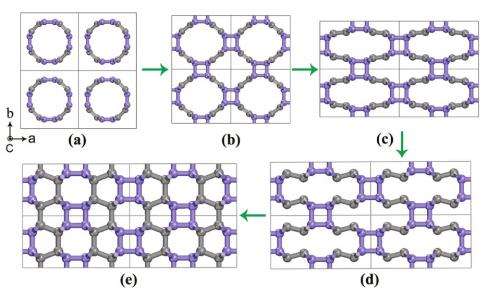
CNT bundles, shown in (a), are compressed and distorted, shown in (b), (c), and (d). After the formation of additional carbon bonds, they are transformed into the new carbon allotrope, Cco-C8, shown in (e). Image credit: Zhao, et al. ©2011 American Physical Society

(PhysOrg.com) -- By applying extreme pressure to compress and flatten carbon nanotubes, scientists have discovered that they can create a new carbon polymer that simulations show is hard enough to crack diamond. The pressure-induced formation process of the new carbon allotrope, called Cco-C8, is similar to the 3D polymerization of the soccer-ball-like buckminsterfullerene, C60, at high pressure. When the carbon nanotube bundle is subjected to further compression, it becomes even more distorted and flattened to produce the Cco-C8 structure.

The scientists, led by Professor Yongjun Tian from the State Key Laboratory of Metastable Materials Science and Technology at Yanshan University in Qinhuangdao, China, have published their study on the new superhard in a recent issue of .1

“Star material carbon exists in various architectures due to its ability to form sp-, sp2-, and sp3-hybridized bonds, fostering graphite, diamond, lonsdaleite, carbine, chaoite, amorphous carbon, nanotubes, fullerenes, graphene, and so on,” Tian told PhysOrg.com. “These carbon allotropes possess outstanding and unparalleled properties, as well as unique scientific and technological importance, such that searching for new carbon allotropes has long been a hot topic in scientific research communities. The greatest significance of this work lies in the new strategy of directly compressing carbon nanotube bundles to design and to synthesize novel metastable carbon allotropes. This strategy implies that some metastable phases of carbon with higher energy may also be experimentally obtained.”

As the scientists explain, applying pressure to some of these carbon allotropes can change the bonds, resulting in different forms of carbon with novel electronic and mechanical properties.

Instead of experimentally searching for new carbon allotropes, the scientists here used a recently developed technique called the Crystal Structure Analysis by Particle Swarm Optimization (CALYPSO). This computerized search was designed to predict stable crystal structures using only chemical compositions of a given compound at specified external conditions, such as pressure.

The CALYPSO simulations first yielded several carbon structures that are already experimentally known (such as graphite and diamond) or theoretically proposed (such as chiral C6). The simulations then revealed the novel Cco-C8 allotrope, a 3D composed of thin (2, 2) carbon nanotubes interconnected through 4-and 6-member carbon rings, which arises due to the formation of additional bonds between carbon atoms.

The simulations showed that Cco-C8 has a Vickers hardness of 95.1 GPa, which is slightly below diamond’s 97.5 GPa. Although there are several ways to measure the hardness of a material, Vickers hardness is one of the most common methods. In this method, a sharp object is compressed into a material, and the dimensions of the resulting indentation are measured.

“Hardness has been used as one of the macroscopic mechanical properties of materials for about three centuries,” Tian explained. “Usually, hardness can be defined macroscopically as the ability of a material to resist being scratched or dented by another. Recently, we defined hardness microscopically as the combined resistance of chemical bonds in a crystal to indentation.” 2

Although Cco-C8 has a Vickers hardness slightly below that of diamond, the scientists predict that Cco-C8 should be hard enough to scratch and crack diamond. As Tian explains, this is because Cco-C8’s compressive strength is higher than diamond’s shear strength.

“The mechanical strength or ideal strength of a material depends on the loading modes of tensile, shear and compression,” he said. “For example, both the tensile strength and shear strength of diamond are about 90 GPa, while its compressive strength is up to 223 GPa. If forced into the surface of a single diamond crystal, Cco-C8 as an indenter is mainly in a compressed state, the chemical bonds of diamond below the indenter withstand compressive deformation, and the bonds around the indenter withstand shear deformation. Although Cco-C8 has slightly lower hardness than diamond, the compressive strength of Cco-C8 should be much higher than the shear strength of diamond. When the stress in the shear deformation zone exceeds the shear strength of diamond, an indentation is formed. In other words, Cco-C8 is able to crack diamond.”

Cco-C8 may not be too difficult to synthesize in the future. The simulations showed that Cco-C8 is highly stable; the new carbon allotrope is energetically more favorable than almost all other theoretical carbon structures. Also, the simulations suggest that Cco-C8 can be synthesized by directly compressing carbon nanotube bundles in a similar way to synthesizing 3D C60 polymers.

In fact, Cco-C8 may have already been synthesized unknowingly. Previous experiments on the cold compression of carbon nanotube bundles yielded a new phase of carbon that was originally identified as P-62c. However, Tian and his coauthors think that the structure was more likely Cco-C8.

In addition, the researchers expect that other novel carbon materials with unique physical properties can be formed by similar compression techniques by using different sized nanotubes or other carbon structures. They plan to search for these materials in the future.

“First, we will use this strategy to design more novel carbon allotropes, especially conducting superhard carbons with partially sp2-hybridized C-C bonds (in the crystal structure of Cco-C8, each carbon atom is sp3-hybridized),” Tian said. “Second, we will try to synthesize these designed carbon materials using bundles at high pressure and high temperature.”

He added that Cco-C8 could have applications in fields where diamond has been used as a superhard material. And if the CALYPSO search discovers conducting superhard carbon materials, they could have potential applications in electronic devices.

More information: 1Zhisheng Zhao, et al. “Novel Superhard Carbon: C-Centered Orthorhombic C8.” PRL 107, 215502 (2011). DOI: 10.1103/PhysRevLett.107.215502

2Bo Xu, Zhisheng Zhao, and Yongjun Tian. “Microscopic theory of hardness and design of novel superhard crystals.” (Invited Review), Int. J. Refract. Met. Hard. Mater. (under review)

Copyright 2011 PhysOrg.com.
All rights reserved. This material may not be published, broadcast, rewritten or redistributed in whole or part without the express written permission of PhysOrg.com.

4.7 /5 (27 votes)  

Filter


Move the slider to adjust rank threshold, so that you can hide some of the comments.


Display comments: newest first

Eikka
Dec 07, 2011

Rank: 1 / 5 (1)
I thought denting and cracking were two different things.
SolidStateUniverse
Dec 07, 2011

Rank: not rated yet
The first thing I read was 'Star Material Carbon'... which references shape instead of origin, I know, but I wonder if these shapes would be similar to those found in the so-called Diamond Stars?

http://news.bbc.c...2919.stm

Also, I wonder about the thermal conductivity of this new allotrope. Seems like it should be quite high and be quite stable at high temperatures.
Pete1983
Dec 07, 2011

Rank: not rated yet
The first thing I read was 'Star Material Carbon'... which references shape instead of origin, I know, but I wonder if these shapes would be similar to those found in the so-called Diamond Stars?

http://news.bbc.c...2919.stm

Also, I wonder about the thermal conductivity of this new allotrope. Seems like it should be quite high and be quite stable at high temperatures.


Even with a poor conductivity, this could be pretty spectacular stuff. Manufacturing it on any large scale is probably a long way off (I don't know enough to speculate, but surely 10 to 30 years?), yet if you can produce it on a large scale it would be the best choice yet for a space elevator (assuming better tension strength than other wonder-carbon alternatives).

I can't help but think that once we crack large scale nanotubes, many other forms of carbon (such as this) will fall into place shortly after.

It will be like the plastic revolution (but better) all over again.
Husky
Dec 08, 2011

Rank: not rated yet
i would think of a heavy anvil pressing machine that use diamond coated rolls to weld the nanotubes, if you line up two sets of nanotubes lenghtwise and use a slight offset so that they overlap at the linking points you could press together a nanochain of arbitrary length of 2 nanotubes thick, these long strands could be used to weave a cable, i would think it would work for chaining up small patches of overlapping graphene flakes also, allthough it would ewsemble more like a patched quilt than a single giant monolayer piece of graphene, i would think the physical properties be very good for industrial/consumer uses and easier to manufacture
visual
Dec 08, 2011

Rank: not rated yet
If it's so easy to create, why did they leave this at the "simulation" stage? It would have been much better for CALYPSO's reputation if they had actually created the material to prove the simulation's effectiveness.
despinos
Dec 09, 2011

Rank: not rated yet
The first thing I read was 'Star Material Carbon'... which references shape instead of origin, I know, but I wonder if these shapes would be similar to those found in the so-called Diamond Stars?

http://news.bbc.c...2919.stm

Also, I wonder about the thermal conductivity of this new allotrope. Seems like it should be quite high and be quite stable at high temperatures.


Here "Star" does not refer to shape, but has the same meaning as in "movie star"...

rwinners
Dec 12, 2011

Rank: not rated yet
Let me know when they have something that will scratch diamond.
fmfbrestel
Dec 15, 2011

Rank: not rated yet
At least this is meta-stable. I cant stand it when they report some great material that has crazy properties, but only exists when it is under immense pressure or massive magnetic field.
Rank 4.7 /5 (27 votes)
Relevant PhysicsForums posts
  • How to determine the flexural rigidity of a composite
    created4 hours ago
  • microstructure of titanium
    createdMay 26, 2012
  • Steam in My Espresso Machine
    createdMay 26, 2012
  • Density question
    createdMay 24, 2012
  • Mass transport originating from a point source at a solid gas interface
    createdMay 22, 2012
  • Ammonia dispersion in Air
    createdMay 22, 2012
  • More from Physics Forums - Materials & Chemical Engineering

More news stories

Stunning image of smallest possible five-ringed structure

Scientists have created and imaged the smallest possible five-ringed structure – about 100,000 times thinner than a human hair – and you'll probably recognise its shape.

Nanotechnology / Nanophysics

created 2 hours ago | popularity 4.7 / 5 (3) | comments 1 | with audio podcast

'Unzipped' carbon nanotubes could help energize fuel cells, batteries

Multi-walled carbon nanotubes riddled with defects and impurities on the outside could replace some of the expensive platinum catalysts used in fuel cells and metal-air batteries, according to scientists at ...

Nanotechnology / Nanomaterials

created 8 hours ago | popularity 3 / 5 (2) | comments 0 | with audio podcast

Dopant gives graphene solar cells highest efficiency yet

(Phys.org) -- By taking advantage of graphene’s favorable electrical and optical properties, and then adding an organic dopant, researchers have achieved the highest power conversion efficiency yet for ...

Nanotechnology / Nanophysics

created May 21, 2012 | popularity 5 / 5 (10) | comments 14 | with audio podcast feature

In nanorod crystal growth, nanoparticles seen as artificial atoms

In the growth of crystals, do nanoparticles act as "artificial atoms" forming molecular-type building blocks that can assemble into complex structures? This is the contention of a major but controversial theory ...

Nanotechnology / Nanophysics

created May 24, 2012 | popularity 4.8 / 5 (6) | comments 0 | with audio podcast

First direct observation of oriented attachment in nanocrystal growth

Berkeley Lab researchers have reported the first direct observation of nanoparticles undergoing oriented attachment, the critical step in biomineralization and the growth of nanocrystals. A better understanding ...

Nanotechnology / Nanophysics

created May 24, 2012 | popularity 4.7 / 5 (3) | comments 0 | with audio podcast


Change in developmental timing was crucial in the evolutionary shift from dinosaurs to birds: study

At first glance, it's hard to see how a common house sparrow and a Tyrannosaurus Rex might have anything in common. After all, one is a bird that weighs less than an ounce, and the other is a dinosaur that ...

Computer model used to pinpoint prime materials for efficient carbon capture

When power plants begin capturing their carbon emissions to reduce greenhouse gases – and to most in the electric power industry, it's a question of when, not if – it will be an expensive undertaking.

T cells 'hunt' parasites like animal predators seek prey, study shows

By pairing an intimate knowledge of immune-system function with a deep understanding of statistical physics, a cross-disciplinary team at the University of Pennsylvania has arrived at a surprising finding: T cells use a movement ...

Land and sea species differ in climate change response: study

(Phys.org) -- Marine and terrestrial species will likely differ in their responses to climate warming, new research by Simon Fraser University and Australia’s University of Tasmania has found.

Yale study concludes public apathy over climate change unrelated to science literacy

Are members of the public divided about climate change because they don't understand the science behind it? If Americans knew more basic science and were more proficient in technical reasoning, would public consensus match ...

10 million years needed to recover from mass extinction

It took some 10 million years for Earth to recover from the greatest mass extinction of all time, latest research has revealed.