Scientists discover why buttercups reflect yellow on chins
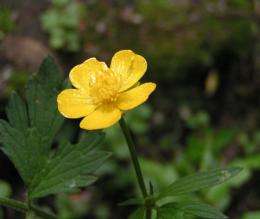
Scientists have found that the distinctive glossiness of the buttercup flower (Ranunculus repens), which children like to shine under the chin to test whether their friends like butter, is related to its unique anatomical structure. Their findings were published today, 14 December, in the Royal Society journal Interface.
The researchers discovered that the buttercup petal's unique bright and glossy appearance is the result of the interplay between its different layers. In particular, the strong yellow reflection responsible for the chin illumination is mainly due to the epidermal layer of the petal that reflects yellow light with an intensity that is comparable to glass.
Scientists have been interested in how the buttercup flower works for over a century. They have previously shown that the reflected colour is yellow due to the absorption of the colours in the blue-green region of the spectrum by the carotenoid pigment in the petals. As the blue-green light is absorbed, the light in the other spectral regions (in this case, primarily yellow) is reflected. It has also been known for many years that the epidermal layer of the petals is composed of very flat cells, providing strong reflection.
This new study shows how the buttercup's exceptionally bright appearance is a result of a special feature of the petal structure. The epidermal layer of cells has not one but two extremely flat surfaces from which light is reflected. One is the top of the cells, the other exists because the epidermis is separated from the lower layers of the petal by an air gap. Reflection of light by the smooth surface of the cells and by the air layer effectively doubles the gloss of the petal, explaining why buttercups are so much better at reflecting light under your chin than any other flower.
The researchers also found that the buttercup reflects a significant amount of UV light. As many pollinators, including bees, have eyes sensitive in the UV region, this provides insight into how the buttercup uses its unique appearance to attract insects.
Dr Silvia Vignolini, from the University of Cambridge's Department of Physics (Cavendish Laboratory), explained the importance of the buttercup's unique appearance: "Although many different factors, such as scent and temperature, influence the relationships between pollinators and flowers, the visual appearance of flowers is one of the most important factors in this communication. Flowers develop brilliant colour, or additional cues, such as glossiness - in the case of the buttercup - that contribute to make the optical response of the flower unique. Moreover, the glossiness might also mimic the presence of nectar droplets on the petals, making them that much more attractive."
Dr Beverley Glover, Department of Plant Sciences, said: "This phenomenon has intrigued scientists and laymen alike for centuries. Our research provides exciting insight into not only a children's game but also into the lengths to which flowers will go to attract pollinators."
Professor Ulli Steiner, from the Nanophotonics Centre at the Cavendish Laboratory, the University of Cambridge's Department of Physics, said: "It is fun to revisit a problem that is more than one century old and, using modern methods, discover something new. The strong collaboration between Physics and the Plant Sciences has enabled this."
More information: The paper 'Directional scattering from the glossy flower of Ranunculus: how the buttercup lights up your chin' will be published in the 14 December edition of the Royal Society journal Interface.
Provided by University of Cambridge


