Revolutionary navigation system for future Mars rovers
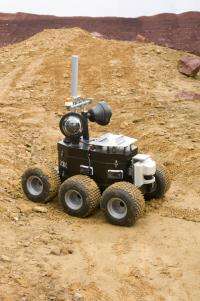
BAe Robotic rover being tested on the simulated martian landscape
(PhysOrg.com) -- An autonomous navigation system that will enable a future planetary rover vehicle to be in complete control of its own actions as it explores the surface of Mars is being designed by top-calibre scientists and engineers at STFC’s Rutherford Appleton Laboratory. The team from the UK, France and Canada are joining forces to design ‘Seeker’ as part of the European Space Agency’s (ESA’s) StarTiger initiative, which tackles specific space-related challenges through targeted projects with fixed timeframes. Details of Seeker’s development were unveiled today on the day STFC’s RAL Space is holding its 7th Appleton Space conference.
The high level conference organised by RAL (Rutherford Appleton Laboratory) Space, brings together leading figures from the global space industry to share the very latest developments in current and future space exploration; this year’s programme features a video address from the Rt Hon David Willetts MP, Minister of State for Universities and Science. The StarTiger-Seeker project, led by RAL Space, is a seven month project that will see the team work intensively day and night to design a navigation system that, unlike previous systems, will enable a rover to navigate around Mars totally independently, covering at least 1km a day. The Seeker navigation system will allow a rover to react better to its surroundings and undertake experiments in more locations, enabling our understanding of the Red Planet to take a major leap forward.
Designed for use on future missions to Mars, Seeker will perform a range of key actions completely unaided by Mission Control or by GPS-type technology. These include: identifying the precise location of the rover on Mars, identifying promising scientific opportunities; long-range pinpointing of particular sites to visit; detecting and avoiding hazards; and navigating back to previously visited sites. It is expected that the Seeker technology will also have potential applications here on Earth, particularly in inhospitable environments.
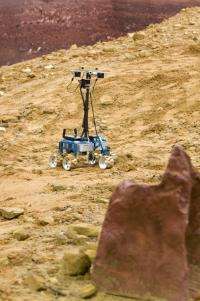
Robotic rover "indie" being tested on the simulated martian landscape
The Seeker team includes experts from RAL Space, SciSys, BAe Systems, Roke Manor Research (all from the UK), LAAS (France) and MDA Space & Robotics (Canada). It will apply leading-edge skills in autonomy and intelligence, electronic sensing, image processing and other disciplines to tackle the huge challenges presented by the project.Kim Ward of RAL Space, the Project Director, says: “The keys to Seeker’s success will be imagination, application and team work. With radio signals to conventional rovers taking at least 30 minutes to travel between Earth and Mars, Seeker’s ability to work autonomously in hostile terrain will be crucial to extending our understanding of our planetary neighbour.”
David Willetts said: "Space captures the imagination of so many people, and it’s excellent to see UK experts playing such a significant role in the groundbreaking StarTiger initiative. The Seeker project has the potential to transform our exploration of Mars and make an important contribution to the international body of knowledge on the universe around us."
The UK Space Agency (UKSA) was instrumental in bringing the ESA StarTiger project to the UK, through working with ESA Harwell (ESA’s only UK base) and securing funding for ESA Harwell’s establishment as a focus for space exploration.
Among those attending today’s Appleton Space Conference are Jean-Jacques Dordain, Director General of ESA, and Robert Cabana, Director of the Kennedy Space Centre in the USA.
Also at the conference, the President of UrtheCast, Scott Larson, gave more details about RAL Space’s plans to design and build two cameras that will provide the first-ever live video feeds from space. The cameras will be installed on the International Space Station now in orbit around Earth.
Provided by
Science and Technology Facilities Council
-
From lemons to lemonade: Reaction uses carbon dioxide to make carbon-based semiconductor,
32 comments
-
Thioridazine kills cancer stem cells in human while avoiding toxic side-effects of conventional cancer treatments,
3 comments
-
SpaceX private rocket blasts off for space station (Update),
42 comments
-
Climate scientists say they have solved riddle of rising sea,
31 comments
-
SpaceX capsule has 'new car' smell, astronauts say (Update),
4 comments
-
Distance of planets from stars and revolution
5 hours ago
-
revamping general concept and cosmological principle
May 25, 2012
-
Transiting Exoplanet Light Curve
May 25, 2012
-
Math behind Theoretical Physics
May 24, 2012
-
Do we know whats at the center of galaxies yet?
May 23, 2012
-
Structure of the Milky Way?
May 20, 2012
- More from Physics Forums - General Astronomy
More news stories
Land and sea species differ in climate change response: study
(Phys.org) -- Marine and terrestrial species will likely differ in their responses to climate warming, new research by Simon Fraser University and Australia’s University of Tasmania has found.
3 hours ago |
3.7 / 5 (3) |
3
|
Yale study concludes public apathy over climate change unrelated to science literacy
Are members of the public divided about climate change because they don't understand the science behind it? If Americans knew more basic science and were more proficient in technical reasoning, would public consensus match ...
5 hours ago |
4.8 / 5 (4) |
11
|
10 million years needed to recover from mass extinction
It took some 10 million years for Earth to recover from the greatest mass extinction of all time, latest research has revealed.
Space & Earth / Earth Sciences
5 hours ago |
5 / 5 (3) |
1
|
Sophisticated simulations predict future warming
The chances of our planet being hit by a global warming of 3 degrees Celsius by 2050 is as likely as it being hit by an increase of 1.4 degrees, new research shows. Presented in the journal Nature Geoscience, the British study ...
Space & Earth / Earth Sciences
May 22, 2012 |
4.4 / 5 (9) |
51
Aliens don't want to eat us, says former SETI director
Alien life probably isnt interested in having us for dinner, enslaving us or laying eggs in our bellies, according to a recent statement by former SETI director Jill Tarter.
Space & Earth / Space Exploration
May 25, 2012 |
4.4 / 5 (14) |
41
'Unzipped' carbon nanotubes could help energize fuel cells, batteries
Multi-walled carbon nanotubes riddled with defects and impurities on the outside could replace some of the expensive platinum catalysts used in fuel cells and metal-air batteries, according to scientists at ...
Change in developmental timing was crucial in the evolutionary shift from dinosaurs to birds: study
At first glance, it's hard to see how a common house sparrow and a Tyrannosaurus Rex might have anything in common. After all, one is a bird that weighs less than an ounce, and the other is a dinosaur that ...
Computer model used to pinpoint prime materials for efficient carbon capture
When power plants begin capturing their carbon emissions to reduce greenhouse gases and to most in the electric power industry, it's a question of when, not if it will be an expensive undertaking.
T cells 'hunt' parasites like animal predators seek prey, study shows
By pairing an intimate knowledge of immune-system function with a deep understanding of statistical physics, a cross-disciplinary team at the University of Pennsylvania has arrived at a surprising finding: T cells use a movement ...
Scientists develop ultra-sensitive test that detects diseases in their earliest stages
Scientists have developed an ultra-sensitive test that should enable them to detect signs of a disease in its earliest stages, in research published today in the journal Nature Materials.
Manufacturing genes to attack flu virus
An international research team has manufactured a new protein that can combat deadly flu epidemics.

Dec 08, 2011
Rank: 2.3 / 5 (3)
Dec 08, 2011
Rank: 4.5 / 5 (2)
Curiosity team better hope Curiosity stays in service for a long time because it looks like they'll soon be out of the job.
Dec 08, 2011
Rank: 3.7 / 5 (3)
An autonomous navigation system, if really advanced, would be an asset if the AI is well advanced also.
Dec 08, 2011
Rank: 1 / 5 (1)
Dec 09, 2011
Rank: 5 / 5 (1)
Dec 09, 2011
Rank: not rated yet
Several times scale replicas of the scenarios have been built on Earth and countless simulations of complex, completely unintuitive maneuvers were tried over and over again (widely varied scenarios of wheels pointing in different directions, turning in different directions, etc). These were done because many of the maneuvers sent would simply dig the rover further and further into the mars (fun to use that as a non-propper noun!).
Eventually, after many hundreds of hours of earth-based to-scale simulations, we've been fortunate in that we've managed to have the rovers dig themselves out.
Somehow I think autonomous drive in locations without a service truck handy will never be a good idea, unless the communication time-lag is truly insurmountable.