Physicists 'turn signals' for neuron growth
Dec 15, 2011
Physicists 'turn signals' for neuron growth
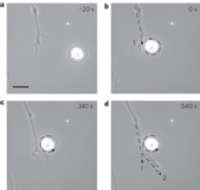
Time-lapse images when a Vaterite particle is rotated anticlockwise and positioned to the left of the axon defined by the growth direction of the axon (dashed arrow 1). (From Nature Photonics)

(PhysOrg.com) -- A new paper scheduled for publication in the January issue of Nature Photonics describes the use of spinning microparticles to direct the growth of nerve fiber, a discovery that could allow for directed growth of neuronal networks on a chip and improve methods for treating spinal or brain injuries.

Samarendra Mohanty, an assistant professor of at The University of Texas at Arlington, is a coauthor of the paper, which is now available online.

The study is based on Mohanty’s hypothesis that neurons can respond to physical (e.g. fluid flow) cues in addition to chemical cues. He conducted the seminal work and observed that a laser-driven spinning Calcite microparticle could guide the direction of neuron growth. Its rotation caused a shearing effect by creating a microfluidic flow.

Mohanty’s work led the University of California, Irvine team led by Professor Michael Berns to test the Vaterite “micro-motors” in guiding neurons.

Mohanty said: “This is the first report to demonstrate that neurons can be turned in a controlled manner by microfluidic flow. With this method, we can direct them to turn right or turn left and we can quickly insert or remove the rotating beads as needed. But flow can be generated by any means. In the body, for example, it will be more convenient to use a tube carrying fluids.”

The researchers in the UC Irvine experiments used a laser tweezers system to trap a birefringent particle (Calcite or Vaterite) near axonal growth cones, which are the tips of neurons where connections are made with other neurons or cells. The same laser causes rotation of the particle, which creates the flow, Mohanty said.

The paper reports that the new method successfully turned the growing axon in a new direction up to 42 percent of the time in lab experiments. The authors noted that the method could also be used to funnel growth between two rotating particles. The effects also may be reproducible on a larger scale, they said.

“One can envision large arrays of these devices that can direct large numbers of axons to different locations,” the authors wrote. “This may have the potential for use in vivo to direct regenerating axons to mediate brain and spinal cord repair.”

Mohanty said that during neurogenesis – the process by which neurons grow and develop in a fetus – flow of spinal fluid can influence guidance of neurons to their destinations. His lab at UT Arlington is currently developing a novel optical method that allows long-range optical guidance of with 100 percent efficacy without use of any additional external objects.

In addition to UC Irvine and UT Arlington, other authors on the study hail from the Quantum Science Laboratory at The University of Queensland in Australia.

The paper said the experiments shed valuable light on the effect of shear or lateral forces on neuron growth and that knowledge may even apply to other forms of cell growth. 

Explore further: New tool has potential for brain mapping

More information: www.nature.com/nphoton/journal/vaop/ncurrent/full/nphoton.2011.287.html

Provided by University of Texas at Arlington

4.5 /5 (6 votes)

Related Stories

Biologists discover genes that repair nerves after injury

Sep 21, 2011

Biologists at the University of California, San Diego have identified more than 70 genes that play a role in regenerating nerves after injury, providing biomedical researchers with a valuable set of genetic leads for use ...

Researchers regenerate axons necessary for voluntary movement

Apr 06, 2009

For the first time, researchers have clearly shown regeneration of a critical type of nerve fiber that travels between the brain and the spinal cord and which is required for voluntary movement. The regeneration was accomplished ...

Helping neurons stay on track

Aug 26, 2011

The complex inner wiring of the brain is coordinated in part by chemical guidance factors that help direct the interactions between individual neurons. As growing cells extend their axons outward, these tendrils ...

Recognizing blood poisoning quickly

Dec 02, 2011

(Medical Xpress) -- Is the patient suffering from blood poisoning? To answer this question, the doctor draws a blood sample and sends it to a central laboratory for testing. This takes up valuable time, which ...

Blood pressure research addresses differences

Nov 21, 2011

(Medical Xpress) -- A UT Arlington researcher’s recent work may hold clues as to why hypertension is more severe and strikes earlier in the African-American population.

Recommended for you

New tool has potential for brain mapping

May 16, 2013

A new tool being developed by UT Arlington assistant professor of physics could help scientists map and track the interactions between neurons inside different areas of the brain.

Quantum dot LED approaches theoretical maximum efficiency

May 14, 2013

(Phys.org) —Quantum dot LEDs (QLEDs) are a promising technology for creating large-area displays that could have applications for TVs, cell phones, and digital cameras. So far, however, the highest efficiencies ...

Photonic quantum computers: A brighter future than ever

May 13, 2013

(Phys.org) —Harnessing the unique features of the quantum world promises a dramatic speed-up in information processing as compared to the fastest classical machines. Scientists from the Group of Philip ...

User comments : 0

More news stories

Promising doped zirconia

Materials belonging to the family of dilute magnetic oxides (DMOs)—an oxide-based variant of the dilute magnetic semiconductors—are good candidates for spintronics applications. This is the object of ...

Bringing life into focus

Spinning-disk confocal microscopy is an optical imaging technique that can be used to generate detailed three-dimensional fluorescence images of living cells and their contents. Although a powerful tool for ...

Nanocrystals grow from liquid interface

An international collaboration of scientists has discovered a unique crystalizing behavior at the interface between two immiscible liquids that could aid in sustainable energy development.

Alaska volcano shoots ash 15,000 feet into the air

(AP)—One of Alaska's most restless volcanoes has shot an ash cloud 15,000 feet into the air in an ongoing eruption that has drawn attention from a nearby community but isn't expected to threaten air traffic.

US seizes Bitcoin operator accounts

US authorities seized the accounts of a Bitcoin digital currency exchange operator, claiming it was functioning as an "unlicensed money service business," court documents showed Friday.

Chinese, Indian airlines face EU pollution fines

Eight Chinese and two Indian airlines face fines of up to several million euros for not paying for their greenhouse gas emissions during flights within the bloc, the European Commission said on Friday.