N.H. voters have become less Republican since 1960s, new research shows
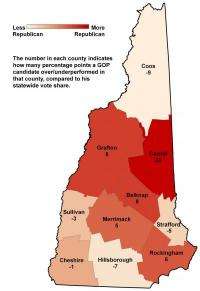
This map shows Republican strength by county for presidential elections from 1960-1968. Credit: Carsey Institute at UNH
New Hampshire voters are about to observe their first-in-the-nation presidential primary. However, someone will be missing from this civic celebration: the Yankee Republican, that rural stalwart of New England conservative values, according to new research from the Carsey Institute at the University of New Hampshire.
"Once upon a time, the rural counties of New Hampshire were among the most Republican in the country. Nowadays, visiting out-of-state reporters are more likely to find Republican primary voters in the densely populated towns of the Granite State's southern tier. In the past, old-time New Hampshire Republicans frequently complained about the negative effects of Massachusetts voters moving north. Now, one might argue that Interstate 93 has only bolstered the state's Grand Old Party," says Dante Scala, associate professor of political science and a faculty fellow the Carsey Institute.
The key findings of the research show:
- Looking at presidential elections from 1960-2008, New Hampshire voters have become less Republican overall.
- Republican presidential candidates no longer have the advantage they once did in New Hampshire's "Yankee" rural counties.
- Historically Republican counties Grafton and Merrimack have both tilted Democratic consistently in recent decades.
- Hillsborough and Rockingham counties' percentage of Republican presidential primary voters across the state has grown from 44 percent in 1976 to 55 percent.
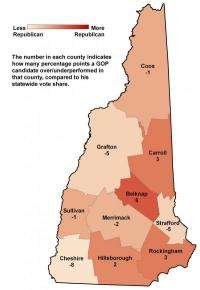
This map shows Republican strength by county for presidential elections from 2000-2008. Credit: Carsey Institute at UNH
In 1976, voters in Hillsborough and Rockingham counties combined to cast 44 percent of all ballots in the Republican primary. By 2008, their portion of the primary vote had increased to 55 percent. Three of 10 votes were cast in Hillsborough alone, one of four in Rockingham.Merrimack and Strafford counties have held steady in terms of voting power in the Republican primary, casting roughly one of five votes.
Thirty years ago, a Republican running for president could find a fair number of votes in the rural counties of the Granite State. One third of all GOP ballots cast in the 1976 primary came from places such as Belknap (6 percent of all ballots) and Carroll (5 percent), as well as counties bordering Vermont such as Grafton (8 percent) and Cheshire (7 percent). Even Coös County accounted for 4 percent of all GOP primary votes.
By 2008, Coös County's "voting power" in the primary had shrunk by half, from 4 percent of ballots cast to just 2 percent. And the influence of the rural periphery as a whole has waned significantly. These six counties now account for just one of every four votes cast in the presidential primary.
"On the one hand, national political reporters will have an increasingly difficult time landing an interview with the laconic old-timer sporting the red plaid jacket. On the other, a chief complaint about the New Hampshire primarythat its voters are too rural, hence too unrepresentative of the general electorateis dissipating," Scala says.
"The fate of Mitt Romney, Newt Gingrich, and the other competitors will largely be decided by voters who live within the environs of the Greater Boston metropolitan area. As such, they might be a harbinger of how Republicans in other suburbs around the country may choose when it is their turn to cast votes," he said.
More information: The complete report about this research, "Changes in New Hampshire's Republican Party: Evolving Footprint in Presidential Politics, 1960-2008," is available at http://carseyinsti … h.php?id=182
Provided by
University of New Hampshire
-
From lemons to lemonade: Reaction uses carbon dioxide to make carbon-based semiconductor,
32 comments
-
Thioridazine kills cancer stem cells in human while avoiding toxic side-effects of conventional cancer treatments,
3 comments
-
SpaceX private rocket blasts off for space station (Update),
42 comments
-
Climate scientists say they have solved riddle of rising sea,
31 comments
-
SpaceX capsule has 'new car' smell, astronauts say (Update),
4 comments
-
Consumption rivalry
May 25, 2012
-
Bilateral trade between all countries
May 24, 2012
-
Is the economic foundation of social media in jeopardy?
May 20, 2012
-
Psychology: Rosenthal and Hawthorne Effect
May 15, 2012
-
Is GDP and National Income the Same Thing?
May 13, 2012
-
Difference between hourly wage and real GDP per hour worked?
May 12, 2012
- More from Physics Forums - Social Sciences
More news stories
Change in developmental timing was crucial in the evolutionary shift from dinosaurs to birds: study
At first glance, it's hard to see how a common house sparrow and a Tyrannosaurus Rex might have anything in common. After all, one is a bird that weighs less than an ounce, and the other is a dinosaur that ...
Other Sciences / Archaeology & Fossils
5 hours ago |
5 / 5 (4) |
0
|
Social welfare cuts ultimately come with heavy price, researchers say
(Phys.org) -- Slashing government funding for Medicaid, food stamps and other programs that serve the poor while politically popular with some lawmakers and many conservatives may do more harm ...
Other Sciences / Social Sciences
May 24, 2012 |
4.2 / 5 (20) |
155
Ancient Bethlehem seal unearthed in Jerusalem
Israeli archaeologists have discovered a 2,700-year-old seal that bears the inscription "Bethlehem," the Israel Antiquities Authority announced Wednesday, in what experts believe to be the oldest artifact ...
Other Sciences / Archaeology & Fossils
May 23, 2012 |
3.3 / 5 (15) |
24
Dollars and sense: Why are some people morally against tax?
As the U.S. presidential election campaigns heat up, the economic debate is dominated by bailouts, austerity and, inevitably, taxation. Now a new study published in Symbolic Interaction asks why tax is such an important issue ...
Other Sciences / Social Sciences
May 23, 2012 |
2.3 / 5 (3) |
16
Oldest Jewish archaeological evidence on the Iberian Peninsula
German archaeologists of the Friedrich Schiller University Jena found one of the oldest archaeological evidence so far of Jewish Culture on the Iberian Peninsula at an excavation site in the south of Portugal, ...
Other Sciences / Archaeology & Fossils
May 25, 2012 |
4.2 / 5 (6) |
12
'Unzipped' carbon nanotubes could help energize fuel cells, batteries
Multi-walled carbon nanotubes riddled with defects and impurities on the outside could replace some of the expensive platinum catalysts used in fuel cells and metal-air batteries, according to scientists at ...
Computer model used to pinpoint prime materials for efficient carbon capture
When power plants begin capturing their carbon emissions to reduce greenhouse gases and to most in the electric power industry, it's a question of when, not if it will be an expensive undertaking.
T cells 'hunt' parasites like animal predators seek prey, study shows
By pairing an intimate knowledge of immune-system function with a deep understanding of statistical physics, a cross-disciplinary team at the University of Pennsylvania has arrived at a surprising finding: T cells use a movement ...
Land and sea species differ in climate change response: study
(Phys.org) -- Marine and terrestrial species will likely differ in their responses to climate warming, new research by Simon Fraser University and Australia’s University of Tasmania has found.
Yale study concludes public apathy over climate change unrelated to science literacy
Are members of the public divided about climate change because they don't understand the science behind it? If Americans knew more basic science and were more proficient in technical reasoning, would public consensus match ...
10 million years needed to recover from mass extinction
It took some 10 million years for Earth to recover from the greatest mass extinction of all time, latest research has revealed.
