Mozambique's new forests may not be as green as they seem
December 5, 2011 by Johannes Myburgh
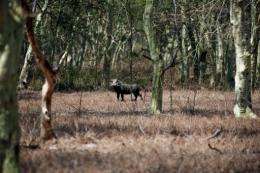
A warthog stands among trees in 2010 in the Gorongosa National Park, Mozambique. Foreign companies are spending billions of dollars to plant forests in Mozambique, but conservationists fear the investments aren't as good for the environment as they might initially seem.
Foreign companies are spending billions of dollars to plant forests in Mozambique, but conservationists fear the investments aren't as good for the environment as they might initially seem.
Mozambique has about 400,000 square kilometres (155,000 square miles) of largely untouched forests, an area larger than Germany that covers half of the country, making it a prime target in the African land rush that has seen foreign firms staking large claims for agri-business across the continent.
Three of Mozambique's biggest forestry investors tout their "green" credentials, with schemes to plant trees to filter carbon from the atmosphere and help slow global warming.
But the projects have drawn the ire of local communities who sometimes claim they were never consulted, and of activists who fear the consequences of replacing natural forests with commercial plantations of pine and eucalyptus.
Norwegian forestry group Green Resources and Portuguese paper producer Portucel have started on eucalyptus plantations, investments each worth more than $2.2 billion covering a total of 250,000 hectares (600,000 acres).
Both companies say their programmes comply with international schemes that aim to remove carbon from the atmosphere while creating economic benefits for Mozambique by processing wood for paper and building materials.
"The forestry plantations are planted in areas degraded by (human activity), therefore no felling of valuable indigenous trees will be required," Portucel spokeswoman Ana Nery told AFP.
But environmentalists argue the plantations will threaten Mozambique's biodiversity, saying degraded forests should be allowed to regenerate naturally.
"It is easy to say it is degraded zones. There is still so much biodiversity left and it recovers quickly," said Philip Owen, president of South African environmental NGO Geasphere.
When companies create new plantations, "especially with eucalyptus and pine, it has a terrible impact on resources", he said.
The Global Solidarity Forest Fund, run by churches in Norway and Sweden, holds around 23,000 hectares for pine and eucalyptus in a similar programme.
But Geasphere has accused the Fund of chopping down trees "at an alarming rate to give space to monoculture tree plantations."
The group criticised "the extremely high water consumption of the alien plants," with a single eucalyptus able to suck up 50 litres (13 gallons) of water a day, and the occupation of fertile land "vital to the food security" of small farmers.
The Swedish Cooperative Centre, a charity that supports small farmers, accused the Fund of bribing local leaders known as regulos to win approval for the plantations, resulting in conflicts with nearby communities.
"The community consultation was not done properly and the community does not feel involved," said Kajsa Johansson, the charity's chief in Mozambique.
Over the past three years small farmers have set fires to plantations out of frustration, she said.
"They uprooted plants. They also burnt the storage room of the company," she added.
The Fund has since replaced its management team.
"We are aware that afforestation has to be done very carefully," Fund spokeswoman Kinna Brundin told AFP.
"We are taking measures in identifying possible problems and will strengthen the consultation."
Globally, programmes to encourage poor countries to preserve large forests are a key part of the UN climate talks underway in the South African city of Durban, after the last round of talks in Mexico agreed to standards on the protection of forests.
South African agronomist Coert Geldenhuys said the trick is to find a balance between natural and planted forests.
"The question is, the new trees need to be integrated in the landscape," he said.
(c) 2011 AFP
-
From lemons to lemonade: Reaction uses carbon dioxide to make carbon-based semiconductor,
32 comments
-
Thioridazine kills cancer stem cells in human while avoiding toxic side-effects of conventional cancer treatments,
3 comments
-
SpaceX private rocket blasts off for space station (Update),
42 comments
-
Climate scientists say they have solved riddle of rising sea,
31 comments
-
SpaceX capsule has 'new car' smell, astronauts say (Update),
4 comments
-
Hypothetical desert earth
20 hours ago
-
More human population = greater mass?
May 25, 2012
-
Conversion from aircraft bearing to normal degrees
May 23, 2012
-
Interpretation/Analysis of the Lab results(HEPA filter)
May 22, 2012
-
Has anyone here attended the The Urbino Summer School in Paleoclimatology?
May 22, 2012
-
Earthquakes: Mag 6 N. Italy and Mag 5.6 W. Bulgaria
May 21, 2012
- More from Physics Forums - Earth
More news stories
Land and sea species differ in climate change response: study
(Phys.org) -- Marine and terrestrial species will likely differ in their responses to climate warming, new research by Simon Fraser University and Australia’s University of Tasmania has found.
3 hours ago |
3.7 / 5 (3) |
3
|
Yale study concludes public apathy over climate change unrelated to science literacy
Are members of the public divided about climate change because they don't understand the science behind it? If Americans knew more basic science and were more proficient in technical reasoning, would public consensus match ...
5 hours ago |
4.8 / 5 (4) |
11
|
10 million years needed to recover from mass extinction
It took some 10 million years for Earth to recover from the greatest mass extinction of all time, latest research has revealed.
Space & Earth / Earth Sciences
5 hours ago |
5 / 5 (3) |
1
|
Sophisticated simulations predict future warming
The chances of our planet being hit by a global warming of 3 degrees Celsius by 2050 is as likely as it being hit by an increase of 1.4 degrees, new research shows. Presented in the journal Nature Geoscience, the British study ...
Space & Earth / Earth Sciences
May 22, 2012 |
4.4 / 5 (9) |
51
Aliens don't want to eat us, says former SETI director
Alien life probably isnt interested in having us for dinner, enslaving us or laying eggs in our bellies, according to a recent statement by former SETI director Jill Tarter.
Space & Earth / Space Exploration
May 25, 2012 |
4.4 / 5 (14) |
41
'Unzipped' carbon nanotubes could help energize fuel cells, batteries
Multi-walled carbon nanotubes riddled with defects and impurities on the outside could replace some of the expensive platinum catalysts used in fuel cells and metal-air batteries, according to scientists at ...
Change in developmental timing was crucial in the evolutionary shift from dinosaurs to birds: study
At first glance, it's hard to see how a common house sparrow and a Tyrannosaurus Rex might have anything in common. After all, one is a bird that weighs less than an ounce, and the other is a dinosaur that ...
Computer model used to pinpoint prime materials for efficient carbon capture
When power plants begin capturing their carbon emissions to reduce greenhouse gases and to most in the electric power industry, it's a question of when, not if it will be an expensive undertaking.
T cells 'hunt' parasites like animal predators seek prey, study shows
By pairing an intimate knowledge of immune-system function with a deep understanding of statistical physics, a cross-disciplinary team at the University of Pennsylvania has arrived at a surprising finding: T cells use a movement ...
Scientists develop ultra-sensitive test that detects diseases in their earliest stages
Scientists have developed an ultra-sensitive test that should enable them to detect signs of a disease in its earliest stages, in research published today in the journal Nature Materials.
Manufacturing genes to attack flu virus
An international research team has manufactured a new protein that can combat deadly flu epidemics.
Dec 05, 2011
Rank: 1.8 / 5 (5)
And world leaders' control of Earth's climate are nothing compared to the forces of nature!
There will be no peace on Earth this holiday season unless they awaken to reality and accept their total powerlessness over nature.
They made agreements in 1971 to save the world by uniting nations against an imaginary common enemy global climate warming and thereafter tried to hide, manipulate or ignore experimental data that showed the same nuclear force that vaporized Hiroshima in 1945:
a.) Produced our chemical elements and gave birth to the Earth and the rest of the solar system five billion years (5 Gyr) ago in a powerful supernova explosion;
b.) Powers the entire cosmos in its current expansive phase; and
c.) Powers the Sun and sustains life on Earth today.
http://judithcurr...t-146625
With kind regards,
O K Manuel
Former NASA PI for Apollo
http://www.omatumr.com