Millipede border control better than ours
December 23, 2011

Millipede border control better than ours

Enlarge

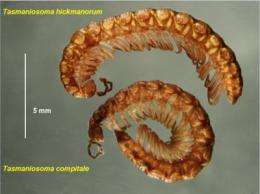
These are Tasmaniosoma hickmanorum and Tasmaniosoma compitale, preserved in alchohol. Credit: Bob Mesibov

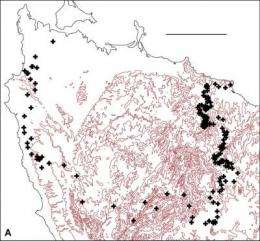
A mysterious line where two millipede species meet has been mapped in northwest Tasmania, Australia. Both species are common in their respective ranges, but the two millipedes cross very little into each other's territory. The 'mixing zone' where they meet is about 230 km long and less than 100 m wide where carefully studied.

The mapping was done over a two-year period by Dr Bob Mesibov, who is a millipede specialist and a research associate at the Queen Victoria Museum and Art Gallery in Launceston, Tasmania. His results have been published in the open access journal ZooKeys.

'I have no idea why the line is so sharp', said Dr Mesibov. 'The boundary runs up and down hills, crosses rivers and different bedrocks and soils, and ignores vegetation type and climate differences. Its position and its sharpness seem to be the result of an unexplained biological arrangement between the two millipede species.'
Millipede border control better than ours
Enlarge

This is the border between the two species of millipedes. Credit: Bob mesibov

Biogeographers use the term 'parapatry' for the case where two species ranges meet but do not overlap, or overlap very little. Dr Mesibov said that parapatry has been reported before in other species of millipedes and in other terrestrial , in Tasmania and elsewhere in the world. However, parapatric boundaries often parallel a geographical feature, such as a ridgeline, or a steep rainfall gradient.

'There does not seem to be an ecological or a geographic explanation for this particular boundary, or for any part of it. It is also longer than any other parapatric boundary I know about. At 230 km, it is 50% longer than the boundary between England and Scotland, and the 'border control' is a lot better than what we humans can do.'

The two millipede , Tasmaniosoma compitale and T. hickmanorum, are in the same and thought to be closely related. They were first scientifically described in 2010, by the same author and again in ZooKeys. The parapatric boundary was mapped as a background study for later investigations of speciation in this group of , and of the mechanism of parapatry.

More information: Mesibov R (2011) A remarkable case of mosaic parapatry in millipedes. In: Mesibov R, Short M (Eds) Proceedings of the 15th International Congress of Myriapodology, 18-22 July 2011, Brisbane, Australia. ZooKeys 156: 71. doi: 10.3897/zookeys.156.1893

Provided by Pensoft Publishers


Rank 4 /5 (1 vote)
Relevant PhysicsForums posts

More news stories

Manufacturing genes to attack flu virus

An international research team has manufactured a new protein that can combat deadly flu epidemics.

Biology / Biotechnology

created 5 hours ago | popularity not rated yet | comments 0 | with audio podcast

Scientist: Evolution debate will soon be history

(AP) -- Richard Leakey predicts skepticism over evolution will soon be history. Not that the avowed atheist has any doubts himself.

Biology / Evolution

created May 26, 2012 | popularity 3.5 / 5 (20) | comments 88

More plant species responding to global warming than previously thought

(Phys.org) -- Far more wild plant species may be responding to global warming than previous large-scale estimates have suggested.

Biology / Ecology

created May 22, 2012 | popularity 4.6 / 5 (14) | comments 18 | with audio podcast

For monogamous sparrows, it doesn't pay to stray (but they do it anyway)

It's quite common for a female song sparrow to stray from her breeding partner and mate with the male next door, but a new study shows that sleeping around can be costly.

Biology / Plants & Animals

created May 22, 2012 | popularity 5 / 5 (2) | comments 8 | with audio podcast

Thousands of shellfish found dead in Peru

Thousands of crustaceans were found dead off the coast of Lima following the mystery mass death of dolphins and pelicans, the Peruvian Navy said Friday.

Biology / Ecology

created May 26, 2012 | popularity 4.7 / 5 (7) | comments 7


'Unzipped' carbon nanotubes could help energize fuel cells, batteries

Multi-walled carbon nanotubes riddled with defects and impurities on the outside could replace some of the expensive platinum catalysts used in fuel cells and metal-air batteries, according to scientists at ...

Change in developmental timing was crucial in the evolutionary shift from dinosaurs to birds: study

At first glance, it's hard to see how a common house sparrow and a Tyrannosaurus Rex might have anything in common. After all, one is a bird that weighs less than an ounce, and the other is a dinosaur that ...

Computer model used to pinpoint prime materials for efficient carbon capture

When power plants begin capturing their carbon emissions to reduce greenhouse gases – and to most in the electric power industry, it's a question of when, not if – it will be an expensive undertaking.

T cells 'hunt' parasites like animal predators seek prey, study shows

By pairing an intimate knowledge of immune-system function with a deep understanding of statistical physics, a cross-disciplinary team at the University of Pennsylvania has arrived at a surprising finding: T cells use a movement ...

Land and sea species differ in climate change response: study

(Phys.org) -- Marine and terrestrial species will likely differ in their responses to climate warming, new research by Simon Fraser University and Australia’s University of Tasmania has found.

Yale study concludes public apathy over climate change unrelated to science literacy

Are members of the public divided about climate change because they don't understand the science behind it? If Americans knew more basic science and were more proficient in technical reasoning, would public consensus match ...