Leicester set to fly high in India's first-ever national astronomy mission
December 1, 2011

Leicester set to fly high in India's first-ever national astronomy mission

Enlarge

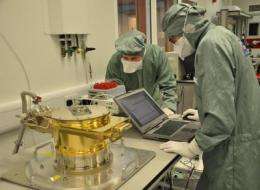
Guy Peters and Chris Bicknell preparing the Astrosat SXT Flight camera for handover to the delegation from India. Credit: University of Leicester

Highly specialised equipment constructed at the University of Leicester for India's first national astronomy satellite- Astrosat – is to be handed over to a delegation from India in December.

The five instruments in Astrosat's payload will observe exotic objects and phenomena such as black holes, neutron stars, and active galaxies at a number of different wavelengths simultaneously, from the ultraviolet band to energetic x-rays. Each of its five instruments is looking at different regions of the electromagnetic spectrum which allows simultaneous measurements to be taken across a wide range of energies.

The Indian Space Research Organisation approached the University of Leicester Space Research Centre to undertake the Soft X-ray Telescope (SXT) camera development. Due to Leicester's acclaimed track record in specialised X-ray camera design with successful missions such as SWIFT and XMM-Newton, the University was able to provide the expertise and support to build the CCD camera for the SXT on Astrosat.

The University of Leicester has invested a significant amount of expertise into this Anglo-Indian collaboration of which Guy Peters, Astrosat Project Manager-UK said: "Leicester's involvement with Astrosat is hugely significant, not just for the University, but for Leicester as a whole. It speaks volumes for the scientific and technological expertise housed at the University of Leicester that we have been sought-out to develop this equipment. It is something the whole city can be proud of."

The event on 5th December will not only be attended by the Indian and UK Astrosat teams, but also by Professor Sir Robert Burgess, Vice-Chancellor of the University of Leicester, Deputy Mayor Councillor Ted Cassidy and members of the Indo British Trade Council and local councillors.

Mr Peters said: "The event will showcase the importance placed on successful collaborations between the UK and and more importantly the partnership between the University of Leicester's Space Research Centre, TIFR and the Indian Space Research Organisation, sowing the seeds for future collaborative missions.

"Following this visit, we will fly over to India for the final test of the CCD camera for the SXT before the expected launch in 2012."

Professor K. P Singh, Principal Investigator for the SXT from Mumbai, will be talking at the event about how important this mission is for India and highlight the pride the Indian Astrosat Team feel, seeing their original concept come closer to launch date. He will also discuss what this means 'on the ground'-how Astrosat can better enable us to understand and its many phenomena.

Guy Peters added that he hoped the success of this mission will pave the way for many more missions to come-"Here in Leicester we are a young team gaining experience on a major project. Astrosat has provided a really exciting opportunity for the team and we hope the success of this mission will provide opportunities for further collaborations in the future".

Provided by University of Leicester search and more info website


Rank 5 /5 (1 vote)
Relevant PhysicsForums posts
  • Distance of planets from stars and revolution
    created5 hours ago
  • revamping general concept and cosmological principle
    createdMay 25, 2012
  • Transiting Exoplanet Light Curve
    createdMay 25, 2012
  • Math behind Theoretical Physics
    createdMay 24, 2012
  • Do we know whats at the center of galaxies yet?
    createdMay 23, 2012
  • Structure of the Milky Way?
    createdMay 20, 2012
  • More from Physics Forums - General Astronomy

More news stories

Land and sea species differ in climate change response: study

(Phys.org) -- Marine and terrestrial species will likely differ in their responses to climate warming, new research by Simon Fraser University and Australia’s University of Tasmania has found.

Space & Earth / Environment

created 3 hours ago | popularity 3.7 / 5 (3) | comments 2 | with audio podcast

Yale study concludes public apathy over climate change unrelated to science literacy

Are members of the public divided about climate change because they don't understand the science behind it? If Americans knew more basic science and were more proficient in technical reasoning, would public consensus match ...

Space & Earth / Environment

created 5 hours ago | popularity 4.8 / 5 (4) | comments 11 | with audio podcast

10 million years needed to recover from mass extinction

It took some 10 million years for Earth to recover from the greatest mass extinction of all time, latest research has revealed.

Space & Earth / Earth Sciences

created 5 hours ago | popularity 5 / 5 (3) | comments 1 | with audio podcast

Sophisticated simulations predict future warming

The chances of our planet being hit by a global warming of 3 degrees Celsius by 2050 is as likely as it being hit by an increase of 1.4 degrees, new research shows. Presented in the journal Nature Geoscience, the British study ...

Space & Earth / Earth Sciences

created May 22, 2012 | popularity 4.4 / 5 (9) | comments 51

Aliens don't want to eat us, says former SETI director

Alien life probably isn’t interested in having us for dinner, enslaving us or laying eggs in our bellies, according to a recent statement by former SETI director Jill Tarter.

Space & Earth / Space Exploration

created May 25, 2012 | popularity 4.4 / 5 (14) | comments 40


Nvidia trumpets Tegra 3 phone design wins for 2012

(Phys.org) -- Nvidia’s competitive war paint has a name, Tegra 3. On the heels of Nvidia announcements about lowering costs of its Tegra 3 processors and Nvidia-enabled tablets running Android Ice Cream ...

'Unzipped' carbon nanotubes could help energize fuel cells, batteries

Multi-walled carbon nanotubes riddled with defects and impurities on the outside could replace some of the expensive platinum catalysts used in fuel cells and metal-air batteries, according to scientists at ...

T cells 'hunt' parasites like animal predators seek prey, study shows

By pairing an intimate knowledge of immune-system function with a deep understanding of statistical physics, a cross-disciplinary team at the University of Pennsylvania has arrived at a surprising finding: T cells use a movement ...

Computer model used to pinpoint prime materials for efficient carbon capture

When power plants begin capturing their carbon emissions to reduce greenhouse gases – and to most in the electric power industry, it's a question of when, not if – it will be an expensive undertaking.

Change in developmental timing was crucial in the evolutionary shift from dinosaurs to birds: study

At first glance, it's hard to see how a common house sparrow and a Tyrannosaurus Rex might have anything in common. After all, one is a bird that weighs less than an ounce, and the other is a dinosaur that ...

Scientist: Evolution debate will soon be history

(AP) -- Richard Leakey predicts skepticism over evolution will soon be history. Not that the avowed atheist has any doubts himself.