The Habitable Exoplanets Catalog, a new online database of habitable worlds
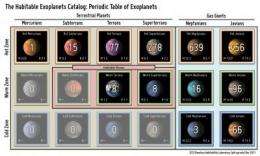
Scientists are now starting to identify potential habitable exoplanets after nearly twenty years of the detection of the first planets around other stars. This image shows all known examples using 18 mass and temperature categories similar to a periodic table, including confirmed and unconfirmed exoplanets. Only 16 in the Terrans groups are potential habitable candidates. Credit: PHL copyright UPR Arecibo
Scientists are now starting to identify potential habitable exoplanets after nearly twenty years of the detection of the first planets around other stars. Over 700 exoplanets have been detected and confirmed with thousands more still waiting further confirmation by missions such as NASA Kepler. Most of these are gas giants, similar to Jupiter and Neptune, but orbiting very dangerously close to their stars. Only a few have the right size and orbit to be considered suitable for any life.
Now the Planetary Habitability Laboratory (PHL) of the University of Puerto Rico at Arecibo (UPR Arecibo) presents a new assessment of the habitability of these worlds as part of its Habitable Exoplanets Catalog (HEC). The catalog not only identifies new potential habitable exoplanets, including exomoons like the Pandora world in the movie Avatar, but also ranks them according to various habitability indices.
"One important outcome of these rankings is the ability to compare exoplanets from best to worst candidates for life", says Abel Méndez, Director of the PHL and principal investigator of the project.
The catalog uses new habitability assessments like the Earth Similarity Index (ESI), the Habitable Zones Distance (HZD), the Global Primary Habitability (GPH), classification systems, and comparisons with Earth past and present. It also uses data from other databases, such as the Extrasolar Planets Encyclopaedia (http://www.exoplanet.eu), the Exoplanet Data Explorer (http://www.exoplanets.org), the NASA Kepler Mission (http://www.kepler.nasa.gov), and other sources.
According to Méndez, "New observations with ground and orbital observatories will discover thousands of exoplanets in the coming years. We expect that the analyses contained in our catalog will help to identify, organize, and compare the life potential of these discoveries."
The catalog lists and categorizes exoplanets discoveries using various classification systems, including tables of planetary and stellar properties. One of the classifications divides them into eighteen mass and thermal categories, creating a table similar to a periodic table for exoplanets. Additional resources of the catalog will include scientific visualizations and stellar maps of exoplanets. Various undergraduate students participated in the project.
Only two confirmed exoplanets so far match the criteria for habitability in the catalog, Gliese 581d and HD 85512b, both still marginally Earth-like. However, the catalog identifies over 15 exoplanets and 30 exomoons as potential habitable candidates. Future observations with new instruments, such as the proposed NASA Terrestrial Planet Finder (TPF), will be necessary to confirm the suitability for life of any of these candidates.
"I hope this database will help increase interest in building a big space-based telescope to observe exoplanets directly and look for possible signatures of life," says Jim Kasting, an expert on planetary habitability science from Penn State.
More information: The catalog is available now online at the PHL website http://www.phl.upr.edu . A poster will be presented at the Kepler Science Conference from December 5th to 9th, 2011 in NASA Ames, Moffet Field, California.
Provided by University of Puerto Rico, Arecibo Campus
-
From lemons to lemonade: Reaction uses carbon dioxide to make carbon-based semiconductor,
32 comments
-
Thioridazine kills cancer stem cells in human while avoiding toxic side-effects of conventional cancer treatments,
3 comments
-
SpaceX private rocket blasts off for space station (Update),
42 comments
-
Climate scientists say they have solved riddle of rising sea,
31 comments
-
SpaceX capsule has 'new car' smell, astronauts say (Update),
4 comments
-
Distance of planets from stars and revolution
8 hours ago
-
revamping general concept and cosmological principle
May 25, 2012
-
Transiting Exoplanet Light Curve
May 25, 2012
-
Math behind Theoretical Physics
May 24, 2012
-
Do we know whats at the center of galaxies yet?
May 23, 2012
-
Structure of the Milky Way?
May 20, 2012
- More from Physics Forums - General Astronomy
More news stories
Land and sea species differ in climate change response: study
(Phys.org) -- Marine and terrestrial species will likely differ in their responses to climate warming, new research by Simon Fraser University and Australia’s University of Tasmania has found.
5 hours ago |
3.7 / 5 (3) |
5
|
Yale study concludes public apathy over climate change unrelated to science literacy
Are members of the public divided about climate change because they don't understand the science behind it? If Americans knew more basic science and were more proficient in technical reasoning, would public consensus match ...
7 hours ago |
4.8 / 5 (5) |
19
|
10 million years needed to recover from mass extinction
It took some 10 million years for Earth to recover from the greatest mass extinction of all time, latest research has revealed.
Space & Earth / Earth Sciences
7 hours ago |
4 / 5 (4) |
1
|
Sophisticated simulations predict future warming
The chances of our planet being hit by a global warming of 3 degrees Celsius by 2050 is as likely as it being hit by an increase of 1.4 degrees, new research shows. Presented in the journal Nature Geoscience, the British study ...
Space & Earth / Earth Sciences
May 22, 2012 |
4.1 / 5 (10) |
51
Aliens don't want to eat us, says former SETI director
Alien life probably isnt interested in having us for dinner, enslaving us or laying eggs in our bellies, according to a recent statement by former SETI director Jill Tarter.
Space & Earth / Space Exploration
May 25, 2012 |
4.4 / 5 (15) |
41
Stunning image of smallest possible five-ringed structure
Scientists have created and imaged the smallest possible five-ringed structure about 100,000 times thinner than a human hair and you'll probably recognise its shape.
'Unzipped' carbon nanotubes could help energize fuel cells, batteries
Multi-walled carbon nanotubes riddled with defects and impurities on the outside could replace some of the expensive platinum catalysts used in fuel cells and metal-air batteries, according to scientists at ...
Change in developmental timing was crucial in the evolutionary shift from dinosaurs to birds: study
At first glance, it's hard to see how a common house sparrow and a Tyrannosaurus Rex might have anything in common. After all, one is a bird that weighs less than an ounce, and the other is a dinosaur that ...
Computer model used to pinpoint prime materials for efficient carbon capture
When power plants begin capturing their carbon emissions to reduce greenhouse gases and to most in the electric power industry, it's a question of when, not if it will be an expensive undertaking.
T cells 'hunt' parasites like animal predators seek prey, study shows
By pairing an intimate knowledge of immune-system function with a deep understanding of statistical physics, a cross-disciplinary team at the University of Pennsylvania has arrived at a surprising finding: T cells use a movement ...
Scientists develop ultra-sensitive test that detects diseases in their earliest stages
Scientists have developed an ultra-sensitive test that should enable them to detect signs of a disease in its earliest stages, in research published today in the journal Nature Materials.
Dec 05, 2011
Rank: 5 / 5 (1)