Google wins patent for driverless car technology
December 19, 2011 by Nancy Owano report

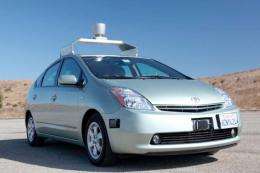
Google driverless car

Enlarge

(PhysOrg.com) -- News surfaced this week that Google has won a patent for driverless car technology. Google filed the patent in May this year. The application is titled “Transitioning a Mixed-mode Vehicle to Autonomous Mode.” The patent presents a method listing numerous “embodiments” suggested, for a vehicle that switches from being driven by a human to moving, stopping, and parking autonomously.

The patent describes how the car can know where it is located and which direction to drive.

The car would arrive at a specific location and once reaching a “landing strip” could show acceptable parking places for the vehicle.

Additionally the strip may tell the vehicle that it is parked in a region where it can transition into autonomous mode.

The car could get helpful information from Internet-driven data about other spaces available, or which direction to move for the next part of the trip.

The patent presents an example of the vehicle providing a tour of Millennium Park in Chicago The machine could be programmed to stop at a sculpture for five minutes, move to a fountain for five minutes and then to the ice rink for a pre-set amount of time, before returning to its starting point.

“Disclosed are methods and devices for transitioning a mixed-mode from a human driven mode to an autonomously driven mode” says the patent. “Transitioning may include stopping a vehicle on a predefined landing strip and detecting a reference indicator. Based on the reference indicator, the vehicle may be able to know its exact position. Additionally, the vehicle may use the reference indictor to obtain an autonomous vehicle instruction via a URL. After the vehicle knows its precise location and has an autonomous vehicle instruction, it can operate in . “

For watchers, the patent victory is an easy reminder of all the publicity that the company has enjoyed over its ambitious dream project of driverless cars. Google has used a fleet of cars clocking 190,000 miles on highways, in city traffic and on roads in demonstrating how successful driverless cars can be.

Earlier this year, Google also set up a demo system on its campus to show off driverless golf carts that communicate with sensors.

Google’s project leaders are convinced that smarter vehicles equipped with specially designed sensors, artificial intelligence, video cameras, and other sophisticated tools could help to make transportation safer.

Of the many reports about the patent victory, BBC’s report has raised the question of how the patent might possibly be used. “The will allow Google to restrict other companies from using a similar method to switch their cars between human-controlled and automatic modes. Alternatively, it could charge them a fee for a licence.”

© 2011 PhysOrg.com

Filter


Move the slider to adjust rank threshold, so that you can hide some of the comments.


Display comments: newest first

_nigmatic10
Dec 19, 2011

Rank: not rated yet
I'm sure apple patent filing dept hates them for it too. On a side note, i can imagine a fleet of driverless cars being hacked to crash. Oh the joy.
JRi
Dec 19, 2011

Rank: not rated yet
Soon we may be seeing Google cars with cameras on top taking photos and driving alone on streets...
finitesolutions
Dec 19, 2011

Rank: not rated yet
This reminds me of the need to stop the convertible car on the highway in order to raise/lower the top.
Now a days you can do it while going of course at low speed.
Happy inventing.
Autonomous cars will be regulated by the government because accidents by autonomous vehicles need special handling when they WILL happen.
jdbertron
Dec 19, 2011

Rank: 2.3 / 5 (6)
How can this be a valid patent. This stuff has been invented years ago in movies before Google even existed.
There's nothing original about it.
Actually implementing it one way, is not a legitimate 'invention' of the autonomous car, because others may have different approaches that work too and are just as legitimate as Google's. Calling other approaches an infringement to Google's patent would stifle competition and progress.
What a shame our patent office really is.
randith
Dec 19, 2011

Rank: not rated yet
The places we drive reveal a lot about our interests and what we spend money on. This information will enable Google to make better targeted ads.
plasticpower
Dec 19, 2011

Rank: not rated yet
Nothing to do with this patent, but I was wondering how multiple driverless cars will operate alongside with each other if they're all using radar/lidar at the same time trying to map their surroundings. I would think this isn't a problem for a few of these cars, but if every car is equipped with that sensor it would introduce an incredible amount of "noise". I guess if bats and dolphins can do it though..

@randith, they can already do it with their Android phones, but I believe the recent "locationgate" scandal showed that, at least for now, this is still illegal..
Callippo
Dec 19, 2011

Rank: 1 / 5 (1)
How can this be a valid patent. This stuff has been invented years ago in movies before Google even existed.
There's nothing original about it. What a shame our patent office really is.
No wonder, if it makes money with acceptation of patent applications. It's just logical consequence of free market approach to the patent law. These two principles should be separated each other, because the patent law is socialistic principle and it essentially restricts free market. It's purpose is to protect investments into research and prohibit their free exploitation instead.
finitesolutions
Dec 20, 2011

Rank: 1 / 5 (1)
This is just common sense.
If I embed a voice solution into the car ( Siri or the new Majel from Goggle or ...) I should be able to voice control the behavior and end destination of the vehicle.
How will I infringe any patent while talking to my car?!!?!?!?!?! We can even have our own language.
Rank 5 /5 (2 votes)
Relevant PhysicsForums posts

More news stories

Browser wars flare in mobile space

The browser wars are heating up again, but this time the fight is for dominance of the mobile Internet.

Technology / Software

created 15 hours ago | popularity 5 / 5 (2) | comments 3

Probability of contamination from severe nuclear reactor accidents is higher than expected: study

Catastrophic nuclear accidents such as the core meltdowns in Chernobyl and Fukushima are more likely to happen than previously assumed. Based on the operating hours of all civil nuclear reactors and the number ...

Technology / Energy & Green Tech

created May 22, 2012 | popularity 3.6 / 5 (25) | comments 56 | with audio podcast

HyperSolar shows dirty water no barrier to power world

(Phys.org) -- The Santa Barbara, California, company, HyperSolar, is set to transparently share the ups and downs of its research experiences toward the company’s ultimate vision, successfully producing ...

Technology / Energy & Green Tech

created May 24, 2012 | popularity 4.8 / 5 (16) | comments 17 | with audio podcast report

SpotterRF debuts Radar Backpack Kit (w/ Video)

(Phys.org) -- SpotterRF has announced a special radar backpack kit designed to enhance situational awareness for soldiers on the ground. The company says its special radar is designed for warfighters as part ...

Technology / Hi Tech & Innovation

created May 26, 2012 | popularity 5 / 5 (5) | comments 13 | with audio podcast report

Tesla to launch electric sedan in US on June 22

Tesla Motors said Tuesday it would begin deliveries of "the world's first premium electric sedan" on June 22, slightly ahead of schedule.

Technology / Energy & Green Tech

created May 22, 2012 | popularity 4.5 / 5 (12) | comments 18


Stunning image of smallest possible five-ringed structure

Scientists have created and imaged the smallest possible five-ringed structure – about 100,000 times thinner than a human hair – and you'll probably recognise its shape.

'Unzipped' carbon nanotubes could help energize fuel cells, batteries

Multi-walled carbon nanotubes riddled with defects and impurities on the outside could replace some of the expensive platinum catalysts used in fuel cells and metal-air batteries, according to scientists at ...

Change in developmental timing was crucial in the evolutionary shift from dinosaurs to birds: study

At first glance, it's hard to see how a common house sparrow and a Tyrannosaurus Rex might have anything in common. After all, one is a bird that weighs less than an ounce, and the other is a dinosaur that ...

Computer model used to pinpoint prime materials for efficient carbon capture

When power plants begin capturing their carbon emissions to reduce greenhouse gases – and to most in the electric power industry, it's a question of when, not if – it will be an expensive undertaking.

T cells 'hunt' parasites like animal predators seek prey, study shows

By pairing an intimate knowledge of immune-system function with a deep understanding of statistical physics, a cross-disciplinary team at the University of Pennsylvania has arrived at a surprising finding: T cells use a movement ...

Land and sea species differ in climate change response: study

(Phys.org) -- Marine and terrestrial species will likely differ in their responses to climate warming, new research by Simon Fraser University and Australia’s University of Tasmania has found.