Fluorescent probes increase understanding of bacterium's electron transfer
December 12, 2011

Fluorescent probes increase understanding of bacterium's electron transfer

Enlarge

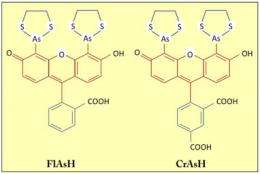
Structures of biarsenic fluorophores, CrAsH-EDT2 and FlAsH-EDT2. FlAsH-EDT2 represents a fluorescein scaffold derivatized with two As(III) groups (4′,5′-bis(1,3,2-dithioarsolan-2-yl)fluorescein). Each arsenic is capped with an ethanedithiol (EDT). Similarly, CrAsH-EDT2 represents 6-carboxy-FlAsH-EDT2.

(PhysOrg.com) -- When it comes to transporting a cell's valuable electrons, the metal-reducing microbe Shewanella oneidensis only trusts stable, mature proteins, according to scientists at Pacific Northwest National Laboratory. Immature proteins are degraded before they can take up the task, suggesting that protein trafficking to the outer membrane is tightly regulated.

These results mark another step toward understanding the that enable a bacterial protein-in this case, the cytochrome MtrC-to transfer electrons to minerals in soil, sediment, and subsurface materials. This new information contributes to understanding protein stability and between cells and minerals, which is important for applications in synthetic biology such as biofuel production. The results were published in the journal Biochemistry.

Electron transfer by MtrC, an cytochrome on S. oneidensis, can stabilize contaminants, mitigating their impact on the population and environment. However, scientists believe that gaining insight into the electron transfer mechanisms could also play a role in directing the bacterium toward biofuel production.

"Our goal is to define the role of these cytochromes in the metabolic switching between different terminal electron acceptors," said Dr. Thomas Squier, a PNNL biochemist and senior author of the publication. "The long-term goal is to understand the stability and targeting mechanisms important to synthetic biology applications involving, for example, chemical sensing between living cells and electronic detectors as well as the development of biofuel cells."

These findings don't just relate to Shewanella, though it was in this microbe where MtrC was first seen. They also apply to many other bacteria, such as E. coli, notes Squier.

"This research ties very well into looking at and understanding as a whole," he added.

Measuring MtrC's environmental stability requires the ability to differentiate an immature protein from a mature protein after it is secreted and assembled on Shewanella's outer membrane. To do this, the scientists constructed complementary fluorescent probes to label MtrC. The highly charged carboxy-FlAsH (CrAsH) probe selectively labels mature MtrC only on the outer cell membrane, while the cell-permeable Fluorescein Arsenical Helix (FlAsH) probe labels all MtrC, including immature proteins within the cell.

More information: Xiong Y, et al. 2011. "Targeted Protein Degradation of Outer Membrane Decaheme Cytochrome MtrC Metal Reductase in Shewanella oneidensis MR-1 Measured Using Biarsenical Probe CrAsH-EDT2." Biochemistry 50(45):9738-9751 DOI: 10.1021/bi200602f

Journal reference: Biochemistry search and more info website

Provided by Pacific Northwest National Laboratory search and more info website


Rank 5 /5 (1 vote)
Relevant PhysicsForums posts

More news stories

Computer model used to pinpoint prime materials for efficient carbon capture

When power plants begin capturing their carbon emissions to reduce greenhouse gases – and to most in the electric power industry, it's a question of when, not if – it will be an expensive undertaking.

Chemistry / Materials Science

created 7 hours ago | popularity not rated yet | comments 0 | with audio podcast

Scientists develop ultra-sensitive test that detects diseases in their earliest stages

Scientists have developed an ultra-sensitive test that should enable them to detect signs of a disease in its earliest stages, in research published today in the journal Nature Materials.

Chemistry / Analytical Chemistry

created 7 hours ago | popularity not rated yet | comments 0 | with audio podcast

New CO2-removing catalyst can take the heat

(Phys.org) -- The current method of removing the greenhouse gas carbon dioxide (CO2) from the flues of coal-fired power plants uses so much energy that no one bothers to use it. So says Roger Aines, principal ...

Chemistry / Materials Science

created May 24, 2012 | popularity 5 / 5 (9) | comments 11 | with audio podcast

High-speed method to aid search for solar energy storage catalysts

Eons ago, nature solved the problem of converting solar energy to fuels by inventing the process of photosynthesis.

Chemistry / Materials Science

created May 25, 2012 | popularity 5 / 5 (3) | comments 4 | with audio podcast

Researchers demonstrate possible primitive mechanism of chemical info self-replication

(Phys.org) -- When scientists think about the replication of information in chemistry, they usually have in mind something akin to what happens in living organisms when DNA gets copied: a double-stranded molecule ...

Chemistry / Materials Science

created May 25, 2012 | popularity 5 / 5 (4) | comments 2 | with audio podcast


Stunning image of smallest possible five-ringed structure

Scientists have created and imaged the smallest possible five-ringed structure – about 100,000 times thinner than a human hair – and you'll probably recognise its shape.

'Unzipped' carbon nanotubes could help energize fuel cells, batteries

Multi-walled carbon nanotubes riddled with defects and impurities on the outside could replace some of the expensive platinum catalysts used in fuel cells and metal-air batteries, according to scientists at ...

Change in developmental timing was crucial in the evolutionary shift from dinosaurs to birds: study

At first glance, it's hard to see how a common house sparrow and a Tyrannosaurus Rex might have anything in common. After all, one is a bird that weighs less than an ounce, and the other is a dinosaur that ...

T cells 'hunt' parasites like animal predators seek prey, study shows

By pairing an intimate knowledge of immune-system function with a deep understanding of statistical physics, a cross-disciplinary team at the University of Pennsylvania has arrived at a surprising finding: T cells use a movement ...

Land and sea species differ in climate change response: study

(Phys.org) -- Marine and terrestrial species will likely differ in their responses to climate warming, new research by Simon Fraser University and Australia’s University of Tasmania has found.

Yale study concludes public apathy over climate change unrelated to science literacy

Are members of the public divided about climate change because they don't understand the science behind it? If Americans knew more basic science and were more proficient in technical reasoning, would public consensus match ...