Couple finds evidence indicating earliest humans lived by rivers and streams
December 26, 2011 by Bob Yirka report

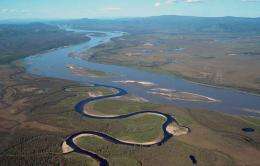
river

Enlarge

Image: USGS

(PhysOrg.com) -- When many people think of our earliest human ancestors, they think of the hot dried out dusty environments in Africa in which many of their remains were found. Unfortunately, such images don’t take into account the changes in environment that have occurred since those times when early peoples walked the Earth. Archeologists of course have thought of such things and for many years have tossed ideas back and forth debating whether such people lived by rivers and streams, as did those that came later and built civilization along such places as the Nile or whether they lived in woodlands.

Now new evidence has come to light that suggests the former might be more likely. Husband and wife team Royhan and Nahid Gani have been studying the sediments surrounding the place where Ardipithecus ramidus, aka, "Ardi," was found in Ethiopia, and have, as they describe in their paper published in , found that most of the evidence in the area points to a group of people that lived near a very large river.

Ardi is believed to have lived some four and half million years ago in what is now Aramis, a hot and dry part of Ethiopia, but until now, no serious study had been done on the dirt in which the skeletal remains were found. After doing so, the Gani’s discovered that the dirt was actually layers of sandstone that appear most likely to have been the result of an ancient stream overflowing it’s banks periodically, leaving behind layers of sand. Branching out, the team discovered that the sediments indicated that such a stream was actually a river, likely twenty six feet deep and over twelve hundred feet wide.

Next they turned their attention to plant material that had been preserved in the sandstone, measuring their isotopes, and found that the material had come from grassy plants, suggesting a savannah type environment. But once again, widening their area of study, they also found that there were wide changes in the types of plant material in the area. This caused them to surmise that there were patches of forests near the rivers and streams.

Based on these two pieces of information, the team suggests that it appears Ardi, who many researchers believe is our oldest found ancestor, lived in a savannah, near fresh flowing water. Some suggest that such an environment would be consistent with learning to walk upright to see over the tall grasses.

More information: River-margin habitat of Ardipithecus ramidus at Aramis, Ethiopia 4.4 million years ago, Nature Communications 2, Article number: 602 doi:10.1038/ncomms1610

Abstract
The nature and type of landscape that hominins (early humans) frequented has been of considerable interest. The recent works on Ardipithecus ramidus, a 4.4 million years old hominin found at Middle Awash, Ethiopia, provided critical information about the early part of human evolution. However, habitat characterization of this basal hominin has been highly contested. Here we present new sedimentological and stable isotopic (carbon and oxygen) data from Aramis, where the in situ, partial skeleton of Ar. ramidus (nicknamed 'Ardi') was excavated. These data are interpreted to indicate the presence of major rivers and associated mixed vegetations (grasses and trees) in adjacent floodplains. Our finding suggests that, in contrast to a woodland habitat far from a river, Ar. ramidus lived in a river-margin forest in an otherwise savanna (wooded grassland) landscape at Aramis, Ethiopia. Correct interpretation of habitat of Ar. ramidus is crucial for proper assessment of causes and mechanisms of early hominin evolution, including the development of bipedalism.

Journal reference: Nature Communications search and more info website

© 2011 PhysOrg.com

3.3 /5 (23 votes)  

Filter


Move the slider to adjust rank threshold, so that you can hide some of the comments.


Display comments: newest first

verkle
Dec 26, 2011

Rank: 2 / 5 (23)
The world's oldest book says that the earliest humans lived by 4 rivers. Old news.

Isaacsname
Dec 26, 2011

Rank: 3.5 / 5 (6)
Makes sense, great place to hunt, as well, floodplains are the perfect area for the concept of agriculture to develop, I'm sure early humans noticed the land around rivers was more fertile than outlaying areas.
Shootist
Dec 26, 2011

Rank: 4.5 / 5 (11)
Makes sense, great place to hunt, as well, floodplains are the perfect area for the concept of agriculture to develop, I'm sure early humans noticed the land around rivers was more fertile than outlaying areas.


And you didn't have to walk a couple of miles to get a drink. The lazy ape is the successful ape.
Mastoras
Dec 26, 2011

Rank: 4.2 / 5 (5)
Makes sense, great place to hunt, as well, floodplains are the perfect area for the concept of agriculture to develop, I'm sure early humans noticed the land around rivers was more fertile than outlaying areas.

Agriculture is a very late invention, about ten or twelve thousand years. But the article speaks about a period of four and a half million years ago.
-.
Callippo
Dec 26, 2011

Rank: 1 / 5 (5)
Aquatic Ape Theory again?
LEVI506
Dec 26, 2011

Rank: 2.6 / 5 (5)
Ditto on the Duh! Suppose they'll figure out that they only needed four foot tall doors for the houses they didn't have?
DrSki
Dec 26, 2011

Rank: 1 / 5 (5)
Woah! Hold your horses.
IF early people found it easier to gather food and drink by living NEAR the river, then why has it taken SO LONG to obtain evidence!
The OBVIOUS answer would be that all of the evidence MUST point the other way - this is the ONLY piece of evidence that supports the authors theory....

Okay - what I meant to say was No Sh.t Sherlock!
_nigmatic10
Dec 26, 2011

Rank: 5 / 5 (4)
A study of population density in today's world will reflect the trend has not changed either. The highest density will often be found near rivers and oceans. Go figure.
barakn
Dec 26, 2011

Rank: 3.3 / 5 (7)
The world's oldest book says that the earliest humans lived by 4 rivers. Old news.

You mean the 5000 year old "Instructions of Shuruppak?" No, no mention of 4 rivers.
scidog
Dec 27, 2011

Rank: 4 / 5 (4)
in the Midwest US artifact hunters know you have the best chance of finding woodland Indian items within 50 feet of anyplace where creek or stream flows into another body of water.
i would think that holds true for any group of hunter-gathers.
kaasinees
Dec 27, 2011

Rank: 3.7 / 5 (3)
easy to catch fish, gather berries and other edible fruit. fresher air, easier to avoid your own waste laying in teh woods..
less predators, more sight etc.
Squirrel
Dec 27, 2011

Rank: 5 / 5 (2)
Nariokotome Boy (KNM-WT 15000) the most important Homo erectus fossil was found in a swamp. Those advocating the aquatic ape theory review much evidence for early humans living near water. The paper may have new information but it is far from the first research upon early humans and water.
AWaB
Dec 27, 2011

Rank: 2 / 5 (4)
Amazing. Someone actually took the time to write a paper on something we all knew. You could live out in the desert and walk every day to get water... or you could live next to / or near, depending upon your current location on the local food chain, your water source.
MarkyMark
Dec 27, 2011

Rank: 5 / 5 (2)
Not to support the Bible humpers but yea seems pretty logical that you would have your settlement near a good source of clean water, and a good source of food such as fish.
A_Paradox
Dec 27, 2011

Rank: 5 / 5 (1)
"DrSki", the flood plains of large rivers get flooded, which would tend to wash away and scatter sticks and other plant materials used by our early ancestors. And such rivers generally erode their channels back and forth across their flood plains over thousands of years so it is not surprising that evidence of swamp land living is hard to find.
Many pros to living by wetlands: drinking water close by, lots of small game to eat like frogs, lizards, birds and eggs, lots of plants to chew on, suck the juice from and make primitive tools from. In the water will be clams, frog spawn and the occasional fish to catch. Also a wetland may provide havens from bush fires, and the opportunity to learn about fire without being incinerated. [this last may have been the clincher, in the long run, I think.]

Cons of wetlands: big animals like hippos, crocodiles, elephants, water buffalo, lions wanting to use the space or just eat you. Also pythons lying in ambush in the shallows.
tadchem
Dec 27, 2011

Rank: not rated yet
Without a ready supply of potable water, hominids would die in a under a month.
There is no evidence Ardipithecus dug wells.
Osiris1
Dec 29, 2011

Rank: 3 / 5 (3)
I have heard '4 rivers' mentioned several times by contributors who did not want to mention the Pentateutch...The Torah...the oldest part of the Old Testament. Simcha Yakubovitch, a Jewish Canadian archaeologist and producer of 'The Naked Archaeologist' on educational TV has mentioned this area as being in what is now covered by the Persian Gulf and outflows to the Indian Ocean thru the Stait of Hormuz. The four rivers are ancient channels, dry now two of them, that include the Tigris and Euphrates Rivers. The two others had to be discovered by analyses of hi-res photos taken from space. This backs up, according to Simcha, the account in the Torah taken as historical record. The area last was above water during the warming from the last ice age when the sea was lower due to the sequestration of water in global glaciation. Other areas all over the world, likewise then shore environments, are now under up to 100 meters of water. Many of these areas show the works of man.
Hev
Dec 30, 2011

Rank: 5 / 5 (1)
Logic says even earliest humans would have needed to live by rivers to survive. It is where most early human remains have been found - even though the river may have changed course, vanished, become part of a sea coast (like the Channel) or under the sea, since then. And is has never changed. Most or perhaps all the main cities of the world are by rivers. It is only very recently that this has become less important.
rawa1
Dec 30, 2011

Rank: 3.7 / 5 (3)
Why every notion of Aquatic Ape Theory is downvoted from there? It's just a rhetorical question from my side, because my experience is, in environment of trolls every correct opinion is unmistakeably downvoted more, than the trollish one.

Aquatic Ape Theory is far more meaningful from this perspective, than the Savannah Ape Theory, especially with respect to possibility of evolutionary bottleneck concept. If the human civilization would face some serious environmental threat, which would limit their survival significantly, then just the people living around rivers would survive, not the savannah people outside of reach of water. And because of sleeping genes, the evolution could be very fast in these years of crisis.
Brandon_Frazer
Jan 01, 2012

Rank: 4 / 5 (1)
What? You mean early humans needed water and it was convenient to live close to it? Wow! I though only modern humans were that smart.
Mike_Massen
Feb 09, 2012

Rank: 1 / 5 (1)
@verkle
The world's oldest book says that the earliest humans lived by 4 rivers. Old news.

There are lots of rivers rather more than 4 one would expect in Africa, some large many small & in terms of 'earliest' this is vague in respect of any possible correlation with the 'oldest book'. Bit of an unscientific stretch to try to link claim of an 'oldest book' that has unsubstantiated provenance with archeological evidence, you are coming across as having an emotional attachment to that book.

Are you talking about Moses' work, surely there are older books than that, what evidence is there that Moses' work is the oldest and do you mean on papyrus, clay tablet, rock face - all are books in general terms ?

This is the problem with any 'source', the linguistic issues cloud any precision and the details that matter that were supposedly derived from an all powerful being, any date information of the time, astronomical reference etc ?

Anything more than a claim from someones mind ?
Rank 3.3 /5 (23 votes)
Relevant PhysicsForums posts

More news stories

Change in developmental timing was crucial in the evolutionary shift from dinosaurs to birds: study

At first glance, it's hard to see how a common house sparrow and a Tyrannosaurus Rex might have anything in common. After all, one is a bird that weighs less than an ounce, and the other is a dinosaur that ...

Other Sciences / Archaeology & Fossils

created 7 hours ago | popularity 5 / 5 (4) | comments 0 | with audio podcast

Social welfare cuts ultimately come with heavy price, researchers say

(Phys.org) -- Slashing government funding for Medicaid, food stamps and other programs that serve the poor – while politically popular with some lawmakers and many conservatives – may do more harm ...

Other Sciences / Social Sciences

created May 24, 2012 | popularity 4 / 5 (21) | comments 155

Ancient Bethlehem seal unearthed in Jerusalem

Israeli archaeologists have discovered a 2,700-year-old seal that bears the inscription "Bethlehem," the Israel Antiquities Authority announced Wednesday, in what experts believe to be the oldest artifact ...

Other Sciences / Archaeology & Fossils

created May 23, 2012 | popularity 3.3 / 5 (15) | comments 24

Dollars and sense: Why are some people morally against tax?

As the U.S. presidential election campaigns heat up, the economic debate is dominated by bailouts, austerity and, inevitably, taxation. Now a new study published in Symbolic Interaction asks why tax is such an important issue ...

Other Sciences / Social Sciences

created May 23, 2012 | popularity 2.3 / 5 (3) | comments 19

Oldest Jewish archaeological evidence on the Iberian Peninsula

German archaeologists of the Friedrich Schiller University Jena found one of the oldest archaeological evidence so far of Jewish Culture on the Iberian Peninsula at an excavation site in the south of Portugal, ...

Other Sciences / Archaeology & Fossils

created May 25, 2012 | popularity 4.2 / 5 (6) | comments 12


Stunning image of smallest possible five-ringed structure

Scientists have created and imaged the smallest possible five-ringed structure – about 100,000 times thinner than a human hair – and you'll probably recognise its shape.

'Unzipped' carbon nanotubes could help energize fuel cells, batteries

Multi-walled carbon nanotubes riddled with defects and impurities on the outside could replace some of the expensive platinum catalysts used in fuel cells and metal-air batteries, according to scientists at ...

Computer model used to pinpoint prime materials for efficient carbon capture

When power plants begin capturing their carbon emissions to reduce greenhouse gases – and to most in the electric power industry, it's a question of when, not if – it will be an expensive undertaking.

T cells 'hunt' parasites like animal predators seek prey, study shows

By pairing an intimate knowledge of immune-system function with a deep understanding of statistical physics, a cross-disciplinary team at the University of Pennsylvania has arrived at a surprising finding: T cells use a movement ...

Land and sea species differ in climate change response: study

(Phys.org) -- Marine and terrestrial species will likely differ in their responses to climate warming, new research by Simon Fraser University and Australia’s University of Tasmania has found.

Yale study concludes public apathy over climate change unrelated to science literacy

Are members of the public divided about climate change because they don't understand the science behind it? If Americans knew more basic science and were more proficient in technical reasoning, would public consensus match ...