Bouncing signals off ceiling can rev up data centers
December 21, 2011 by Nancy Owano report

Bouncing signals off ceiling can rev up data centers

Enlarge

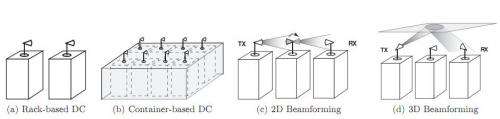
Radio transceivers are placed atop each rack (a) or container (b). Using 2D beamforming (c), transceivers communicate with neighboring racks directly, but forward traffic in multiple hops to non-neighboring racks. Using 3D beamforming (d), the ceiling reflects the signals from each sender to its desired receiver, avoiding multi-hop relays. Image credit: Weile Zhang et al, 3D Beamforming for Wireless Data Centers

(PhysOrg.com) -- Researchers have a startlingly upbeat idea for data center managers coping with packed rooms, Internet traffic bursts, and high costs looming in having to reconfigure data center designs. The researchers find that data centers can use ceilings to bounce off data signals. Doing so enhances data transmission speeds by 30 percent.

What’s more, compared to the cost and complexity of modifying architectures, they say their approach is a much more attractive option that can augment wired links with flexible wireless links in the 60 GHz band.

The team of researchers propose an approach in a short-range, rack-to-rack 60GHz wireless network setting. What they show is how bouncing 60 GHz wireless links off reflective ceilings can address link blockage and link interference.

Heather Zheng, an associate professor of computer science, worked with colleagues at the University of California, Santa Barbara, along with Lei Yang from Intel Labs in Oregon and Weile Zhang at Jiao Tong University in China.

In using a technique of angling the data stream upwards and bouncing it off the ceiling, signals can be transmitted from one area of a densely packed data center to another. Nodes send data to wherever needed regardless of location within a center. What is significant about this approach becomes apparent at peak traffic times, when wireless networks can switch on and provide an overflow for the wired network.

One of the key components in this ceiling approach is the use of metal plates, which the researchers say provided suitable reflection in their simulation of a 160-rack data center. Alternatively, the entire ceiling of the data center could be polished metal. In their studies the team mounted microwave reflectors on the ceiling. The reflectors behaved as specular mirrors to reflect the signals.

The reflectors can be flat metal plates; simple aluminum plates are sufficient. They placed electromagnetic absorbers on top of the racks to prevent local reflection and scattering around the receiving antenna. They note that such absorbers are widely available and maintenance-free.

Overall, they say that the importance of their study is that “We explore the design space, and show how bouncing 60 GHz wireless links off reflective ceilings can address both link blockage and link interference, thus improving link range and number of current transmissions in the data center.”

Also, one of the numerous advantages to their approach is what they categorize as easy rack movement and replacement. “Data center managers can upgrade or move racks without any physical constraints, and quickly calibrate the beam configuration based on rack locations.”

To further exercise this approach, Zheng and team plan on building a prototype data center.

More information:
via TechnologyReview

© 2011 PhysOrg.com

Filter


Move the slider to adjust rank threshold, so that you can hide some of the comments.


Display comments: newest first

Pattern_chaser
Dec 21, 2011

Rank: not rated yet
In my lounge, I get the best response from my TV and remote when I point the remote at the ceiling. Same (or very similar) thing, I suppose.
Isaacsname
Dec 21, 2011

Rank: 5 / 5 (2)
Yet another good reason for my aluminum wallpaper...

:P
antialias_physorg
Dec 21, 2011

Rank: not rated yet
It's a neat idea, but is this really needed? If you space your racks not quite regularly you should be able to have line of sight from all racks to all other racks (given that the emitter/receiver antenna is not overly broad).
Especially if you use modulated laser diode transmission lines this should not be too complicated.
You'd just need one laser and photo diode per rack on each rack. Since these are very small and cheap that should not pose much of a problem.
Msafwan
Dec 21, 2011

Rank: not rated yet
It's a neat idea, but is this really needed? If you space your racks not quite regularly you should be able to have line of sight from all racks to all other racks (given that the emitter/receiver antenna is not overly broad).
Especially if you use modulated laser diode transmission lines this should not be too complicated.
You'd just need one laser and photo diode per rack on each rack. Since these are very small and cheap that should not pose much of a problem.

Why not bounce it off the ceiling? This article is about bouncing signal off the ceiling, it doesn't care what frequency of signal you use (radio or infrared). Arranging a hundred kgs of rack is much difficult than bouncing signal off ceiling, and you pay the fee based on the amount of floorspace you use (can't afford irregular spacing).
kevinrtrs
Dec 21, 2011

Rank: 2.5 / 5 (2)
The article did state "packed rooms, Internet traffic bursts" so that rules out having them irregularly spaced, unfortunately.
Isaacsname
Dec 21, 2011

Rank: 5 / 5 (1)
Why couldn't the signal go from one rack to a reflector on the ceiling that splits the signal to each other rack ? Iow, if you had 10 racks, each rack would have a signal reflected to the other 9. Or is that what they're basically trying ? :P
Nanobanano
Dec 21, 2011

Rank: 1 / 5 (2)
I actually posted ideas like this and other optical interface and networking tricks about a year or so ago.

Of course, the forum mafia all attacked me, claiming it could never work, it was a dumb idea, etc, etc.

Guess now I'm vindicated.

Actually, based on those diagrams, this is almost exactly what I had in mind.

It's as if they stole it from my post, which very well may have been the case...
Telekinetic
Dec 21, 2011

Rank: 5 / 5 (1)
I actually posted ideas like this and other optical interface and networking tricks about a year or so ago.
Of course, the forum mafia all attacked me, claiming it could never work, it was a dumb idea, etc, etc. Guess now I'm vindicated. Actually, based on those diagrams, this is almost exactly what I had in mind. It's as if they stole it from my post, which very well may have been the case...


Your personal information says you joined PhysOrg in August of this year. "Guess now I'm vindicated"? I guess now you're busted.
antialias_physorg
Dec 22, 2011

Rank: not rated yet
he article did state "packed rooms, Internet traffic bursts" so that rules out having them irregularly spaced,

By irregularly spaced I meant shiftet out of perfect alignement by about a centimeter or less - not a completely irregular/chaotic pattern.

E.g. if you use the positioning of prime numbers which are close to each other (e.g. 101, 103 ,107, 109, 113, 127, ...) a 10 by 10 room. Then, assuming a rack uses a littel less than 1 meter squared you would get a position of the nth rack in the first row of
n*10*10meters/101

in the second row of
n*10*10meters/103

etc. etc.

Doing the same with primes for the colums you get a nice regular (but ever so slightly shifted) alignment with each rack having line of sight to every other rack.*

(though you should probably use primes muchlarger than 101, 103, etc. ... )
Bubba Butch
Dec 22, 2011

Rank: not rated yet
This is obviously a solution looking for a problem, and as such I would caution everyone about getting too excited over this idea. I am a FCC licensed radio engineer with decades of experience in the wireless industry, and I can see this is just a lot of hype to get people purchasing 60GHz equipment that was initially developed for other application that have largely gone unused since 60GHz has so many issues with usage outdoors. Historically the three frequency peaks for attenuation have been avoided which are 10GHz 30GHz, and 100GHz, and although 60GHz falls between these peaks at 30GHz and 100GHz the valley in between has so much attenuation just in the open atmosphere that it limits range to a few thousand feet at best. The companies who have invested in 60GHz will see purchases if they can convince the data center designers of the future this makes more sense that the accepted norm now which is to run this traffic over UTP Cat 6 cable at 1Gbps which will soon migrate to 10/100Gbps
Bubba Butch
Dec 22, 2011

Rank: not rated yet
I didn't even get into the issues with Point-To-Multipoint protocols that require some kind of contention protocol which always lowers the actual or aggregate bandwidth to something much lower than the claimed or expected speeds. Wi-Fi has proven this time and again that it never lives up to the expected speeds even if the speeds it gives are still adequate to needs of that day. The next day or phase always requires some additional band-aid to fix the new problem. I as a wireless guy would love to see this work, but a closed transmission medium such as fiber will always outperform wireless. Just simple Physics !! This research is wasting time solving a problem that doesn't exist. I would like to see additional research concerning the exposure of the occupants of this data center to this background radiation as well as the interference to the contents of the server racks.
antialias_physorg
Dec 22, 2011

Rank: not rated yet
I as a wireless guy would love to see this work, but a closed transmission medium such as fiber will always outperform wireless.

I think no one saying that wireless is faster than fibre optics. But as datacenters get bigger the bundles of fibers get thicker if you want total interconnections (even using hubs/routers).
It's simple mathematics until you have the size of a datacenter that will have no more space for actual processors but will be all connecting cables.

That said: A wireless transmission scheme is probably less failue prone than one using cables. Also it is likely a lot easier to set up.

I guess it all depends on what the specs demand of the data center which way you go.
Bubba Butch
Dec 22, 2011

Rank: not rated yet

But as datacenters get bigger the bundles of fibers get thicker if you want total interconnections (even using hubs/routers).
It's simple mathematics until you have the size of a datacenter that will have no more space for actual processors but will be all connecting cables.

That said: A wireless transmission scheme is probably less failue prone than one using cables. Also it is likely a lot easier to set up.


What makes you think as the data-center gets larger the amount of separate antennas would not equal this theoretical huge bundle of fibers you are claiming is a huge drawback, or did you not realize that there is limited spectrum available at 60GHz and the re-usage would ultimately also dictate a hub arrangement.

Now the next part about an active component (60GHz wireless) system being more reliable than an inactive, passive, and inert medium (Cabling) is just nonsense or shows your lack of experience in the real world with figuring out MTBF or MTTR Formulas.
jibbles
Dec 22, 2011

Rank: 5 / 5 (1)
why not do the same but with visible-range l.e.d. (instead of radio) signals. they are offer more security (don't penetrate walls), aren't hampered by f.c.c. regulations, and have higher data capacity.
Rank 5 /5 (5 votes)
Relevant PhysicsForums posts

More news stories

Browser wars flare in mobile space

The browser wars are heating up again, but this time the fight is for dominance of the mobile Internet.

Technology / Software

created 15 hours ago | popularity 5 / 5 (2) | comments 3

Probability of contamination from severe nuclear reactor accidents is higher than expected: study

Catastrophic nuclear accidents such as the core meltdowns in Chernobyl and Fukushima are more likely to happen than previously assumed. Based on the operating hours of all civil nuclear reactors and the number ...

Technology / Energy & Green Tech

created May 22, 2012 | popularity 3.6 / 5 (25) | comments 56 | with audio podcast

HyperSolar shows dirty water no barrier to power world

(Phys.org) -- The Santa Barbara, California, company, HyperSolar, is set to transparently share the ups and downs of its research experiences toward the company’s ultimate vision, successfully producing ...

Technology / Energy & Green Tech

created May 24, 2012 | popularity 4.8 / 5 (16) | comments 17 | with audio podcast report

SpotterRF debuts Radar Backpack Kit (w/ Video)

(Phys.org) -- SpotterRF has announced a special radar backpack kit designed to enhance situational awareness for soldiers on the ground. The company says its special radar is designed for warfighters as part ...

Technology / Hi Tech & Innovation

created May 26, 2012 | popularity 5 / 5 (5) | comments 13 | with audio podcast report

Tesla to launch electric sedan in US on June 22

Tesla Motors said Tuesday it would begin deliveries of "the world's first premium electric sedan" on June 22, slightly ahead of schedule.

Technology / Energy & Green Tech

created May 22, 2012 | popularity 4.5 / 5 (12) | comments 18


Stunning image of smallest possible five-ringed structure

Scientists have created and imaged the smallest possible five-ringed structure – about 100,000 times thinner than a human hair – and you'll probably recognise its shape.

'Unzipped' carbon nanotubes could help energize fuel cells, batteries

Multi-walled carbon nanotubes riddled with defects and impurities on the outside could replace some of the expensive platinum catalysts used in fuel cells and metal-air batteries, according to scientists at ...

Change in developmental timing was crucial in the evolutionary shift from dinosaurs to birds: study

At first glance, it's hard to see how a common house sparrow and a Tyrannosaurus Rex might have anything in common. After all, one is a bird that weighs less than an ounce, and the other is a dinosaur that ...

Computer model used to pinpoint prime materials for efficient carbon capture

When power plants begin capturing their carbon emissions to reduce greenhouse gases – and to most in the electric power industry, it's a question of when, not if – it will be an expensive undertaking.

T cells 'hunt' parasites like animal predators seek prey, study shows

By pairing an intimate knowledge of immune-system function with a deep understanding of statistical physics, a cross-disciplinary team at the University of Pennsylvania has arrived at a surprising finding: T cells use a movement ...

Land and sea species differ in climate change response: study

(Phys.org) -- Marine and terrestrial species will likely differ in their responses to climate warming, new research by Simon Fraser University and Australia’s University of Tasmania has found.