Antarctic expedition checks CryoSat down-under
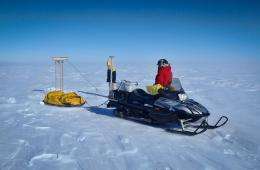
A corner cube reflector placed under the flight path of the AWI Polar-6 aircraft. The corner cube is used to validate the data from the ASIRAS instrument on Polar-6. Credits: UTAS-J. Beardsley
(PhysOrg.com) -- Next week marks 100 years since Roald Amundsen reached the South Pole. As a team of scientists brave the Antarctic to validate data from ESAs CryoSat mission, its hard to imagine what these first intrepid explorers would have thought of todays advances in polar science.
The remote and vast expanse of the Antarctic is arguably the most hostile environment on Earth infamously claiming the lives of Captain Robert Scott and his party all those years ago in their fated race to the South Pole.
While the polar regions are challenging, to say the least, for human survival, they are also very sensitive to climate change. In turn, polar ice plays a crucial role in regulating climate and sea level.
With the effects of climate change becoming more apparent, the CryoSat mission is gathering data on changes in the thickness of ice, both on land and floating in the oceans.
This information is needed to understand exactly how Earths ice is responding to climate change and to help predict what will happen if trends continue.
To ensure CryoSats data are as accurate as possible, ESA organises numerous research campaigns in the Arctic and Antarctic.
These campaigns involve taking measurements from the air and on the ice to compare with the data from CryoSat orbiting above.
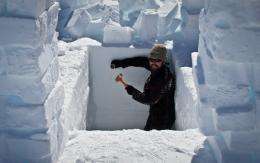
Taking snow and ice samples from one of a number of snow pits dug under the flight path of the Polar-6. These data help interpret the snow accumulation layers observed by the airborne ASIRAS instrument. Credits: AAD-D. Blight
A team of Australian and German scientists from the University of Tasmania, the Australian Antarctic Division and the Alfred Wegner Institute has just finished the first leg a remarkable measurement campaign.The campaign is being carried out in East Antarctica around Law Dome and Totten Glacier. Law Dome is relatively stable but features steep surface slopes and Totten Glacier is changing rapidly so both offer ideal locations for validating CryoSat.
CryoSat carries a new generation of altimeter called SIRAL. It is designed to measure very precisely the elevation of polar ice even around the edges of ice sheets, which are difficult to observe from space because of their steep slopes.
The campaign involves taking measurements from a Polar-6 aircraft. It carries the ASIRAS radar, which mimics CryoSats SIRAL. Ground-truth measurements are also collected for comparison.
Christopher Watson from the University of Tasmania said, Travelling on skidoo, the team gathered ground measurement over about 250 km transects.
The skidoos drag GPS to map the height of the ice, which are later compared to the aircraft and satellite measurements.
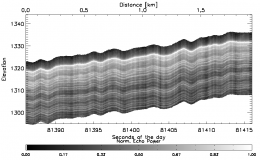
The plot shows preliminary processing of the ASIRAS data from a short 2 km section across Law Dome, Antarctica. Strong layering as a result of seasonal changes in snow accumulation is clearly visible down to about 20 m. In combination with snow pit and firn-core data, scientists can determine the spatial variability of the accumulation rate. Credits: AWI-V. Helm
The experiment examines the influence that physical properties of the top snow and ice layer have on the radar signal that CryoSat emits and receives, explained Veit Helm from the Alfred Wegner Institute.Depending on factors such as snow particle size, the extent to which it has compacted and how it is layered, the radar signal can penetrate deeper or less deep and so is reflected differently.
If we ignore these factors in the data, it may result in misinterpretations and less accurate maps of the changing Antarctic surface.
Malcolm Davidson, ESAs CryoSat Validation Manager, said, The first attempt in East Antarctica had to be abandoned owing to terrible weather conditions.
This makes the success of this years activity highly-value and very welcome both for ESA and for the scientists carrying out this challenging field work.
It also provides a welcome opportunity to bring together the Alfred Wegener Institute, the University of Tasmania and the Australian Antarctic Division, whose work will help ensure we have the best-possible data to understand changing polar ice from space.
Provided by
European Space Agency
-
From lemons to lemonade: Reaction uses carbon dioxide to make carbon-based semiconductor,
32 comments
-
Thioridazine kills cancer stem cells in human while avoiding toxic side-effects of conventional cancer treatments,
3 comments
-
SpaceX private rocket blasts off for space station (Update),
42 comments
-
Climate scientists say they have solved riddle of rising sea,
31 comments
-
SpaceX capsule has 'new car' smell, astronauts say (Update),
4 comments
-
Hypothetical desert earth
21 hours ago
-
More human population = greater mass?
May 25, 2012
-
Conversion from aircraft bearing to normal degrees
May 23, 2012
-
Interpretation/Analysis of the Lab results(HEPA filter)
May 22, 2012
-
Has anyone here attended the The Urbino Summer School in Paleoclimatology?
May 22, 2012
-
Earthquakes: Mag 6 N. Italy and Mag 5.6 W. Bulgaria
May 21, 2012
- More from Physics Forums - Earth
More news stories
Land and sea species differ in climate change response: study
(Phys.org) -- Marine and terrestrial species will likely differ in their responses to climate warming, new research by Simon Fraser University and Australia’s University of Tasmania has found.
4 hours ago |
3.7 / 5 (3) |
5
|
Yale study concludes public apathy over climate change unrelated to science literacy
Are members of the public divided about climate change because they don't understand the science behind it? If Americans knew more basic science and were more proficient in technical reasoning, would public consensus match ...
6 hours ago |
4.8 / 5 (5) |
12
|
10 million years needed to recover from mass extinction
It took some 10 million years for Earth to recover from the greatest mass extinction of all time, latest research has revealed.
Space & Earth / Earth Sciences
6 hours ago |
5 / 5 (3) |
1
|
Sophisticated simulations predict future warming
The chances of our planet being hit by a global warming of 3 degrees Celsius by 2050 is as likely as it being hit by an increase of 1.4 degrees, new research shows. Presented in the journal Nature Geoscience, the British study ...
Space & Earth / Earth Sciences
May 22, 2012 |
4.4 / 5 (9) |
51
Aliens don't want to eat us, says former SETI director
Alien life probably isnt interested in having us for dinner, enslaving us or laying eggs in our bellies, according to a recent statement by former SETI director Jill Tarter.
Space & Earth / Space Exploration
May 25, 2012 |
4.4 / 5 (15) |
41
Stunning image of smallest possible five-ringed structure
Scientists have created and imaged the smallest possible five-ringed structure about 100,000 times thinner than a human hair and you'll probably recognise its shape.
'Unzipped' carbon nanotubes could help energize fuel cells, batteries
Multi-walled carbon nanotubes riddled with defects and impurities on the outside could replace some of the expensive platinum catalysts used in fuel cells and metal-air batteries, according to scientists at ...
Change in developmental timing was crucial in the evolutionary shift from dinosaurs to birds: study
At first glance, it's hard to see how a common house sparrow and a Tyrannosaurus Rex might have anything in common. After all, one is a bird that weighs less than an ounce, and the other is a dinosaur that ...
Computer model used to pinpoint prime materials for efficient carbon capture
When power plants begin capturing their carbon emissions to reduce greenhouse gases and to most in the electric power industry, it's a question of when, not if it will be an expensive undertaking.
T cells 'hunt' parasites like animal predators seek prey, study shows
By pairing an intimate knowledge of immune-system function with a deep understanding of statistical physics, a cross-disciplinary team at the University of Pennsylvania has arrived at a surprising finding: T cells use a movement ...
Scientists develop ultra-sensitive test that detects diseases in their earliest stages
Scientists have developed an ultra-sensitive test that should enable them to detect signs of a disease in its earliest stages, in research published today in the journal Nature Materials.