Africa pitches new promised land for astronomers
December 19, 2011 by Claudine Renaud

The Square Kilometre Array is an instrument that would be able to look back to the infancy of the universe

Enlarge

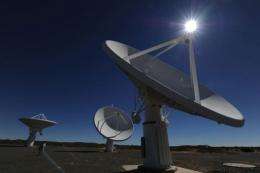
The Karoo Array Telescope construction site, part of the MeerKAT Project, in the Northern Cape. South Africa wants to draw leading astrophysicists to the continent as well with the world's most powerful radio telescope, the Square Kilometre Array.

Africa, the birthplace of the human species, has long been a magnet for archaeologists.

Now South Africa wants to draw leading astrophysicists to the continent as well with the world's most powerful radio telescope, the (SKA), an instrument that would be able to look back to the infancy of the universe.

South Africa and Australia are the two finalists in the competition to host the project, which will eventually link thousands of radio dishes to make a massive antenna with a total surface area of one square kilometre (250 acres).

The telescope, the brainchild of an international consortium of scientists, will be 50 to 100 times more sensitive than today's best and is projected to cost in the neighbourhood of $2.0 billion (1.5 billion euros).

Like an archaeologist digging into ever deeper layers of soil, the telescope will pick up from deeper in space than ever before, ones whose sources are billions of years old and may not even exist anymore.

Scientists say that power will help them look back in time and see how the universe took shape after the big bang.

For African astronomers, next year will be decisive.
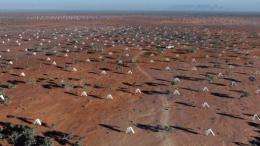
The Square Kilometre Array will eventually link thousands of radio dishes to make a massive antenna
Enlarge

An artist impression of low frequency aperture arrays of the Square Kilometre Array. South Africa is well-placed to host the world's largest telescope because it would cost cheaper, according to the deputy science minister.

Scientists will decide by early March whether the South African and Australian SKA site proposals pass muster. The consortium will then choose the winner, a decision the South Africans say will be political and economic as well as scientific.

South Africa also plans to start construction next year on a 64-antenna radio telescope called MeerKAT that would be one of the five most accurate in the world.

Observation slots at the MeerKAT are already fully booked for its first five years.

A prototype, the KAT-7, is up and running in the Karoo, an arid expanse of sparsely inhabited land stretched across the country's western side.

The government has declared the site, a silent, rocky landscape that looks like a Western movie cast with a few sheep, a " Reserve".

The site, which had no trace of human settlement eight years ago, is an hour by road from the nearest town, itself an hour's flight from Cape Town. Like giant white saucers turned to the sky, seven dish antennas capture the noise of the universe with a small, refrigerator-like hum.

"It is a very difficult place to do farming," said Justin Jonas, an astronomer and engineer and the operating director for SKA Africa.

"Which is good for us. It means the fewest people, fewest cell phones and fewest interferences."

South Africa's SKA bid would also put the core of antennas in the Karoo.

Other antennas would be scattered around the continent in Ghana, Kenya, Madagascar, Mauritius, Mozambique, Namibia and Zambia.
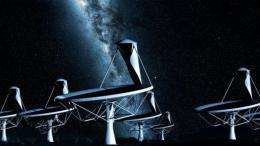
South Africa's SKA bid would put the core of antennas in the Karoo
Enlarge

An artist impression of the Square Kilometre Array (SKA) dish antennas at night. Design and pre-construction on the SKA are scheduled to begin in 2013. The project is expected to be finished around 2024.

Design and pre-construction on the SKA are scheduled to begin in 2013. The project is expected to be finished around 2024.

It is not an ideal time to be raising money for massive science projects. The US pulled out of the SKA last year, leaving it to Australia, Britain, China, Canada, Italy, New Zealand, the Netherlands and South Africa to fund. India is still on the fence.

But South Africa is undeterred. It says it can build the SKA for less money than Australia, which would co-host with New Zealand.

The government has already invested 635 million rand ($75 million) in seven years to build MeerKAT and plans to spend another 500 million rand a year to 2016.

"With a project like this, you don't make money, but you get a lot more. You develop scientific capacity," said Nadeem Oozeer, 36, a researcher from Mauritius.

"In Mauritius, we've got five graduates with terminal (doctorate) degrees. Why not an African Nobel prize winner?"

But officials here say they have to overcome negative perceptions of Africa's scientific potential.

"Afro-pessimism is real," said Derek Hanekom, deputy science minister.

"We believe we are the most suitable country to host successfully the SKA, we compete with the best in the world. But we are proceeding anyway and great astronomy is going to be done with or without the SKA."

(c) 2011 AFP

Filter


Move the slider to adjust rank threshold, so that you can hide some of the comments.


Display comments: newest first

rowbyme
Dec 19, 2011

Rank: 5 / 5 (1)
"because it would cost cheaper" ?

apparently no one proof reads this stuff
omatumr
Dec 19, 2011

Rank: 1 / 5 (5)
Thanks for the story.

If the cage of "consensus thinking" were limited by geographical location, the move to South Africa might help advance astronomy.

I guess the decision will be made by the golden rule: He who has the gold rules.

Rank 5 /5 (3 votes)
Relevant PhysicsForums posts
  • Distance of planets from stars and revolution
    created6 hours ago
  • revamping general concept and cosmological principle
    createdMay 25, 2012
  • Transiting Exoplanet Light Curve
    createdMay 25, 2012
  • Math behind Theoretical Physics
    createdMay 24, 2012
  • Do we know whats at the center of galaxies yet?
    createdMay 23, 2012
  • Structure of the Milky Way?
    createdMay 20, 2012
  • More from Physics Forums - General Astronomy

More news stories

Land and sea species differ in climate change response: study

(Phys.org) -- Marine and terrestrial species will likely differ in their responses to climate warming, new research by Simon Fraser University and Australia’s University of Tasmania has found.

Space & Earth / Environment

created 4 hours ago | popularity 3.7 / 5 (3) | comments 5 | with audio podcast

Yale study concludes public apathy over climate change unrelated to science literacy

Are members of the public divided about climate change because they don't understand the science behind it? If Americans knew more basic science and were more proficient in technical reasoning, would public consensus match ...

Space & Earth / Environment

created 6 hours ago | popularity 4.8 / 5 (5) | comments 12 | with audio podcast

10 million years needed to recover from mass extinction

It took some 10 million years for Earth to recover from the greatest mass extinction of all time, latest research has revealed.

Space & Earth / Earth Sciences

created 6 hours ago | popularity 5 / 5 (3) | comments 1 | with audio podcast

Sophisticated simulations predict future warming

The chances of our planet being hit by a global warming of 3 degrees Celsius by 2050 is as likely as it being hit by an increase of 1.4 degrees, new research shows. Presented in the journal Nature Geoscience, the British study ...

Space & Earth / Earth Sciences

created May 22, 2012 | popularity 4.4 / 5 (9) | comments 51

Aliens don't want to eat us, says former SETI director

Alien life probably isn’t interested in having us for dinner, enslaving us or laying eggs in our bellies, according to a recent statement by former SETI director Jill Tarter.

Space & Earth / Space Exploration

created May 25, 2012 | popularity 4.4 / 5 (15) | comments 41


Stunning image of smallest possible five-ringed structure

Scientists have created and imaged the smallest possible five-ringed structure – about 100,000 times thinner than a human hair – and you'll probably recognise its shape.

'Unzipped' carbon nanotubes could help energize fuel cells, batteries

Multi-walled carbon nanotubes riddled with defects and impurities on the outside could replace some of the expensive platinum catalysts used in fuel cells and metal-air batteries, according to scientists at ...

Change in developmental timing was crucial in the evolutionary shift from dinosaurs to birds: study

At first glance, it's hard to see how a common house sparrow and a Tyrannosaurus Rex might have anything in common. After all, one is a bird that weighs less than an ounce, and the other is a dinosaur that ...

Computer model used to pinpoint prime materials for efficient carbon capture

When power plants begin capturing their carbon emissions to reduce greenhouse gases – and to most in the electric power industry, it's a question of when, not if – it will be an expensive undertaking.

T cells 'hunt' parasites like animal predators seek prey, study shows

By pairing an intimate knowledge of immune-system function with a deep understanding of statistical physics, a cross-disciplinary team at the University of Pennsylvania has arrived at a surprising finding: T cells use a movement ...

Scientists develop ultra-sensitive test that detects diseases in their earliest stages

Scientists have developed an ultra-sensitive test that should enable them to detect signs of a disease in its earliest stages, in research published today in the journal Nature Materials.