A star with spiral arms
November 1, 2011 By Dr. Tony Phillips
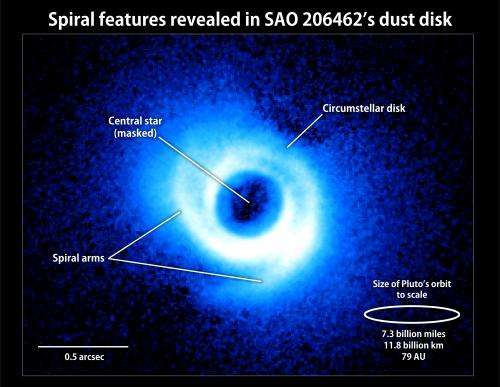
Two spiral arms emerge from the gas-rich disk around SAO 206462, a young star in the constellation Lupus. This image, acquired by the Subaru Telescope and its HiCIAO instrument, is the first to show spiral arms in a circumstellar disk. The disk itself is some 14 billion miles across, or about twice the size of Pluto's orbit in our own solar system. Credit: NAOJ/Subaru
For more than four hundred years, astronomers have used telescopes to study the great variety of stars in our galaxy. Millions of distant suns have been catalogued. There are dwarf stars, giant stars, dead stars, exploding stars, binary stars; by now, you might suppose that every kind of star in the Milky Way had been seen.
That's why a recent discovery is so surprising. Researchers using the Subaru telescope in Hawaii have found a star with spiral arms.
The name of the star is SAO 206462. It's a young star more than four hundred light years from Earth in the constellation Lupus, the wolf. SAO 206462 attracted attention because it has a circumstellar disk--that is, a broad disk of dust and gas surrounding the star. Researchers strongly suspected that new planets might be coalescing inside the disk, which is about twice as wide as the orbit of Pluto.
When they took a closer look at SAO 206462 they found not planets, but arms. Astronomers have seen spiral arms before: theyre commonly found in pinwheel galaxies where hundreds of millions of stars spiral together around a common core. Finding a clear case of spiral arms around an individual star, however, is unprecedented.
The arms might be a sign that planets are forming within the disk.
"Detailed computer simulations have shown us that the gravitational pull of a planet inside a circumstellar disk can perturb gas and dust, creating spiral arms, says Carol Grady, an astronomer with Eureka Scientific, Inc., who is based at NASA's Goddard Space Flight Center. Now, for the first time, we're seeing these dynamical features."
Grady revealed the image to colleagues on Oct. 19th at a meeting at Goddard entitled Signposts of Planets.
Theoretical models show that a single embedded planet may produce a spiral arm on each side of a disk. The structures around SAO 206462, however, do not form a matched pair, suggesting the presence of two unseen worlds, one for each arm.
Grady's research is part of a five-year international study of newborn stars and planets using the giant 8.2 meter Subaru Telescope. Operated by the National Astronomical Observatory of Japan, Subaru scans the heavens from a perch almost 14,000 feet above sea level at the summit of the Hawaiian volcano Mauna Kea. From there it has a crystal-clear view of innumerable young stars and their planet-forming disks throughout the Milky Way.
"What we're finding is that once these systems reach ages of a few million yearsthats young for a star--their disks begin to show all kinds of interesting shapes, says John Wisniewski, a collaborator at the University of Washington in Seattle. "Weve seen rings, divots, gaps--and now spiral features. Many of these structures could be caused by planets moving within the disks."
However, it is not an open and shut case. The research team cautions that processes unrelated to planets might give rise to these structures. Until more evidence is collected--or until the planets themselves are detected--they cant be certain.
Whatever the cause of the arms, their reality is undeniable and the great catalogue of stars has one more type. Stay tuned to science@nasa for future entries.
Source: Science@NASA
-
From lemons to lemonade: Reaction uses carbon dioxide to make carbon-based semiconductor,
32 comments
-
Thioridazine kills cancer stem cells in human while avoiding toxic side-effects of conventional cancer treatments,
3 comments
-
SpaceX private rocket blasts off for space station (Update),
42 comments
-
Climate scientists say they have solved riddle of rising sea,
31 comments
-
SpaceX capsule has 'new car' smell, astronauts say (Update),
4 comments
-
Distance of planets from stars and revolution
5 hours ago
-
revamping general concept and cosmological principle
May 25, 2012
-
Transiting Exoplanet Light Curve
May 25, 2012
-
Math behind Theoretical Physics
May 24, 2012
-
Do we know whats at the center of galaxies yet?
May 23, 2012
-
Structure of the Milky Way?
May 20, 2012
- More from Physics Forums - General Astronomy
More news stories
Land and sea species differ in climate change response: study
(Phys.org) -- Marine and terrestrial species will likely differ in their responses to climate warming, new research by Simon Fraser University and Australia’s University of Tasmania has found.
3 hours ago |
3.7 / 5 (3) |
2
|
Yale study concludes public apathy over climate change unrelated to science literacy
Are members of the public divided about climate change because they don't understand the science behind it? If Americans knew more basic science and were more proficient in technical reasoning, would public consensus match ...
5 hours ago |
4.8 / 5 (4) |
11
|
10 million years needed to recover from mass extinction
It took some 10 million years for Earth to recover from the greatest mass extinction of all time, latest research has revealed.
Space & Earth / Earth Sciences
5 hours ago |
5 / 5 (3) |
1
|
Sophisticated simulations predict future warming
The chances of our planet being hit by a global warming of 3 degrees Celsius by 2050 is as likely as it being hit by an increase of 1.4 degrees, new research shows. Presented in the journal Nature Geoscience, the British study ...
Space & Earth / Earth Sciences
May 22, 2012 |
4.4 / 5 (9) |
51
Aliens don't want to eat us, says former SETI director
Alien life probably isnt interested in having us for dinner, enslaving us or laying eggs in our bellies, according to a recent statement by former SETI director Jill Tarter.
Space & Earth / Space Exploration
May 25, 2012 |
4.4 / 5 (14) |
40
Nvidia trumpets Tegra 3 phone design wins for 2012
(Phys.org) -- Nvidias competitive war paint has a name, Tegra 3. On the heels of Nvidia announcements about lowering costs of its Tegra 3 processors and Nvidia-enabled tablets running Android Ice Cream ...
'Unzipped' carbon nanotubes could help energize fuel cells, batteries
Multi-walled carbon nanotubes riddled with defects and impurities on the outside could replace some of the expensive platinum catalysts used in fuel cells and metal-air batteries, according to scientists at ...
T cells 'hunt' parasites like animal predators seek prey, study shows
By pairing an intimate knowledge of immune-system function with a deep understanding of statistical physics, a cross-disciplinary team at the University of Pennsylvania has arrived at a surprising finding: T cells use a movement ...
Computer model used to pinpoint prime materials for efficient carbon capture
When power plants begin capturing their carbon emissions to reduce greenhouse gases and to most in the electric power industry, it's a question of when, not if it will be an expensive undertaking.
Change in developmental timing was crucial in the evolutionary shift from dinosaurs to birds: study
At first glance, it's hard to see how a common house sparrow and a Tyrannosaurus Rex might have anything in common. After all, one is a bird that weighs less than an ounce, and the other is a dinosaur that ...
Scientist: Evolution debate will soon be history
(AP) -- Richard Leakey predicts skepticism over evolution will soon be history. Not that the avowed atheist has any doubts himself.
Nov 01, 2011
Rank: 1.3 / 5 (30)
Nov 01, 2011
Rank: 1 / 5 (5)
Nov 01, 2011
Rank: 5 / 5 (15)
Just find older stars with similiar discs, and build up a series until you get the whole thing. If it works for one planetary system, it should work for the next one as well, so we should be able to find many different planetary systems in different stages of accretion, provided that we can observe them in enough detail.
Sound familiar?
Nov 01, 2011
Rank: 5 / 5 (2)
Nov 01, 2011
Rank: 5 / 5 (10)
A very strange thing to say since the efforts of science & the discovery of knowledge have been past down from generations that came before us, when something hasn't been understood its observation has been noted and left for another generation to pick up.
Science adjusts its beliefs based on whats observed
Faith is the denial of observation so that Belief can be preserved.
Faith has nothing to do with it, hundreds upon hundreds of simulations using formulas & equations that doubtfully you can read let alone understand, written by people who have spent years refining them, have been run. They may not be perfect but we have a good working idea of how a solar system is formed.
This 'observation' will help refine the model & life cycle of a solar system.
Nov 01, 2011
Rank: 4.7 / 5 (13)
And here I thought you were the one who was all about "believe what you can't see". My bad. Why don't you take that type of scepticism and apply it to your own beliefs? You didn't witness Jesus. Therefore - by your very own logic - he isn't real.
But seriously, like Eikka seid: We have billions of potential forming solar systems to look at. It seems we stand a pretty good chance of catching systems in various stages of formation.
Nov 01, 2011
Rank: 5 / 5 (4)
You will Kevin, in your eternal afterlife. We're all counting on that.
Nov 01, 2011
Rank: 5 / 5 (8)
I have seen fireworks with a similar shapes so maybe its just an alien pinwheel?
Nov 01, 2011
Rank: 3 / 5 (6)
As opposed to believing in god? Which there is no evidence for...
Nov 01, 2011
Rank: 1.8 / 5 (5)
Nov 02, 2011
Rank: 5 / 5 (3)
People sure are desperate to see religion vindicated. Problem here is if there are no gods to be found, who's going to hang around for the next coming to check if He eventually appears? No use making a record of it [and leaving it for posterity to confirm] without being able to have confirmation in one's own lifetime - that would simply reinforce the fact that one has to take the god theory by dumb faith. REALLY, really, really dumb faith.
Nov 02, 2011
Rank: 4.9 / 5 (7)
Huh? Ever ask yourself that? Ay?
Nov 02, 2011
Rank: 1 / 5 (1)
http://www.astro....ycle.pdf
It means, the epicycle model of solar system was not completely wrong, it just applies to different ratio of mutual interactions between objects and interactions between objects and their common center of mass. This insight can be extrapolated to many other systems, which are driven both with central laws, both with individual interactions of their peers, like the biological and social systems.
Nov 02, 2011
Rank: 1.3 / 5 (3)
In general, at the human scale the effects of both mutual, both central forces are balanced, at the atomic and planetary scale the central forces are most pronounced and with increasing distance from human observer scale (both toward quantum, both cosmological scales) the influence of mutual forces increases again. At the most distant scale the influence of both types of forces is balanced in the same way, like at the human scale.
Nov 02, 2011
Rank: 3 / 5 (2)
Dec 31, 2011
Rank: 1 / 5 (1)
Universal Plasma Energy Model- UPE- 1991-IEEE-ICOPS- by author clearly indicates -Source as drive to Spherical Disk and spiral in sequence.A DMVT process distribute Energy to Planets.
Between the hype created through images, let us apply our minds to the functional process that help Science to advance and catch-up with nature and Philosophy. Cosmology Vedas interlinks provides further inputs. Vidyardhi nanduri
Dec 31, 2011
Rank: not rated yet
Plasma Nonsense?
For your reading pleasure, here's a little ditty from NASA's archives for you to enjoy:
http://ntrs.nasa....3880.pdf