Potential for odd election outcomes with ranked choice voting system, says mathematician
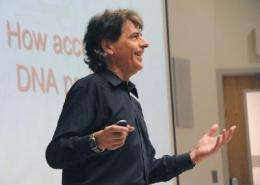
Keith Devlin, Stanford mathematician with the Human-Sciences and Technologies Advanced Research Institute, lecturing. Credit: Stanford University
"Instant runoff" voting which San Franciscans will use next week to choose their new mayor, county sheriff and district attorney requires voters to rank their three top choices in each race, instead of simply voting for their first choice.
Advocates say instant runoff does a better than job of producing a winner who truly represents most of the voters' preference; opponents say the opposite. It all boils down to what you think of the math, which raises an obvious question: What does a mathematician think?
We posed the question to Stanford mathematician (and NPR Math Guy) Keith Devlin.
"There is no perfect voting method," said Devlin. "A famous 1950 result by the Nobel Prizewinning mathematician Kenneth Arrow, who spent much of his career at Stanford, tells us that there is no voting system that meets all basic democratic requirements.
"One advantage of the system we use in our national elections, the 'first past the post' method, is that it is easy to understand. Everyone votes for one candidate and the one with the most votes wins. But ease of understanding is about the only thing in its favor, and all the experts agree it is just about the worst possible system.
"For one thing, in a field with at least three candidates, split votes between two top candidates can result in a third person being elected who is disliked by a large majority of the electorate. Another problem is more social than numerical, in that it forces candidates into opposing camps, slugging it out in a verbal prizefight.
"That may have a lot to do with the current dysfunction in Washington," Devlin suggests, "where no one is willing to compromise or make deals."
The method being used in San Francisco is a variant of the "instant runoff" process, also known as "ranked choice" voting. Here, voters select their top three choices out of the field of candidates and rank them in order of preference. In the mayoral race this year, that means ranking three out of 16 contenders.
Tallying the votes
All the first choice votes are counted and then an iterative tallying process begins.
First, the contender with the lowest number of first-choice votes is dropped from the competition. Each voter who had ranked that candidate as their number one choice then has their vote given to whichever candidate they selected as their second choice. The votes are re-tallied and, as before, the contender with the lowest vote total is eliminated.
This process continues for as many rounds as needed until one candidate has over 50 percent of the votes tallied in a round, at which point he or she is declared the winner.
Costs vs. benefits
Advocates point out that this method can save costs. With the one-vote approach previously used in San Francisco, if no candidate received over 50 percent of the votes in the election, a special runoff election had to be held, entailing the expense of printing new ballots and paying poll workers. With the instant runoff approach, a second election is not needed.
Opponents of the method point out that voters whose choices are repeatedly eliminated effectively get to vote several times, and moreover the process gives equal value to a person's third-place ranking of a candidate and someone else's top-choice vote.
But there are other problems, Devlin points out. "For example, with ranked choice voting, you can get a winner who is the first choice of only a relatively small minority of the voters.
"Undesirable outcomes such as this can arise," he explains, "because the candidates are eliminated and their votes reassigned one after another, and the order in which that happens can make a huge difference.
"A shift of a large block of votes in an early round can eliminate a candidate who would have gone on to win had she survived until a later round and then picked up more votes to boost her tally."
In math, if it can happen, it will
Devlin's example is not a just theoretical possibility. In the 2010 race for supervisor in San Francisco's District 10, the eventual winner received just 11.8 percent of the first-place votes, ultimately edging out the candidate who had the most first-place votes, according to reports in the San Francisco Chronicle.
There is also Jean Quan's win over Don Perata last year for mayor of Oakland. Quan had only 24.4 percent of first-choice votes; Perata had 33.7 percent, the Chronicle reported.
The known vagaries of the voting method have resulted in some candidates trying new approaches to getting votes. For example, mayoral candidate Michela Alioto-Pier sent out a mailing urging voters to "please consider at least making Michela your number 2 choice for Mayor."
A mailing from the San Francisco Republican Party suggested two mayoral "candidates to avoid."
Devlin thinks that as candidates become more aware of the election math and the possibilities it opens up, more of these tactics are likely to be seen. "Particularly in the era of social media, where it is possible for large numbers of voters to coordinate their actions," he adds.
Is this a misuse of election math? Devlin does not think so. "Arrow's theorem tells us that the only mathematically ideal system is a dictatorship, and no American wants that."
It isn't rocket science
"So voting is not like physics or engineering, where we have to do what the math tells us. Rather, it is one of those cases where we can make the math work for us to use it to achieve our own ends as a society. The voters will make the selection, but the math we choose can shape the kind of government we get. Do we want politics to be about partisanship and fighting, where half the electorate will always end up as losers and we just keep seesawing between the two, or do we encourage cooperation and compromise, where no one gets everything but everyone gets something?" Devlin says.
Devlin says that ranked choice voting now in use in San Francisco almost certainly encourages coalition building and reduces negative campaigning. "The question is, do you think that is a good thing? I have my opinion, but there I am being a citizen, not a mathematician."
Provided by
Stanford University
-
From lemons to lemonade: Reaction uses carbon dioxide to make carbon-based semiconductor,
32 comments
-
Thioridazine kills cancer stem cells in human while avoiding toxic side-effects of conventional cancer treatments,
3 comments
-
SpaceX private rocket blasts off for space station (Update),
42 comments
-
Climate scientists say they have solved riddle of rising sea,
31 comments
-
SpaceX capsule has 'new car' smell, astronauts say (Update),
4 comments
-
Consumption rivalry
May 25, 2012
-
Bilateral trade between all countries
May 24, 2012
-
Is the economic foundation of social media in jeopardy?
May 20, 2012
-
Psychology: Rosenthal and Hawthorne Effect
May 15, 2012
-
Is GDP and National Income the Same Thing?
May 13, 2012
-
Difference between hourly wage and real GDP per hour worked?
May 12, 2012
- More from Physics Forums - Social Sciences
More news stories
Change in developmental timing was crucial in the evolutionary shift from dinosaurs to birds: study
At first glance, it's hard to see how a common house sparrow and a Tyrannosaurus Rex might have anything in common. After all, one is a bird that weighs less than an ounce, and the other is a dinosaur that ...
Other Sciences / Archaeology & Fossils
7 hours ago |
5 / 5 (4) |
0
|
Social welfare cuts ultimately come with heavy price, researchers say
(Phys.org) -- Slashing government funding for Medicaid, food stamps and other programs that serve the poor while politically popular with some lawmakers and many conservatives may do more harm ...
Other Sciences / Social Sciences
May 24, 2012 |
4.2 / 5 (20) |
155
Ancient Bethlehem seal unearthed in Jerusalem
Israeli archaeologists have discovered a 2,700-year-old seal that bears the inscription "Bethlehem," the Israel Antiquities Authority announced Wednesday, in what experts believe to be the oldest artifact ...
Other Sciences / Archaeology & Fossils
May 23, 2012 |
3.3 / 5 (15) |
24
Dollars and sense: Why are some people morally against tax?
As the U.S. presidential election campaigns heat up, the economic debate is dominated by bailouts, austerity and, inevitably, taxation. Now a new study published in Symbolic Interaction asks why tax is such an important issue ...
Other Sciences / Social Sciences
May 23, 2012 |
2.3 / 5 (3) |
19
Oldest Jewish archaeological evidence on the Iberian Peninsula
German archaeologists of the Friedrich Schiller University Jena found one of the oldest archaeological evidence so far of Jewish Culture on the Iberian Peninsula at an excavation site in the south of Portugal, ...
Other Sciences / Archaeology & Fossils
May 25, 2012 |
4.2 / 5 (6) |
12
Stunning image of smallest possible five-ringed structure
Scientists have created and imaged the smallest possible five-ringed structure about 100,000 times thinner than a human hair and you'll probably recognise its shape.
'Unzipped' carbon nanotubes could help energize fuel cells, batteries
Multi-walled carbon nanotubes riddled with defects and impurities on the outside could replace some of the expensive platinum catalysts used in fuel cells and metal-air batteries, according to scientists at ...
Computer model used to pinpoint prime materials for efficient carbon capture
When power plants begin capturing their carbon emissions to reduce greenhouse gases and to most in the electric power industry, it's a question of when, not if it will be an expensive undertaking.
T cells 'hunt' parasites like animal predators seek prey, study shows
By pairing an intimate knowledge of immune-system function with a deep understanding of statistical physics, a cross-disciplinary team at the University of Pennsylvania has arrived at a surprising finding: T cells use a movement ...
Land and sea species differ in climate change response: study
(Phys.org) -- Marine and terrestrial species will likely differ in their responses to climate warming, new research by Simon Fraser University and Australia’s University of Tasmania has found.
Yale study concludes public apathy over climate change unrelated to science literacy
Are members of the public divided about climate change because they don't understand the science behind it? If Americans knew more basic science and were more proficient in technical reasoning, would public consensus match ...
Nov 07, 2011
Rank: not rated yet
The reason for this is that voters need to understand the issues to make correct choices, the reasoning behind who, what and why you are voting for one and not the other, and this involves studying, weeding through sound bites, coming to an intimate understanding of issues and the repercussions involved.
Very few people do this, voting for politicians for most people is simply "cult of personality" or "I voted for him because he has a nice smile".
So with that in mind you can understand why:
""There is no perfect voting method," said Devlin."
Voting isn't "broken" the people making the decisions are.
Nov 07, 2011
Rank: not rated yet
Nov 07, 2011
Rank: 5 / 5 (1)
This is not to say that top-remaining-candidate ranked voting in single-seat constituencies is a great method (in particular, it often inappropriately eliminates the centrist in a close three-way race). Methods that take some account of lower-ranked candidates do better, and those that use multi-seat constituencies can do better still. With some adjustments, this style of election could work very well.
Arrow's analysis shows that it is not possible to be completely fair to the candidates. But they are not the point. We should be more concerned with making elections play a positive role in our society.
Nov 07, 2011
Rank: 3 / 5 (2)
Nov 07, 2011
Rank: 5 / 5 (1)
Yes, but your 'second choice candidate' can win *ONLY IF* your first choice *COULD NOT POSSIBLY* win under *any* electoral system.
In such a 'strange' scenario, under the current system, a candidate which was the *LAST* choice of the majority would likely win. That's screwy.
Instant run-off (aka STV) means more democratic representation. If more people like Person A than Person B, you're going to have Person A elected before Person B. ALWAYS.
That is not true in First Past the Post. In FPP, you often have to vote strategically (vote for Candidate A, even though you really want to vote for Candidate B, because you don't want Candidate C to win.
Under FPP, you *ensure* divisive politics. Under more representational voting, you eliminate the "you're either with us or against us" mentality that is actually true to a large degree under FPP.
Nov 07, 2011
Rank: not rated yet
http://www.youtub...KMa1cYHk
It's both entertaining and informative. (Note: It applies to voting in members of the British Parliament, but it applies equally to any election for any body).
Nov 07, 2011
Rank: not rated yet
Nov 07, 2011
Rank: not rated yet
You're wrong, human stupidity is exactly the reason why there is no perfect (read useful) voting system, because stupidity can't be compensated for in this system, there is no such thing as "perfect" when dealing with humans, but there is useful.
So if you want to throw theorems out there remember what you're dealing with, human stupidity.
But hey Einstein said it better.
"Two things are infinite: the universe and human stupidity; and I'm not sure about the the universe."
If people would take the time to educate themselves the current system would be fine, all this article really talks about is watering down an already damaged (by human stupidity) system, no other "theorems" needed.
Nov 07, 2011
Rank: 1 / 5 (1)