Physicists chip away at mystery of antimatter imbalance
November 9, 2011

Physicists chip away at mystery of antimatter imbalance

Enlarge

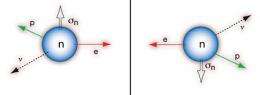
Two types of neutron decay produce a proton, an electron and an electron antineutrino but eject them in different configurations, The experiments at NIST detected no imbalance, but the improved sensitivity could help place limits on competing theories about the matter-antimatter imbalance in the universe. Credit: emiT team

(PhysOrg.com) -- Why there is stuff in the universe—more properly, why there is an imbalance between matter and antimatter—is one of the long-standing mysteries of cosmology. A team of researchers working at the National Institute of Standards and Technology has just concluded a 10-year-long study of the fate of neutrons in an attempt to resolve the question, the most sensitive such measurement ever made. The universe, they concede, has managed to keep its secret for the time being, but they’ve succeeded in significantly narrowing the number of possible answers.

Though the word itself evokes science fiction, is an ordinary—if highly uncommon—material that cosmologists believe once made up almost exactly half of the substance of the universe. When particles and their antiparticles come into contact, they instantly annihilate one another in a flash of light. Billions of years ago, most of the matter and all of the antimatter vanished in this fashion, leaving behind a tiny bit of matter awash in cosmic energy. What we see around us today, from stars to rocks to living things, is made up of that excess matter, which survived because a bit more of it existed.

“The question is, why was there an excess of one over the other in the first place?” says Pieter Mumm, a physicist at NIST’s Physical Measurements Lab. “There are lots of theories attempting to explain the imbalance, but there’s no experimental evidence to show that any of them can account for it. It’s a huge mystery on the level of asking why the universe is here. Accepted physics can’t explain it.”
Physicists chip away at mystery of antimatter imbalance
Enlarge

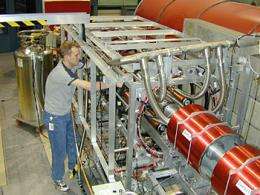
Physicists including Pieter Mumm (shown) used the emiT detector they built at NIST to investigate any potential statistical imbalance between the two natural types of neutron decay. Credit: emiT team

An answer might be found by examining radioactivity in neutrons, which decay in two different ways that can be distinguished by a specially configured detector. Though all observations thus far have invariably shown these two ways occur with equal frequency in nature, finding a slight imbalance between the two would imply that nature favors conditions that would create a bit more matter than antimatter, resulting in the universe we recognize.

Mumm and his collaborators from several institutions used a detector at the NIST Center for Neutron Research to explore this aspect of neutron decay with greater sensitivity than was ever possible before. For the moment, the larger answer has eluded them—several years of observation and data analysis once again turned up no imbalance between the two decay paths. But the improved sensitivity of their approach means that they can severely limit some of the numerous theories about the universe’s matter-antimatter imbalance, and with future improvements to the detector, their approach may help constrain the possibilities far more dramatically.

“We have placed very tight constraints on what these theories can say,” Mumm says. “We have given theory something to work with. And if we can modify our detector successfully, we can envision limiting large classes of theories. It will help ensure the physics community avoids traveling down blind alleys.”

The research team also includes scientists from the University of Washington, the University of Michigan, the University of California at Berkeley, the University of Notre Dame, Hamilton College and the University of North Carolina at Chapel Hill. Funding was provided by the U.S. Department of Energy and the National Science Foundation.

More information: H.P. Mumm, T.E. Chupp, R.L. Cooper, K.P. Coulter, S.J. Freedman, B.K. Fujikawa, A. García, G.L. Jones, J.S. Nico, A.K. Thompson, C.A. Trull, J.F. Wilkerson and F.E. Wietfeldt. New limit on time-reversal violation in beta decay. Physical Review Letters, Vol. 107, Issue 10, DOI: 10.1103/PhysRevLett.107.102301

Provided by National Institute of Standards and Technology search and more info website

4.7 /5 (14 votes)  

Filter


Move the slider to adjust rank threshold, so that you can hide some of the comments.


Display comments: newest first

kevinrtrs
Nov 09, 2011

Rank: 1.4 / 5 (20)
Billions of years ago, most of the matter and all of the antimatter vanished in this fashion, leaving behind a tiny bit of matter awash in cosmic energy.


This is unfortunately sheer speculation since there is no evidence to support this, only MORE unsubstantiated speculation. No one was there to observe and record it and this 10-yr research did nothing2change that lack.

The mystery of why there's matter and not the same amount of anti matter around is similar to why living organisms display such an intolerably inexplicable preference for chirality at the molecular level. The two phenomena have exactly the same common characteristic: Eneergy transformation produces both matter and anti-matter - without exception whilst similarly organic chemical reactions tend to produce both left-and right-handed isomers in equal quantities.
So there's no explanation for how matter can exist naturally and also how organic life can contain proteins/enzymes/dna made up of single-handed isomer
kaasinees
Nov 09, 2011

Rank: 1 / 5 (14)
I agree with kevinrtrs, they could have published their findings without their speculations about early universe etc.
Zarabtul
Nov 09, 2011

Rank: 1 / 5 (12)
There is less anti-matter due to the fact there are less possible breaks caused by quarks and anti-quarks in the gluon field than there are possible connections. Showing at a below molecular level why and rather simple there would be less anti-matter. It's all about using the Physics available to you. The connections are what make matter or proton energy and the breaks are what make anti-matter or neutron weight..... It really a simple discovery that was made quite some time ago. People just like to argue instead of hear the truth. I do agree though this experiment was a waste of funding.
Neodim
Nov 09, 2011

Rank: 1 / 5 (6)
antimatter we do not see
MaxwellsDemon
Nov 09, 2011

Rank: 3.8 / 5 (8)
The mystery surrounding the abundance of matter over antimatter in the universe may turn out to be a "wrong question."

Because we don't know yet whether matter and antimatter gravitational attract, or repel. Like most people I had assumed that they must attract, and there are a number of sound arguments for that assumption - but it turns out that those arguments are all unproven.

Until we answer that question experimentally, it's possible that there are an equal number of antimatter galaxy clusters in the universe gravitationally repelling matter galaxy clusters. This would neatly resolve the "annihilation catastrophe" problem, and also offer an intriguing new explanation of dark energy.

We should know soon. Antimatter containment is *almost* advanced enough to test the idea in the lab, and the Alpha Magnetic Spectrometer is looking for an anti-alpha particle (finding just one would prove the existence of antimatter stars in the universe: http://ams.nasa.g...t.html).
MaxwellsDemon
Nov 09, 2011

Rank: 4.6 / 5 (5)
Here's some further reading for anyone interested in the theoretical basis of gravitational repulsion between matter and antimatter, and its cosmological implications:

http://arxiv.org/abs/0804.4199
http://arxiv.org/.../0610079
http://arxiv.org/abs/1103.4937
http://arxiv.org/.../9906012
http://en.wikiped...timatter
MaxwellsDemon
Nov 09, 2011

Rank: 5 / 5 (4)
And here's more on the Alpha Magnetic Spectrometer experiment to find evidence for antimatter galaxies. The detector was conceived and created under Dr. Samuel Ting, Nobel laureate and physics professor at MIT:

http://public.web...3-a.html
http://science.na...aug_ams/
http://www.nature...260.html
omatwankr
Nov 09, 2011

Rank: 5 / 5 (2)
"inexplicable preference for chirality at the molecular level"

Recent Progress in Chirality Research Using Circularly Polarized Light
http://arxiv.org/abs/1009.6169
"Circularly polarized light could bring the enantiomeric excess of prebiotic molecules in space. Recent experimental works on photochemistry under ultraviolet circularly polarized light are remarkable. Recent astronomical observations by imaging polarimetry of star-forming regions are now revealing the distribution of circularly polarized light in space."
barakn
Nov 09, 2011

Rank: 5 / 5 (4)
That's the most cogent thing I've ever seen Omatwankr post. Did you use the wrong sockpuppet?
Callippo
Nov 10, 2011

Rank: 1.2 / 5 (6)
Physicists chip away at mystery of antimatter imbalance ...the experiments at NIST detected no imbalance, but the improved sensitivity could help place limits on competing theories about the matter-antimatter imbalance in the universe.
This is very diplomatic way, how to present at public, their confusion with this mystery just deepened. These alchemists didn't find a gold, but they found another way, how the gold cannot be produced.
Seeker2
Nov 10, 2011

Rank: not rated yet
Billions of years ago, most of the matter and all of the antimatter vanished in this fashion, leaving behind a tiny bit of matter awash in cosmic energy.


kevinrtrs:
This is unfortunately sheer speculation since there is no evidence to support this, only MORE unsubstantiated speculation. No one was there to observe and record it and this 10-yr research did nothing2change that lack.


I can't be the first to speculate about anti-gravity. However I don't believe matter and antimatter directly interact unless they annihilate. Nuclei can be formed using quarks and antiquarks in a non-symmetrical configuration (else they annihilate) when there is apparently no intervening spacetime. They are repulsive only when mediated by spacetime, as in the quantum elements of causal dynamical triangulations, or perhaps loop quantum gravity.
Seeker2
Nov 10, 2011

Rank: 1 / 5 (2)
cont...
I think in terms of matter as being compressed regions of spacetime and anti-matter expanded regions instead of positive and negative curvature but it's essentially the same. Compression results in stretching neighboring spacetime toward the compressed elements, hence gravity. Similar idea for antimatter - expanded elements of spacetime. However in regions of denser spacetime expanded elements are repulsed - hence anti-gravity. The net effect is matter/antimatter repulsion mediated by spacetime.

Point being antimatter is repulsed to the outer regions of spacetime. The second point is antimatter is mutually repulsive when mediated by spacetime. That is intervening spacetime repels antimatter. Hence I don't expect to see galaxies or any cosmic bodies of antimatter formed.
Seeker2
Nov 10, 2011

Rank: 1 / 5 (2)
cont...
The implications seem important for a cyclic universe theory. Antimatter accumulates in an outer shell of spacetime, matter in an inner shell, spacetime mediating the separation of the two shells. However when the dark energy runs out, the accelerated expansion stops. Spacetime could continue to expand at a constant velocity, but the electrostatic force between the positrons in the outer shell and electrons in the inner shell stops expansion and starts compression where the potential energy of expansion is returned to the internal DE of spacetime. Eventually the electrostatic forces overcome the repulsive gravitational forces and the two shells merge together, resulting in a bolt of lightning like in a double-barreled van de Graf generator resulting in the inflationary phase of expansion. Roger Penrose claims to see images of circles in the CMBR, which could be these two shells.

More discussions at http://www.physor...ory.html
Seeker2
Nov 10, 2011

Rank: 1 / 5 (1)
cont...
Note particles in the inner and outer shells, being mutually repulsive, assure symmetric (or very nearly so) configurations.

Seeker2
Nov 12, 2011

Rank: 1 / 5 (1)
MaxwellsDemon:
Note in your references I see no consideration of the mediating effects of spacetime on matter and anti-matter. That is matter and antimatter don't normally interact gravitationally in the absence of spacetime, hence mesons can exist for short times until spacetime intervenes and subjects the matter particle to gravity and the antimatter particle to anti-gravity.
Seeker2
Nov 14, 2011

Rank: 1 / 5 (1)
cont...
Note particles in the inner and outer shells, being mutually repulsive, assure symmetric (or very nearly so) configurations.


So my question is at what distance does the force of gravity between 2 electrons counter-balance the electrostatic force of repulsion? Obviously I'm thinking about a stable configuration for the inner shell of electrons.

It may be a moot question if the Planck constant changes with time. That is when the dark energy is converted to electrostatic attraction between the inner and outer shells do quantum fluctuations and perhaps the Planck constant cease to exist? In that case spacetime and something like a singularity might actually occur.
Seeker2
Nov 14, 2011

Rank: 1 / 5 (1)
cont...
Note if the Planck constant changes with time redshift values and age of the universe calculations would be affected.

Seeker2
Nov 14, 2011

Rank: 1 / 5 (1)
cont...
A U with 0 Planck constant would be a pretty dark place - no radiation. With nothing to fuel the uncertainty principle spacetime would become deterministic and collapse, at least untill the collapse of the outer shell, when the stored electrostatic energy is again released as radiation.
MarkyMark
Nov 15, 2011

Rank: not rated yet
Really Seeker2 did you REALLY have to spam so many times? Your last two posts dont even break the Charecter limit at all? So why?
Shootist
Nov 15, 2011

Rank: 1 / 5 (1)
Really Seeker2 did you REALLY have to spam so many times? Your last two posts dont even break the Charecter limit at all? So why?


Munchhausen syndrome.
Seeker2
Nov 18, 2011

Rank: 1 / 5 (1)
Really Seeker2 did you REALLY have to spam so many times? Your last two posts dont even break the Charecter limit at all? So why?

Well maybe psycobabble is easier to understand in small chuncks. Like if the Planck "constant" changes over time as the dark energy runs out it would be one of those inconvenient truth issues. That is redshifts and the age of the universe would have to be recalculated. Sorry.

Seeker2
Nov 20, 2011

Rank: 1 / 5 (1)
In string theory terms as the DE runs out the strings stop vibrating and the music is over.
Seeker2
Nov 22, 2011

Rank: 1 / 5 (1)
We can re-define matter and anti-matter to make some interesting predictions, especially about the cyclic U.

When the DE, or internal energy of spacetime is greater than 0, elements of spacetime undergo random quantum fluctuations in size and shape. Suppose at any specific time all elements have a fixed energy, so quantum fluctuations only cause various energy densities. If the fluctuation falls into an allowed quantum state it can assume the energy density of that state. The actual fluctuation is random but the quantum states are discrete. So any residual energy after formation of the quantum state is released as radiation.
Seeker2
Nov 22, 2011

Rank: 1 / 5 (1)
Some quantum states will have energy density greater than neighboring spacetime and some lesser. Ones with higher energy density can be considered as having a given energy in a smaller volume. These are quarks and lower energy than normal are anti-quarks. The smaller volume stretches neighboring spacetime inwards causing gravity. Larger volumes push away neighboring spacetime causing anti-gravity.

Note the definitions involve the idea of normal, that is what appears to be undistorted spacetime. So whether it's elements of matter or anti-matter depends on what you call normal. As spacial expansion continues and the DE runs out, normal will become less and less dense. When it reaches the density of antimatter the antimatter dissolves into spacetime. So as normal becomes less dense the distribution of matter and anti-matter, as it is observed relative to undistorted spacetime, changes. CP violation should appear to increase as expansion continues.
Seeker2
Nov 22, 2011

Rank: 1 / 5 (1)
Also matter is pulled into black holes until its energy density matches that inside the black hole, at which point it dissolves and appears as normal energy density in the black hole.

Black holes eventually evaporate and antimatter is dissolved in spacetime expansion, leaving spacetime with an outer shell of positrons and an inner cloud of electrons. DE is now transformed into electrostatic potential energy of the electrons and positrons. Spacetime has essentially become a huge supercharged battery. Electrostatic attraction takes over and accelerating particles radiate, raising the temperature of spacetime. No new quark matter is created in the collapsing phase because that requires condensation which can't happen as spacetime temperature rises. When the charges meet the currents really start to flow and the next BB comes in like a giant stroke of lightening. Or so it appears here in Lake Wobegon.
Seeker2
Nov 24, 2011

Rank: 1 / 5 (1)
Note this theory views gravity as a suction effect, not as some form of pressure. So the highest density of matter in a black hole is that of its heaviest, or densest, particle, and thus no singularities.
Seeker2
Dec 09, 2011

Rank: 1 / 5 (1)
Feynman used to talk about positrons orbiting in opposite directions from electrons in a syncrotron. He claimed electrons were merely positrons travelling backwards in time. I wonder if it every occurred to him and Dirac that antimatter might react similarly in a gravitational field (experience antigravity).
The universe expands in opposite directions in space. I wonder if it does the same thing in time. Like we experience time running forwards and in reverse. The present time thus has a double meaning - present in forward and reverse time.
Rank 4.7 /5 (14 votes)
Tags

Relevant PhysicsForums posts

More news stories

Is a classical electrodynamics law incompatible with special relativity?

(Phys.org) -- The laws of classical electromagnetism that were developed in the 19th century are the same laws that scientists use today. They include Maxwell’s four equations along with the Lorentz la ...

Physics / General Physics

created May 24, 2012 | popularity 4.7 / 5 (18) | comments 43 | with audio podcast feature

Landmark calculation clears the way to answering how matter is formed

(Phys.org) -- An international collaboration of scientists, including Thomas Blum, associate professor of physics, is reporting in landmark detail the decay process of a subatomic particle called a kaon – ...

Physics / General Physics

created May 25, 2012 | popularity 4.3 / 5 (22) | comments 51 | with audio podcast

Lying in wait for WIMPs: Researchers seek to dramatically increase sensitivity of Large Underground Xenon detector

Although it's invisible, dark matter accounts for at least 80 percent of the matter in the universe. No one knows what it is, but most scientists would bet on weakly interacting massive particles, or WIMPs.

Physics / General Physics

created May 23, 2012 | popularity 4 / 5 (7) | comments 16 | with audio podcast

Hawaii lab turns laser-powered bubbles into microrobots

(Phys.org) -- A team of scientists from the University of Hawaii are working on microrobots created from bubbles of air in a saline solution. The bubbles take on their title of “robots” as a laser ...

Physics / General Physics

created May 23, 2012 | popularity 5 / 5 (4) | comments 2 | with audio podcast weblog

Sound increases the efficiency of boiling

Scientists at the Georgia Institute of Technology achieved a 17-percent increase in boiling efficiency by using an acoustic field to enhance heat transfer. The acoustic field does this by efficiently removing vapor bubbles ...

Physics / Soft Matter

created May 24, 2012 | popularity 5 / 5 (2) | comments 2


Nvidia trumpets Tegra 3 phone design wins for 2012

(Phys.org) -- Nvidia’s competitive war paint has a name, Tegra 3. On the heels of Nvidia announcements about lowering costs of its Tegra 3 processors and Nvidia-enabled tablets running Android Ice Cream ...

'Unzipped' carbon nanotubes could help energize fuel cells, batteries

Multi-walled carbon nanotubes riddled with defects and impurities on the outside could replace some of the expensive platinum catalysts used in fuel cells and metal-air batteries, according to scientists at ...

T cells 'hunt' parasites like animal predators seek prey, study shows

By pairing an intimate knowledge of immune-system function with a deep understanding of statistical physics, a cross-disciplinary team at the University of Pennsylvania has arrived at a surprising finding: T cells use a movement ...

Computer model used to pinpoint prime materials for efficient carbon capture

When power plants begin capturing their carbon emissions to reduce greenhouse gases – and to most in the electric power industry, it's a question of when, not if – it will be an expensive undertaking.

Change in developmental timing was crucial in the evolutionary shift from dinosaurs to birds: study

At first glance, it's hard to see how a common house sparrow and a Tyrannosaurus Rex might have anything in common. After all, one is a bird that weighs less than an ounce, and the other is a dinosaur that ...

Land and sea species differ in climate change response: study

(Phys.org) -- Marine and terrestrial species will likely differ in their responses to climate warming, new research by Simon Fraser University and Australia’s University of Tasmania has found.