Parasitoid larvae in caterpillars affect behaviour of moths
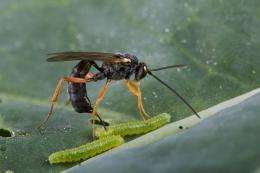
(PhysOrg.com) -- Parasitoid larvae that feed within caterpillars that eat cabbage plants influence the plant via the caterpillar, making the cabbage plant an unattractive prospect for moths looking for a spot to lay their eggs. Together with French colleagues, researchers from the Entomology Laboratory at Wageningen University, part of Wageningen UR, will be publishing their discovery this week in PNAS.
Plants that are gnawed at by caterpillars produce blends of volatiles that attract parasitic wasps, parasitoids. These wasps lay eggs in the caterpillars, after which the parasitoid larvae devour their host. So rather than turning into butterflies, the caterpillars are actually helping to produce a new generation of wasps. So in fact, the parasitoids are rescuing the plants from their attackers. During their development, the parasitoid larvae influence the caterpillars they are developing in and in turn, the caterpillars influence the cabbage plant; and all with far-reaching consequences for the diamondback (or cabbage) moth.
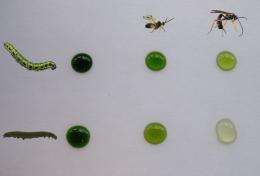
Saliva from caterpillars of the large cabbage white (top row) and the small cabbage white (bottom row). The caterpillars were uncolonized (left) or colonized by either the Cotesia glomera parasitoid (middle) or the Hyposoter ebeninus parasitoid (right). The colour of the saliva differs depending on the caterpillar and the species of parasitoid that attacks the caterpillar. Photo: Erik Poelman
Cabbage plants eaten by cabbage white caterpillars are particularly attractive to female diamondback moths in search of a plant on which to lay their eggs. However, if the caterpillars have been colonized by parasitoids, the plants become less attractive to the diamondback moths. The level of impact depends on the species of parasitoid that is developing within the caterpillars.
To find out exactly how the parasitic wasps alter the cabbage plants, the researchers monitored the activity of 9 genes that are activated when the caterpillars of the small and large cabbage white gnaw the cabbage plant. The researchers used caterpillars that were parasitized with one of three different species of parasitoids. The plants appear to respond differently to two types of caterpillars, but the actual species of parasitoid that is developing within the caterpillar makes a much bigger difference. It is the saliva of the caterpillars that affects the plant’s response. Interestingly enough, each individual species of parasitoid has a different effect on the quality of the caterpillars’ saliva, which is reflected in the colour of the saliva.
This research carried out by researchers from the Universities of Wageningen and Rennes shows that parasitic wasps that infest cabbage white caterpillars do not only kill the caterpillars, but also make the cabbage plants less attractive to another enemy, the diamondback moth. Diamondback moths throughout the world have become resistant to countless insecticides, and there is an urgent need for alternative pesticides. In the case of cabbage whites, biological pest control gives the cabbage plants extra protection against diamondback moths. Researcher Erik Poelman calls this a ‘spectacular’ discovery, and adds: “This could help us to develop an environmentally-friendly way of protecting cabbage plants from diamondback moths.”
More information: Parasitoid-specific induction of plant responses to parasitized herbivores affects colonization by subsequent herbivores. Erik H. Poelman, Si-Jun Zheng, Zhao Zhang, Nanda M. Heemskerk, Anne-Marie Cortesero, Marcel Dicke, Proceedings of the National Academy of Sciences (PNAS).
Provided by Wageningen University


