Long-term study shows acid pollution in rain decreased with emissions
November 16, 2011

Long-term study shows acid pollution in rain decreased with emissions

Enlarge

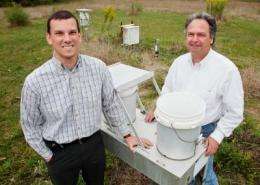
Researchers Christopher Lehmann, left, and David Gay completed a 25-year study of acidic pollutants in rainwater collected across the US and found that both frequency and concentration of acid rainfall has decreased. Credit: L. Brian Stauffer

Emissions regulations do have an environmental impact, according to a long-term study of acidic rainfall by researchers at the University of Illinois.

The National Atmospheric Deposition Program collects rainfall samples weekly from more than 250 stations across the United States and analyzes them for pollutants. The program recently released a report detailing trends in acidic rainfall frequency and concentration over 25 years, from 1984 to 2009.

"This is the longest-term, widest-scale precipitation study in the U.S. In particular, we wanted to see how the trends in the pollution and the rain correlated back to regulations," said Christopher Lehmann, a researcher in the program, which is part of the Illinois State Water Survey at the U. of I. "We're seeing regulations on emissions sources having direct and positive impact to reduce pollutants in rain."
Long-term study shows acid pollution in rain decreased with emissions
Enlarge

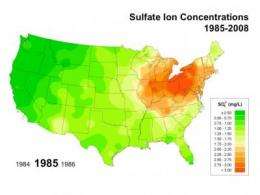
The mean concentration of sulfuric acid ions in rainwater in 1985, as measured by the National Atmospheric Deposition Program's network of collection sites across the United States. Credit: National Atmospheric Deposition Program, Illinois State Water Survey

The phenomenon commonly known as "" has widespread effects not only on the ecosystem, but also on infrastructure and the economy. Polluted precipitation adversely affects , fishing, agriculture and other industries. Acid also erodes structures, damaging buildings, roads and bridges.

According to the report, acidic precipitation – rain or snowfall with a pH value of 5.0 or less – decreased in both frequency and concentration over the 25-year span.

The researchers largely attribute the decrease to the amendments to the Clean Air Act in 1990 regulating emissions of sulfur dioxide and nitrogen oxide, the gases that become sulfuric and nitric acid when mixed with rain water.

"What goes up does come down," Lehmann said. "Rainfall chemistry directly correlates with air pollution. When we looked at the magnitude of the trend, we found it compared very well to the magnitude of the decrease in emissions reported by the EPA (Environmental Protection Agency)."
Long-term study shows acid pollution in rain decreased with emissions
Enlarge

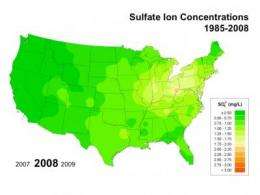
The mean concentration of sulfuric acid ions in rainwater in 2008, as measured by the National Atmospheric Deposition Program's network of collection sites across the United States. Credit: National Atmospheric Deposition Program, Illinois State Water Survey

According to EPA data, sulfate emissions dropped more than 50 percent during the period covered by the study and nitrate emissions dropped more than 30 percent. The National Atmospheric Deposition Program report found that concentrations of corresponding acid ions in rainwater have dropped by similar magnitudes. In addition, frequency of acidic precipitation has decreased across the U.S.

"You want to make sure that the regulations you put in place are effective, that they do what they were designed to do," said David Gay, the coordinator of the deposition program. "That's why we're here. We spend a lot of money to promulgate regulations. There's a lot of concern about their impact on industry. This study shows clear, significant evidence of the direct impact of regulation."

The deposition program continues to monitor sulfur and nitrogen compounds in rain. Although acidic precipitation has decreased, it has not disappeared, particularly remaining prevalent across the eastern U.S. In addition, the program has expanded its screening and monitoring other problematic pollutants such as ammonia and mercury.

"We still have acid ," Lehmann said. "Yes, the trend is down, and we should celebrate that, but it's still a problem. There is still progress to be made, and there are new regulations coming along to continue to reduce emissions of sulfur and nitrogen compounds."

Provided by University of Illinois at Urbana-Champaign search and more info website

Filter


Move the slider to adjust rank threshold, so that you can hide some of the comments.


Display comments: newest first

Vendicar_Decarian
Nov 16, 2011

Rank: 1 / 5 (1)
Imagine that. Gubderment regulation actually reduced the emissions of pollutants. Libertarians and other Fascists said it was impossible.

Originally they said that there was no such thing as acid rain, and many of them continue with their denial of that reality to this day.

Death is the only cure for them.
Rank 5 /5 (2 votes)
Relevant PhysicsForums posts

More news stories

Land and sea species differ in climate change response: study

(Phys.org) -- Marine and terrestrial species will likely differ in their responses to climate warming, new research by Simon Fraser University and Australia’s University of Tasmania has found.

Space & Earth / Environment

created 5 hours ago | popularity 3.7 / 5 (3) | comments 5 | with audio podcast

Yale study concludes public apathy over climate change unrelated to science literacy

Are members of the public divided about climate change because they don't understand the science behind it? If Americans knew more basic science and were more proficient in technical reasoning, would public consensus match ...

Space & Earth / Environment

created 7 hours ago | popularity 4.8 / 5 (5) | comments 15 | with audio podcast

10 million years needed to recover from mass extinction

It took some 10 million years for Earth to recover from the greatest mass extinction of all time, latest research has revealed.

Space & Earth / Earth Sciences

created 7 hours ago | popularity 4 / 5 (4) | comments 1 | with audio podcast

Sophisticated simulations predict future warming

The chances of our planet being hit by a global warming of 3 degrees Celsius by 2050 is as likely as it being hit by an increase of 1.4 degrees, new research shows. Presented in the journal Nature Geoscience, the British study ...

Space & Earth / Earth Sciences

created May 22, 2012 | popularity 4.4 / 5 (9) | comments 51

Aliens don't want to eat us, says former SETI director

Alien life probably isn’t interested in having us for dinner, enslaving us or laying eggs in our bellies, according to a recent statement by former SETI director Jill Tarter.

Space & Earth / Space Exploration

created May 25, 2012 | popularity 4.4 / 5 (15) | comments 41


Stunning image of smallest possible five-ringed structure

Scientists have created and imaged the smallest possible five-ringed structure – about 100,000 times thinner than a human hair – and you'll probably recognise its shape.

'Unzipped' carbon nanotubes could help energize fuel cells, batteries

Multi-walled carbon nanotubes riddled with defects and impurities on the outside could replace some of the expensive platinum catalysts used in fuel cells and metal-air batteries, according to scientists at ...

Change in developmental timing was crucial in the evolutionary shift from dinosaurs to birds: study

At first glance, it's hard to see how a common house sparrow and a Tyrannosaurus Rex might have anything in common. After all, one is a bird that weighs less than an ounce, and the other is a dinosaur that ...

Computer model used to pinpoint prime materials for efficient carbon capture

When power plants begin capturing their carbon emissions to reduce greenhouse gases – and to most in the electric power industry, it's a question of when, not if – it will be an expensive undertaking.

T cells 'hunt' parasites like animal predators seek prey, study shows

By pairing an intimate knowledge of immune-system function with a deep understanding of statistical physics, a cross-disciplinary team at the University of Pennsylvania has arrived at a surprising finding: T cells use a movement ...

Scientists develop ultra-sensitive test that detects diseases in their earliest stages

Scientists have developed an ultra-sensitive test that should enable them to detect signs of a disease in its earliest stages, in research published today in the journal Nature Materials.