Using ionized plasmas as cheap sterilizers for developing world
November 15, 2011 By Robert Sanders

Using ionized plasmas as cheap sterilizers for developing world

Enlarge

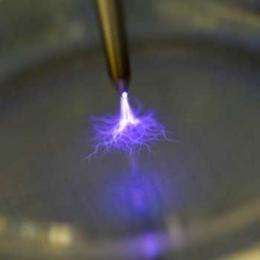
A brief spark in air produces a low-temperature plasma of partially ionized and dissociated oxygen and nitrogen that will diffuse into nearby liquids or skin, where they can kill microbes similar to the way some drugs and immune cells kill microbes by generating similar or identical reactive chemicals. Credit: Steve Graves

(PhysOrg.com) -- University of California, Berkeley, scientists have shown that ionized plasmas like those in neon lights and plasma TVs not only can sterilize water, but make it antimicrobial – able to kill bacteria – for as long as a week after treatment.

Devices able to produce such plasmas are cheap, which means they could be life-savers in developing countries, disaster areas or on the battlefield where sterile water for medical use – whether delivering babies or major surgery – is in short supply and expensive to produce.

“We know plasmas will kill bacteria in water, but there are so many other possible applications, such as sterilizing medical instruments or enhancing wound healing,” said chemical engineer David Graves, the Lam Research Distinguished Professor in Semiconductor Processing at UC Berkeley. “We could come up with a device to use in the home or in remote areas to replace bleach or surgical antibiotics.”

Low-temperature plasmas as disinfectants are “an extraordinary innovation with tremendous potential to improve health treatments in developing and disaster-stricken regions,” said Phillip Denny, chief administrative officer of UC Berkeley’s Blum Center for Developing Economies, which helped fund Graves’ research and has a mission of addressing the needs of the poor worldwide.
Using ionized plasmas as cheap sterilizers for developing world
Enlarge

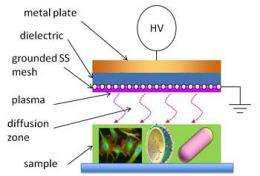
Diagram of dielectric barrier discharge, which generates a plasma (pink) that diffuses into a nearby liquid and kills bacterial contaminants. Credit: Graves lab, UC Berkeley

“One of the most difficult problems associated with medical facilities in low-resource countries is infection control,” added Graves. “It is estimated that infections in these countries are a factor of three-to-five times more widespread than in the developed world.”

Graves and his UC Berkeley colleagues published a paper in the November issue of the Journal of Physics D: Applied Physics, reporting that water treated with killed essentially all the E. coli bacteria dumped in within a few hours of treatment and still killed 99.9 percent  of bacteria added after it sat for seven days. Mutant strains of E. coli have caused outbreaks of intestinal upset and even death when they have contaminated meat, cheese and vegetables.

Based on other experiments, Graves and colleagues at the University of Maryland in College Park reported Oct. 31 at the annual meeting of the American Vacuum Society that plasma can also “kill” dangerous proteins and lipids – including prions, the infectious agents that cause mad cow disease – that standard sterilization processes leave behind.

In 2009, one of Graves’ collaborators from the Max Planck Institute for Extraterrestrial Physics built a device capable of safely disinfecting human skin within seconds, killing even drug-resistant bacteria.

“The field of low-temperature plasmas is booming, and this is not just hype. It’s real!” Graves said.

In the study published this month, Graves and his UC Berkeley colleagues showed that plasmas generated by brief sparks in air next to a container of water turned the water about as acidic as vinegar and created a cocktail of highly reactive, ionized molecules – molecules that have lost one or more electrons and thus are eager to react with other molecules. They identified the reactive molecules as hydrogen peroxide and various nitrates and nitrites, all well-known antimicrobials. Nitrates and nitrites have been used for millennia to cure meat, for example.

Graves was puzzled to see, however, that the water was still antimicrobial a week later, even though the peroxide and nitrite concentrations had dropped to nil. This indicated that some other reactive chemical – perhaps a nitrate – remained in the water to kill microbes, he said.

Plasma discharges have been used since the late 1800s to generate ozone for water purification, and some hospitals use low-pressure plasmas to generate hydrogen peroxide to decontaminate surgical instruments. Plasma devices also are used as surgical instruments to remove tissue or coagulate blood. Only recently, however, have low-temperature plasmas been used as disinfectants and for direct medical therapy, said Graves, who recently focused on medical applications of plasmas after working for more than 20 years on low-temperature plasmas of the kind used to etch semiconductors.

“I’m a chemical engineer who applies physics and chemistry to understanding plasmas,” Graves said. “It’s exciting to now look for ways to apply plasmas in medicine.”

Graves’ UC Berkeley coauthors are former post-doctoral fellow Matthew J. Traylor; graduate students Matthew J. Pavlovich and Sharmin Karim; undergraduate Pritha Hait; research associate Yukinori Sakiyama; and chemical engineer Douglas S. Clark, The Warren and Katharine Schlinger Distinguished Professor in Chemical Engineering and the chair of the Department of Chemical and Biomolecular Engineering.

The work on deactivating dangerous and persistent biological molecules was conducted with a group led by Gottlieb Oehrlein, a professor of materials science and engineering at the University of Maryland in College Park.

More information:Long-term antibacterial efficacy of air plasma-activated water (J. Phys. D: Appl. Phys.)
Redefining ‘clean’ (Press release from AVS meeting, 10/31/11)

Provided by University of California - Berkeley search and more info website

4.3 /5 (7 votes)  

Filter


Move the slider to adjust rank threshold, so that you can hide some of the comments.


Display comments: newest first

pauljpease
Nov 15, 2011

Rank: 5 / 5 (1)
Great, can't wait to buy a plasma toothbrush/mouthwash!
BillFox
Nov 15, 2011

Rank: 5 / 5 (2)
Old news again... Old news new article I see physorg is up to the usual.
Callippo
Nov 15, 2011

Rank: 1 / 5 (2)
Ionized plasma is actually pretty expensive sterilizer. It uses a rare helium and the whole device is complex too. It doesn't sterilize the convex or metallic surfaces, too. The ionized plasma is not so effective sterilizer, as one could think after all. The charged surface attracts dusts and another bacteria from outside, so that this method is quite unreliable and in some cases (dirty environment common in developing world) it just makes the things worse.
Shootist
Nov 15, 2011

Rank: 5 / 5 (1)
Maybe letting the 'developing world' develop, would be a better idea? Prime directive, so to speak.
gwrede
Nov 15, 2011

Rank: 5 / 5 (2)
If the treated water can kill microbes and even prions after a week, I wouldn't drink it. Just like I wouldn't drink any other disinfectant.
bugmenot23
Nov 16, 2011

Rank: not rated yet
wow....a plasma water filer or even better a plasma water bottle....hope to buy one soon
Isaacsname
Nov 16, 2011

Rank: 5 / 5 (1)
....Meh

Off topic ~ does plasma in space act to prevent the spread of life by Panspermia ?
Mabus
Nov 16, 2011

Rank: 2 / 5 (4)
Don't plasma discharges in air also generate ozone?
Callippo
Nov 16, 2011

Rank: 1 / 5 (1)
not only can sterilize water, but make it antimicrobial able to kill bacteria for as long as a week after treatment
Whereas the plasma sterilization is an apparent nonsense with respect to its economy, the action of plasma to water is completely different stuff. It could be closely related to polarization of water clusters, "dead" and "live" water and similar stuffs, which are generally considered a "pseudoscience" if not "mythology" - but which they were never seriously checked in the same way, like the cold fusion and many other findings. It could be the very first accepted evidence for so-called memory of water, cluster medicine and homeopathy.
Callippo
Nov 16, 2011

Rank: 1 / 5 (1)
does plasma in space act to prevent the spread of life by Panspermia
It depends on intensity of electric field. The weak electric field could help to transport virii and bacteria between planets instead.
Great, can't wait to buy a plasma toothbrush/mouthwash!
You can buy electrolysing toothbrush powered with tiny solar cell instead. After all, it kills the innocent bacteria with electrons, too.

http://www.slashg...2098468/
Rank 4.3 /5 (7 votes)
Relevant PhysicsForums posts

More news stories

Browser wars flare in mobile space

The browser wars are heating up again, but this time the fight is for dominance of the mobile Internet.

Technology / Software

created 14 hours ago | popularity 5 / 5 (2) | comments 3

Probability of contamination from severe nuclear reactor accidents is higher than expected: study

Catastrophic nuclear accidents such as the core meltdowns in Chernobyl and Fukushima are more likely to happen than previously assumed. Based on the operating hours of all civil nuclear reactors and the number ...

Technology / Energy & Green Tech

created May 22, 2012 | popularity 3.6 / 5 (25) | comments 56 | with audio podcast

HyperSolar shows dirty water no barrier to power world

(Phys.org) -- The Santa Barbara, California, company, HyperSolar, is set to transparently share the ups and downs of its research experiences toward the company’s ultimate vision, successfully producing ...

Technology / Energy & Green Tech

created May 24, 2012 | popularity 4.8 / 5 (16) | comments 17 | with audio podcast report

SpotterRF debuts Radar Backpack Kit (w/ Video)

(Phys.org) -- SpotterRF has announced a special radar backpack kit designed to enhance situational awareness for soldiers on the ground. The company says its special radar is designed for warfighters as part ...

Technology / Hi Tech & Innovation

created May 26, 2012 | popularity 5 / 5 (5) | comments 13 | with audio podcast report

Tesla to launch electric sedan in US on June 22

Tesla Motors said Tuesday it would begin deliveries of "the world's first premium electric sedan" on June 22, slightly ahead of schedule.

Technology / Energy & Green Tech

created May 22, 2012 | popularity 4.5 / 5 (12) | comments 18


Stunning image of smallest possible five-ringed structure

Scientists have created and imaged the smallest possible five-ringed structure – about 100,000 times thinner than a human hair – and you'll probably recognise its shape.

'Unzipped' carbon nanotubes could help energize fuel cells, batteries

Multi-walled carbon nanotubes riddled with defects and impurities on the outside could replace some of the expensive platinum catalysts used in fuel cells and metal-air batteries, according to scientists at ...

Change in developmental timing was crucial in the evolutionary shift from dinosaurs to birds: study

At first glance, it's hard to see how a common house sparrow and a Tyrannosaurus Rex might have anything in common. After all, one is a bird that weighs less than an ounce, and the other is a dinosaur that ...

Computer model used to pinpoint prime materials for efficient carbon capture

When power plants begin capturing their carbon emissions to reduce greenhouse gases – and to most in the electric power industry, it's a question of when, not if – it will be an expensive undertaking.

T cells 'hunt' parasites like animal predators seek prey, study shows

By pairing an intimate knowledge of immune-system function with a deep understanding of statistical physics, a cross-disciplinary team at the University of Pennsylvania has arrived at a surprising finding: T cells use a movement ...

Land and sea species differ in climate change response: study

(Phys.org) -- Marine and terrestrial species will likely differ in their responses to climate warming, new research by Simon Fraser University and Australia’s University of Tasmania has found.