HRP-4C female robot has a new walk (w/ video)
November 13, 2011 by Nancy Owano report

HRP-4C female robot has a new walk (w/ video)

Enlarge

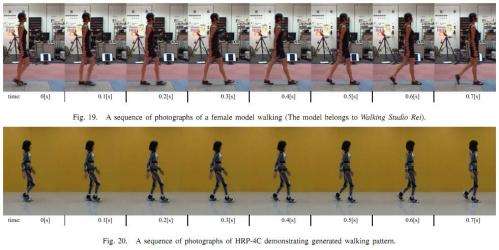
Image credit: Miura, Kanako, et al. DOI:10.1109/IROS.2011.6048511

(PhysOrg.com) -- Japan's entertaining robot that sings and looks like a beautiful young female is finally learning how to walk just like a beautiful girl—well, almost. Robotics developers at the National Institute of Advanced Industrial Science and Technology (AIST) have released a video of their HRP-4C “Miim robot” to show how it can walk better than before.

HRP-4C has 30 motors in its body that allow it to walk and move its arms; and eight motors on its face to create human expressions. The robot is based on User Centered Robot Open Architecture utilizing fundamental robotic technologies including real-time Linux, RT middleware, robot simulator openHRP3, and speech recognition.

AIST researchers, like other scientific groups dedicated to robotics, have been working hard to create the “perfect” walking robot and to design walking technologies that can make their robots most closely resemble the way humans walk.

This video is not supported by your browser at this time.

This has not been easy. Developing a robot to walk like a human has been a challenge for engineers, but that has only motivated more work toward this end in robotics.

The AIST researchers focused on a few key areas of the robot to improve results. The robot’s toes now support the legs better during each stride, and the legs straighten out more.

Details about how they got “Miim” to walk in a more human fashion than in previous iterations are in the paper, “Human-Like Walking with Toe Supporting for Humanoids,” by Kanako Miura, Mitsuharu Morisawa, Fumio Kanehiro, Shuuji Kajita, Kenji Kaneko, and Kazuhito Yokoi.

The authors explain that in working up a model of a walking pattern imitating human motion their focus was placed on three characteristics of walking: single toe support, knee stretching, and swing leg motion.

Based on a conventional pattern generator, the researchers added single toe support, changed the robot’s waist height to stretch the knees as much as possible, and sought to generate a swing leg motion more closely approximating a human's motion.

Curiously, while some tech sites have highly praised the team for having succeeded in making HRP-4C “Miim” walk like a human being, the video showing Miim walking resembles a woman who has just been released from a long stay in hospital from suffering broken bones and must learn to walk normally again in broad daylight without crutches.

Still, Miim’s new walking abilities are a step up, less mechanical than before. At the least, this is seen as a promising building block upon which to improve in the coming months and years.

HRP-4C was devised as a female humanoid robot for entertainment events. It was designed to have a realistic-looking face and to carry measurements reflecting the average figure of a young Japanese female. The robot was first shown to the public in March 2009.

Elsewhere, Boston Dynamics has been hard at work to perfect the walking movements of human-like robots. Its recent news about robots focuses on PETMAN, which the company claims is “the first anthropomorphic that moves dynamically like a real person.”

More information: Human-like walking with toe supporting for humanoids, This paper appears in: Intelligent Robots and Systems (IROS), 2011 IEEE/RSJ International Conference on Issue Date: 25-30 Sept. 2011 On page(s): 4428 - 4435 Location: San Francisco, CA, USA ISSN: 2153-0858 DOI:10.1109/IROS.2011.6048511 (PDF available)

ABSTRACT
A model of a walking pattern imitating human motion is presented. An accurate imitation of human motion and a robust bipedal walking motion are, however, hardly realized together. We therefore focus on only three characteristics of human walking motion: single toe support, knee stretching, and swing leg motion. Based on a conventional pattern generator, single toe support is added, waist height is changed in order to stretch the knees as much as possible, and swing leg motion is generated approximating the human's motion. The generated motion is then filtered to provide a feasible pattern. In addition, the stabilizer is improved in order to keep the Zero Moment Point (ZMP) within the tiny support polygon during the single support phase with toe link. Finally, we successfully demonstrate the generated walking pattern with the robot HRP-4C.

© 2011 PhysOrg.com

4.9 /5 (15 votes)  

Filter


Move the slider to adjust rank threshold, so that you can hide some of the comments.


Display comments: newest first

Going
Nov 13, 2011

Rank: 3.5 / 5 (2)
Amazing the speed at which robots are progressing towards human-like performance. Also where has all the hissing, buzzing and whirring there used to be with robotic machines?
Vendicar_Decarian
Nov 13, 2011

Rank: 1 / 5 (2)
Well, it certainly is noisier than most of the women I know. But the gate is pretty impressive.

More impressive will be balance recovery if it is pushed or stubs it's toe on a rock. I haven't seen that demonstrated by this robot design or Asmio. But Boston Dynamics Petman has some limited capacity to do this.

PoppaJ
Nov 13, 2011

Rank: not rated yet
Lal is that you? I am so looking forward to moving to a robot work force. Let me sit back and invent stuff and let them assemble it.
Eikka
Nov 13, 2011

Rank: 5 / 5 (2)
It still looks like it's walking with bent knees. They've just pushed the envelope a little bit more, but it's still operating under active balance control that keeps the robot up with brute force, only now with tighter tolerances.

As they approach the point where active balance turns into passive balance, the balancing algorithms break down because the robot does not fundamentally walk like people walk. We walk by falling and catching ourselves, almost like walking on stilts because the knee locks up when we put weight on the leg. That's not how they programmed the robot to walk.
hopefulbl
Nov 13, 2011

Rank: not rated yet
I Sing The Body Electric is getting closer
Isaacsname
Nov 13, 2011

Rank: not rated yet
Nice, seems these things are getting less herky-jerky by the day.

I've always been surprised that feet have been fairly overlooked in robotics, at least as far as I've seen. I know they are very complex, but wouldn't it behoove somebody to start working towards developing it ?

Things like this

http://www.youtub...=related

seem uninspired, compared to other body parts that are being developed.
geokstr
Nov 13, 2011

Rank: 1.6 / 5 (14)
Where do I order my Cherry2000?
hb_
Nov 14, 2011

Rank: not rated yet
@Eikka

Why does robot walking have to be done with a locked knee joint? I think the key is having a dynamic walk, i.e. when the walk consists in falling and catching. That way you can increase the speed.

A straight knee may make it look more humanlike, but just having something that walks is good enough for me.
Ricochet
Nov 14, 2011

Rank: not rated yet
This'll probably get ranked low, but I can't resist...

So, if the robot were to try to fall to the ground, and miss, would it then fly?
xznofile
Nov 14, 2011

Rank: not rated yet
As a male I must point out that the robot doesn't walk like a pretty girl. Pretty girls use body language. That robots body language says she recently had knee and back surgery, and is being careful not to fall over. The shoulders are a nice touch, but they don't carry the message by themselves.
Ricochet
Nov 15, 2011

Rank: not rated yet
As a male I must point out that the robot doesn't walk like a pretty girl. Pretty girls use body language. That robots body language says she recently had knee and back surgery, and is being careful not to fall over. The shoulders are a nice touch, but they don't carry the message by themselves.

So, if she were carrying a purse and wearing a hat, you'd be more impressed? Maybe they should pattern its gait after Marilyn Monroe's.
l_ones1969
Nov 18, 2011

Rank: not rated yet
Where do you put the power supply as asimo has a great big box on his back.But Miim has non.
Ricochet
Nov 18, 2011

Rank: not rated yet
Where do you put the power supply as asimo has a great big box on his back.But Miim has non.


Probably somewhere in the central cavity... In the chest area.
Rank 4.9 /5 (15 votes)
Relevant PhysicsForums posts

More news stories

Nvidia trumpets Tegra 3 phone design wins for 2012

(Phys.org) -- Nvidia’s competitive war paint has a name, Tegra 3. On the heels of Nvidia announcements about lowering costs of its Tegra 3 processors and Nvidia-enabled tablets running Android Ice Cream ...

Electronics / Hardware

created 14 hours ago | popularity 5 / 5 (2) | comments 1 | with audio podcast report

Dell tablet leak: 10.1-inch display, two-battery choice

(Phys.org) -- Headline after headline talks about vendors’ tablets in the wings as likely number-one contenders for the iPad. Such claims have justifiably been taken with a grain of salt, considering ...

Electronics / Consumer & Gadgets

created May 26, 2012 | popularity 4 / 5 (4) | comments 11 | with audio podcast report

Nvidia says Kai platform will turn price tide for tablets

(Phys.org) -- In March, Nvidia gave some signs that they were working to lower the cost of their Tegra 3 processors and they suggested consumers might see prices for Android tablets as low as $199. Connect ...

Electronics / Hardware

created May 24, 2012 | popularity 4.3 / 5 (4) | comments 3 | with audio podcast report

OmniVision tops up sensors for cameras, phones

(Phys.org) -- OmniVision has announced two high-resolution image sensors for the digital still and digital video camera market (DS/DVC) and higher end smartphones. In end-user language, it is a claim for superior ...

Electronics / Hardware

created May 25, 2012 | popularity 5 / 5 (6) | comments 3 | with audio podcast report

MIT researchers devise new means to synchronize a group of robots (w/ Video)

(Phys.org) -- For several years, roboticists have been working out ways to get a group of robots to perform synchronized activities as demonstrated most often in dance routines. It’s not just about trying ...

Electronics / Robotics

created May 25, 2012 | popularity 5 / 5 (1) | comments 1 | with audio podcast report


Stunning image of smallest possible five-ringed structure

Scientists have created and imaged the smallest possible five-ringed structure – about 100,000 times thinner than a human hair – and you'll probably recognise its shape.

'Unzipped' carbon nanotubes could help energize fuel cells, batteries

Multi-walled carbon nanotubes riddled with defects and impurities on the outside could replace some of the expensive platinum catalysts used in fuel cells and metal-air batteries, according to scientists at ...

Change in developmental timing was crucial in the evolutionary shift from dinosaurs to birds: study

At first glance, it's hard to see how a common house sparrow and a Tyrannosaurus Rex might have anything in common. After all, one is a bird that weighs less than an ounce, and the other is a dinosaur that ...

Computer model used to pinpoint prime materials for efficient carbon capture

When power plants begin capturing their carbon emissions to reduce greenhouse gases – and to most in the electric power industry, it's a question of when, not if – it will be an expensive undertaking.

T cells 'hunt' parasites like animal predators seek prey, study shows

By pairing an intimate knowledge of immune-system function with a deep understanding of statistical physics, a cross-disciplinary team at the University of Pennsylvania has arrived at a surprising finding: T cells use a movement ...

Land and sea species differ in climate change response: study

(Phys.org) -- Marine and terrestrial species will likely differ in their responses to climate warming, new research by Simon Fraser University and Australia’s University of Tasmania has found.